

Could a “natural” supplement complicate your pet’s medication routine? It’s a reasonable concern: ingredients can overlap across products, and a reassuring label doesn’t tell the whole story. Knowing what not to mix with pet supplements starts with gathering a complete product list for your veterinarian.
Include prescriptions, over-the-counter products, supplements, and relevant foods, along with each product’s ingredients and how much your pet receives. If PetREGEN is part of your pet’s routine, include its label and serving directions too.
This guide explains how to compare ingredient labels, recognize combinations that need professional review, and share useful details with your veterinarian. The goal isn’t to second-guess every product. It’s to replace guesswork with a clear routine that takes your pet’s individual needs into account.
This product is intended for supplemental use only. It is not intended to diagnose, treat, cure, or prevent any disease. If your pet has a medical condition or is on medication, consult your veterinarian before use.
Key Takeaways
- Review prescriptions, over-the-counter products, foods, and supplements together to spot overlapping ingredients.
- A possible interaction is a reason to seek advice, not proof that a combination has caused harm.
- Don’t assume that “natural,” human-grade, or familiar ingredients suit every animal or routine.
- Keep a dated list of products, label directions, and changes, then review it with your veterinarian.
- Include PetREGEN in a transparent product review, while keeping its role distinct from medication and veterinary care.
What Not to Mix With Pet Supplements: Start With the Main Risks
A possible interaction is a reason to review your pet’s products, not a reason to assume harm has occurred. “Mixing” means more than giving two supplements at once. It can include supplements used alongside prescriptions, over-the-counter products, topical treatments, regularly offered foods or dietary additions, and formulas with overlapping ingredients. The details matter: a combination that suits one animal may not suit another.
Species and individual health can affect a veterinarian’s assessment. General information about what not to mix with pet supplements can help you prepare questions, but it can’t identify an interaction or replace advice tailored to your pet. If your pet seems unwell after receiving a product, or may have gotten into something accidentally, contact a veterinarian promptly.
Which products belong in a pet’s full inventory?
Make one list of everything your pet receives regularly or occasionally. Include products even if you think they’re unrelated to a supplement routine:
- Prescription medicines and over-the-counter products, including those used only as needed.
- Supplements, powders, chews, oils, and multi-ingredient formulas.
- Topical products, such as those applied to the skin or coat.
- Regular dietary additions, such as treats, toppers, or foods offered for a specific purpose.
Why can combining products deserve a closer look?
Ingredients can overlap, and different products may have effects that matter when used together. Whether that creates a concern depends on the ingredients, amounts, timing, and the animal receiving them. A familiar-sounding label doesn’t establish that a product is compatible with another one. Natural origin alone isn’t proof of suitability for every pet or combination.
Reviewing the full routine helps your veterinarian consider products together rather than in isolation. It may also reveal that two labels use different names for an ingredient, or that a dietary addition should be included in the discussion. Don’t stop or change a prescribed product based only on a general warning. Ask your veterinarian how to handle the specific combination.
A complete product inventory gives your veterinarian a clearer starting point for reviewing your pet’s routine.
How Supplements and Medications Can Interact in Pets
An interaction is possible when one product changes another product’s effects, how the body handles it, or the risks associated with using it. For example, a combination could affect how a medicine is absorbed, processed, or eliminated. These are possible pathways, not proof that a particular combination has harmed your pet. A veterinarian can assess the specific products and your animal’s circumstances.
Individual health, existing conditions, and other treatments all matter. Timing may be part of the review, but changing the schedule or stopping a prescribed product without veterinary direction can create its own problems.
What kinds of overlap should pet owners notice?
Start by comparing ingredient panels. The same ingredient may appear in more than one product under a familiar or less familiar name. Formulas marketed for different purposes may also share ingredients or ingredient categories. Flag these overlaps for review, but don’t assume they prove a harmful dose or interaction.
Notice when several products are used for a similar stated purpose, too. That alone doesn’t establish a problem, but it gives your veterinarian useful context. If you suspect an overlap, share the packaging or label photos and ask for guidance before adding, removing, or adjusting products. Don’t assume that spacing products apart makes a combination suitable.
Why does a pet’s medication list matter?
A medication list lets your veterinarian review the combination rather than considering each supplement in isolation. Include prescriptions and over-the-counter products, even those used only occasionally, and note the directions and timing shown on each label. Mention changes in your pet’s health or routine as well. These details can help your veterinarian decide whether an ingredient, schedule, or product formulation needs closer attention.
Human supplement guidance can raise useful questions, but it can’t automatically answer them for animals. Species, product formulations, and individual responses may differ. The FDA’s overview of pet food and related products offers context on the U.S. framework; it isn’t a pet-specific interaction check. Review the FDA Regulation of Pet Supplements alongside individualized veterinary guidance, rather than treating human examples as established advice for pets.
Interaction risk depends on the specific products and the individual pet. A clear label inventory can make the conversation more precise. If PetREGEN Stem Cell Activator Supplement is part of your pet’s routine, include its label and serving directions in the review.
This product is intended for supplemental use only. It is not intended to diagnose, treat, cure, or prevent any disease. If your pet has a medical condition or is on medication, consult your veterinarian before use.
Natural, Human, and Multi-Ingredient Supplements: What Not to Assume
A label that says “natural” or features a familiar ingredient can feel reassuring, but it doesn’t establish that a product suits every animal or works well alongside another product. The species named on the label, the full formula, serving directions, and your pet’s health all matter. Human products aren’t automatically appropriate for animals, and human serving guidance shouldn’t be transferred to pets.
Use the comparisons below as prompts for a closer look, not as a list of combinations that are universally safe or unsafe.
| Common assumption | Safer interpretation |
|---|---|
| “Natural” means harmless. | Natural ingredients can still have biological effects. Ask your veterinarian to review the specific formula and your pet’s situation. |
| “Human-grade” means suitable for my pet. | This describes an ingredient quality claim, not a guarantee that the product is intended or appropriate for every species. |
| A familiar ingredient is fine in any product. | Formulation, serving directions, other ingredients, and the animal receiving it can all matter. |
| A multi-ingredient blend is safe because it has several purposes. | Review the complete ingredient panel and look for ingredients that may also appear in other products. |
| An example of a risky combination is a complete warning list. | Examples are prompts for veterinary review, not an exhaustive guide to every pet or product. |
Can a human supplement be treated like a pet supplement?
No. A product intended for people shouldn’t be assumed suitable for an animal just because the ingredients or purpose sound familiar. Species, formulation, and serving directions all matter. Don’t use human serving guidance as pet-care instructions. Before introducing a human supplement, show its label to your veterinarian and get advice specific to your pet.
What can a multi-ingredient label tell you?
The full ingredient list and serving directions provide more useful details for review than the main claim on the front of a package. Compare panels across products and note ingredients that appear more than once, even if the formulas are marketed for different purposes. A shared ingredient is a discussion point, not a diagnosis. If your pet accidentally receives an extra or unknown product, contact a veterinarian promptly with the package, estimated amount, and time received.
Examples of ingredients or combinations cited as concerns aren’t a complete pet interaction list. They shouldn’t be treated as individualized advice or proof that every similar product will cause harm. The practical answer to what not to mix with pet supplements depends on the specific products and the animal. If you’re unsure, pause before adding something new and ask your veterinarian to review the labels together.
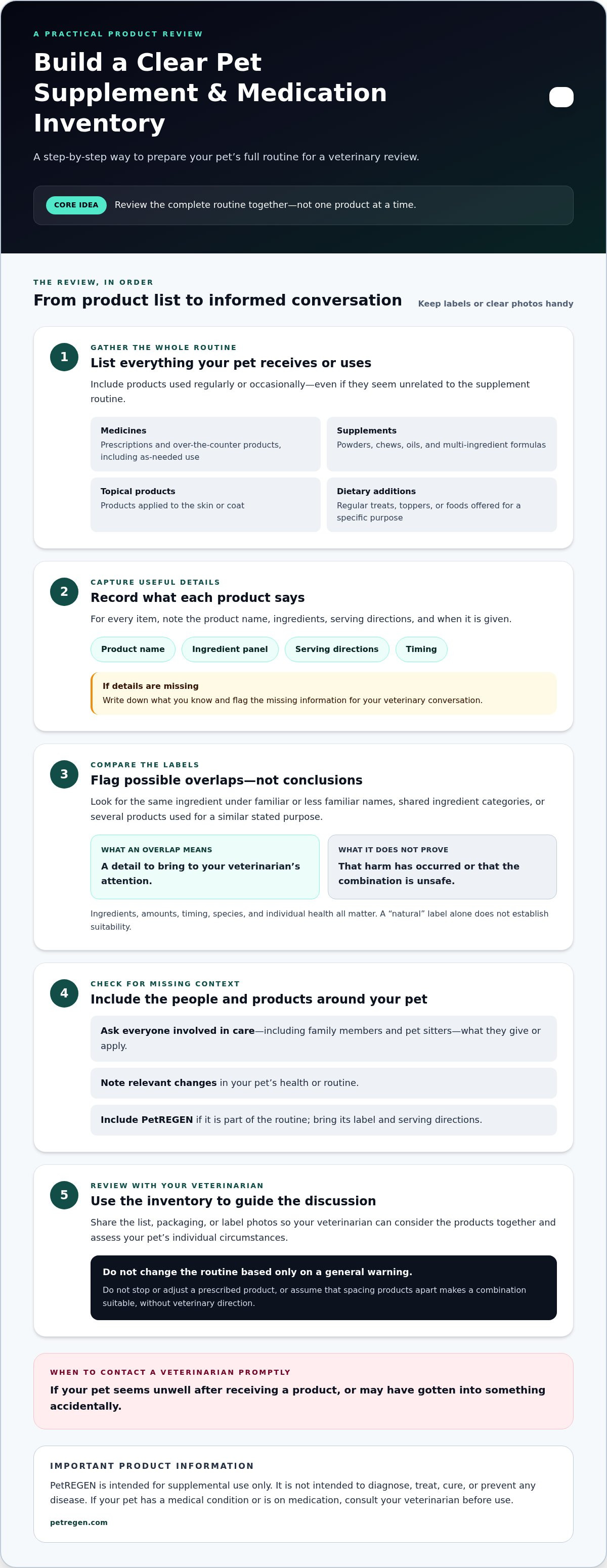
A Practical Checklist for Reviewing and Changing a Pet Supplement Routine
You don’t need to identify every possible interaction yourself. Gather accurate details and make changes with veterinary guidance. This checklist turns the question of what not to mix with pet supplements into a more useful conversation about your pet’s actual routine.
- Gather the labels. Collect packages or clear photos showing full ingredient panels and serving directions for supplements, prescriptions, over-the-counter products, and other regularly used items. Include products used only occasionally.
- Record current use. Note what your pet receives, how much, how often, and at what time. Include who gives each product, so an occasional dose from another household member isn’t missed.
- Mark possible overlaps. Compare ingredients and stated purposes across products. Highlight anything that appears more than once or that you’re unsure how to interpret. Treat this as a prompt for review, not proof of a problem.
- Consult your veterinarian. Share the list, labels, and relevant health details. Ask what to continue, pause, or change, and whether timing or monitoring matters for your pet’s specific routine.
- Follow the agreed directions. Write down the plan and who recommended it. Don’t start, stop, or alter prescribed medication based only on general online information.
What should you prepare before consulting a veterinarian?
Bring your pet’s species, current weight, known health conditions, and complete product list. Add when each item was started and any changes you noticed afterward, such as a change in appetite, behavior, or routine. Share the full label rather than only the front panel, since ingredients and directions can be easy to overlook in a summary.
How can you make routine changes easier to track?
Keep a dated log of products, serving directions, timing, and observations. Follow your veterinarian’s instructions and each label’s storage and serving directions. Unless advised otherwise, avoid changing several products at once, since that can make it harder to tell what changed. Add questions as they arise and bring the log to your next veterinary conversation.
If your pet accidentally receives an extra, unknown, or unintended product, or develops unexpected symptoms after receiving one, contact a veterinarian or an appropriate animal poison resource promptly. Keep the package available and share what was received, the estimated amount, and when it happened. Don’t wait to finish comparing labels if your pet seems unwell.
Include every supplement in your inventory, including PetREGEN Stem Cell Activator Supplement, and bring its label and serving directions to the veterinary review.
Where PetREGEN Fits in a Pet Supplement Review
A product review should include every supplement in your pet’s routine, including PetREGEN® Natural Stem Cell Support Supplement for Pets. PetREGEN is a daily powder supplement, not a medication. It supports natural stem cell activity and whole-body wellness, including support for healthy joints, mobility, comfort, and recovery; a healthy inflammatory response; energy, vitality, and healthy aging; digestive health, nutrient absorption, and gut balance; and healthy skin, coat, and immune function.
The formula includes AFA algae, reishi mushrooms, and other botanicals. Include those product details in your review alongside your pet’s other supplements, medicines, and dietary additions. A label review helps make the full routine clear; it doesn’t mean that any supplement is suitable for every animal or combination.
What product information can owners add to their inventory?
Record the full product name, powder format, label directions, and when you give it. PetREGEN is for dogs, cats, birds, and horses, and for pets of all ages and sizes. Keep the product label or a clear photo of its ingredient and direction panels with your dated inventory. This gives your veterinarian the product information to review, rather than relying on memory or a brief description.
Note any other products your pet receives and when they’re used. When comparing labels, include the full ingredient panels, not only front-label claims. That makes it easier to flag shared ingredients or serving directions that deserve a question. Your veterinarian can consider those details in light of your pet’s species, health, and current routine.
What are the next steps before adding it to a routine?
If your pet has a medical condition or takes medication, consult your veterinarian before use. Share the product label and your complete inventory, then follow the guidance you receive. Don’t use a supplement to diagnose or manage a disease, or as a substitute for veterinary care.
When reviewing what not to mix with pet supplements, include PetREGEN in the veterinary review. Keep its label and directions accessible, and record when it’s given and any changes you observe. For product questions, email info@petregen.com. We typically respond within 24 hours Monday to Friday.
PetREGEN includes a 30-day money-back guarantee (risk-free trial). This is a purchasing policy, not a promise of a health outcome. A clear record and a conversation with your veterinarian can help you make a considered decision for your pet.
Make Your Pet’s Next Wellness Step a Thoughtful One
Your next step doesn’t have to be complicated. Keep the product information you’ve gathered close and use it to make a considered choice with your veterinarian. What not to mix with pet supplements is best answered in the context of your individual pet, not through guesswork or a broad online rule.
PetREGEN is a powder supplement with a pet-approved taste, sprinkled onto food once or twice daily. Its label states: No artificial colors or flavors; No preservatives; No added sugar; No fillers or unnecessary additives; Gluten-free; GMO-free. The 30-day money-back guarantee (risk-free trial) is a purchasing policy, not a promise of results.
When you’re ready to learn more, explore PetREGEN and its whole-body wellness approach. A clear, thoughtful routine can help you move forward with greater confidence and care for the companion you love.
Frequently Asked Questions
Is it safe to give my pet two supplements at the same time?
Not automatically. Compatibility depends on the ingredients, the animal, and any medicines or health conditions. Note the product names and label directions, including whether an ingredient is already included in a food or another formula. That inventory helps your veterinarian assess what not to mix with pet supplements in your pet’s specific situation. Don’t change prescribed medication based on general online advice; ask the prescribing veterinarian how to proceed.
Can pet supplements interact with prescription medications?
Some supplements may affect how medicines work, but the specific risk depends on the products and the pet. Human interaction examples don’t prove that the same effect occurs in animals. Share prescription and over-the-counter product details with your veterinarian, including labels and schedules. If your pet has a medical condition or takes medication, consult your veterinarian before use.
How long should I wait between giving my pet different supplements?
There’s no universal waiting period that makes every combination safe. Spacing products apart may not remove a possible interaction, and timing advice depends on the products and your pet’s circumstances. Check each label and ask your veterinarian for directions tailored to your pet. A written schedule can help everyone in the household follow the same plan, especially if products are given at different times.
What happens if my pet accidentally eats a supplement?
Contact a veterinarian promptly for advice, especially if your pet shows unexpected symptoms. Keep the package, note the product name, estimate how much may be missing, and record when the exposure happened. Don’t induce vomiting or give another product unless a veterinary professional directs you to. If possible, share a clear photo of the ingredient and direction panels so the professional can identify what your pet may have ingested.
Are human supplements safe for dogs, cats, birds, or horses?
A supplement made for people shouldn’t automatically be considered suitable for an animal. Formulas, amounts, and intended use can differ, and considerations may vary by species and individual health. Keep human products stored where pets can’t reach them, and consult a veterinarian before giving one to an animal. Never use human serving directions as pet dosing instructions.
Can I give PetREGEN with my pet’s medication or another supplement?
That depends on your pet and the complete combination, so no pairing can be assumed suitable for every animal. If your pet has a medical condition or takes medication, share the PetREGEN label and the names and directions of other products with your veterinarian before use. PetREGEN is a supplement, not a replacement for veterinary care.


