

Supplements for dog CCL tear recovery may support cartilage, joint lubrication, and connective-tissue health, but they don’t repair a torn ligament or replace veterinary treatment. Glucosamine and chondroitin are commonly used to support cartilage and joint lubrication, while omega-3 fatty acids may support joint health and flexibility. Nutrients such as amino acids, minerals, and vitamins also contribute to normal tendon and ligament maintenance.
A CCL tear can make every step difficult for your dog, so it’s natural to look for supplements for dog CCL tear recovery. Supplements can provide nutritional support for joint health and connective tissue, but they cannot repair a torn ligament or replace veterinary care.
This article explains what supplements can and cannot support, how to review a product, and how nutritional support fits alongside veterinary care and recovery planning. Use these points to prepare practical questions for your veterinarian.
Key Takeaways
- Learn how glucosamine, chondroitin, and omega-3s may support joint structures, and why supplements aren’t a replacement for CCL treatment.
- See what rehabilitation testimonials can reveal about recovery, while keeping individual stories in perspective.
- Understand how a CCL rupture affects knee stability and why treatment choices matter for long-term joint health.
- Explore how silicon, amino acids, antioxidants, minerals, and vitamins contribute to connective-tissue health.
- Review what to consider when choosing a supplement, including ingredient fit and PetREGEN’s amino acids, omega 7, and collagen.
Glucosamine and chondroitin for cartilage and joint lubrication
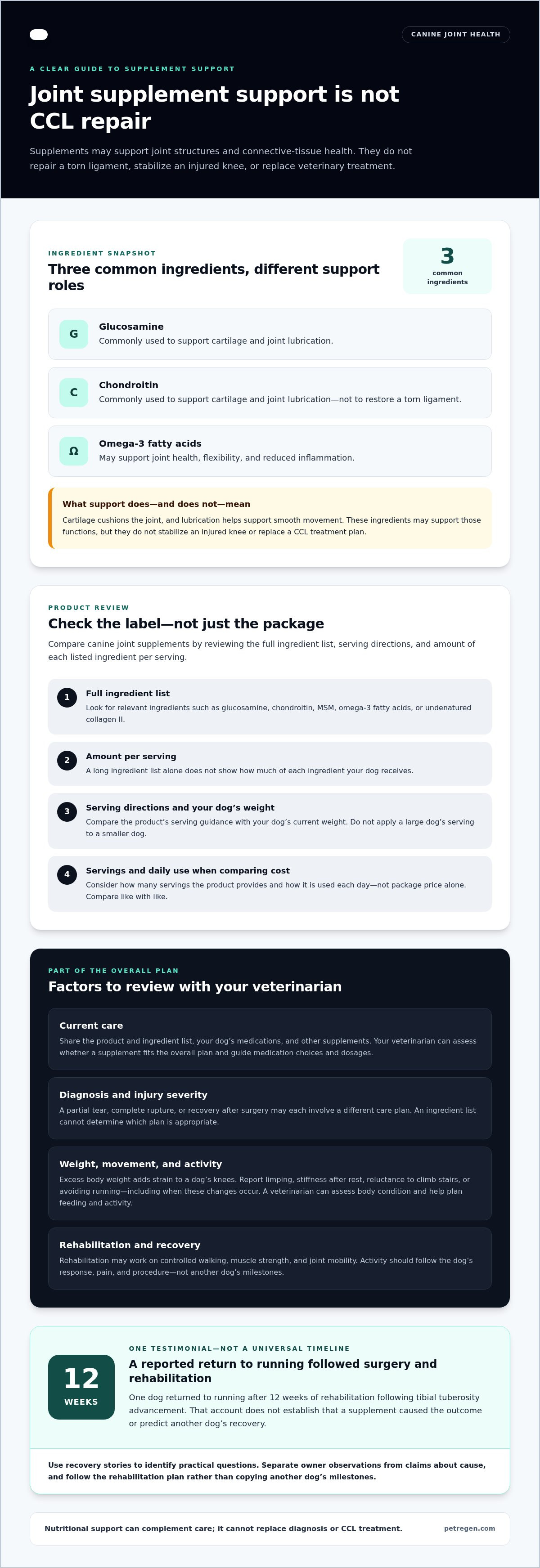
Glucosamine, chondroitin, and omega-3 fatty acids are common ingredients in canine joint supplements. Their potential role is to support joint structures, not to replace CCL treatment or surgery.
Glucosamine and Chondroitin for Joint Lubrication
Glucosamine and chondroitin are commonly used to support cartilage and joint lubrication in dogs with CCL injuries. Cartilage cushions the joint, while lubrication helps support smooth movement. These functions can matter when a dog is limping or reluctant to walk. However, these ingredients do not restore a torn ligament or stabilize an injured knee.
Comparing Joint Supplement Ingredients and Quality
Compare canine joint supplements by reviewing the full ingredient list, serving directions, and amount of each listed ingredient per serving. Look for relevant ingredients such as glucosamine, chondroitin, MSM, omega-3 fatty acids, or undenatured collagen II. To compare cost, consider the product’s servings and daily use, rather than package price alone. Veterinary joint supplements vary in formulation, so compare like with like.
When comparing supplements for a dog with a CCL tear, consider the dog’s current medications and other supplements. No single ingredient combination is right for every dog. Share the product and ingredient list with your veterinarian, along with your dog’s medication list. Your veterinarian should guide medication choices and dosages and can help assess whether a supplement fits the overall plan.
In the United States, veterinarians can recommend joint supplements for dogs with CCL tears. These supplements are different from prescription pain medications, which may be used to manage pain after an injury.
Omega-3 fatty acids may support joint health, reduce inflammation, and promote flexibility. They’re found in some canine joint supplements, sometimes alongside glucosamine and chondroitin. Check the label for the named ingredients and serving directions. A long list alone doesn’t show how much of each ingredient the dog receives.
Weight also matters: excess body weight puts added strain on a dog’s knees during everyday movement. A veterinarian can assess your dog’s body condition and help set an appropriate feeding and activity plan. For example, a dog that struggles to rise may need gradual weight management alongside limits on painful activity.
Watch for changes in your dog’s everyday movement. Limping, stiffness after rest, reluctance to climb stairs, or avoiding running can signal discomfort or reduced mobility. These signs don’t identify the cause on their own, but they are useful to report. Note when limping occurs, such as after a walk, and whether your dog’s movement changes over time.
Joint supplements can offer support, but they do not replace diagnosis, pain management, or a CCL treatment plan. Reviewing ingredients with your veterinarian helps you consider your dog’s needs, current medications, and recovery approach.
Customer testimonials involving ligament and ACL injuries
A recovery story can show what daily progress looked like for one dog, but it can’t predict another dog’s outcome. One dog featured in a customer testimonial returned to running after 12 weeks of rehabilitation following a tibial tuberosity advancement procedure. That account combines surgery and rehabilitation; it doesn’t establish that a supplement caused the return to activity. Details such as the procedure, rehab plan, and activity change help readers understand what the story actually describes.
Use testimonials to identify practical questions, not to judge whether a product repairs ligaments. A story may describe a dog walking more comfortably or returning to play, but those changes can occur alongside surgery, pain management, activity restrictions, and rehabilitation. Chondroitin in a supplement is not evidence that a torn ligament has healed. Look for a clear account of the injury and care, and distinguish the owner’s observations from claims about what caused the change.
A dog’s size matters when reviewing supplement directions. Compare the product’s serving guidance with your dog’s current weight, and don’t apply a large dog’s serving to a smaller one. Injury severity matters too: a partial tear, a complete rupture, and recovery after surgery may each involve a different care plan. An ingredient list cannot determine which plan is appropriate. Share your dog’s weight, diagnosis, and current medications with the veterinarian when discussing a product.
Rehabilitation addresses more than the injured ligament. Canine rehabilitation therapy can help reduce inflammation, strengthen supporting muscles, and improve joint mobility. A rehabilitation professional may tailor activity to the dog’s movement, pain, and surgical recovery. Cold laser therapy may be used to reduce pain and inflammation, while acupuncture may be used to relieve discomfort and stimulate healing. Neither approach replaces a treatment plan for the CCL injury.
For example, a structured rehabilitation plan may gradually work on controlled walking and muscle strength before returning to active play. The pace should reflect the dog’s response and the procedure performed, such as tibial tuberosity advancement. The testimonial’s 12-week timeline belongs to that dog’s experience, not a universal schedule. Returning to running too soon can undermine activity restrictions, so owners should follow the rehabilitation plan rather than copying a testimonial’s milestones.
When reading a ligament or ACL testimonial, identify the procedure, note the rehabilitation involved, and see whether the account discusses a supplement separately from other care. Compare those details with your dog’s diagnosis and activity limits. Stories can offer encouragement and help you prepare questions, but they don’t prove that a supplement repairs a ligament or prevents arthritis.
Canine cranial cruciate ligament rupture and osteoarthritis
A dog’s cranial cruciate ligament connects the tibia and femur and helps stabilize the knee. When it ruptures, the joint loses support during everyday movements such as walking and turning. Many canine CCL injuries develop through gradual wear and tear rather than a single dramatic accident. As a result, an early change, such as limping after a walk, can be easy to miss.
Osteoarthritis is an important concern after a CCL injury because the damaged knee may remain unstable. Dogs managed without surgery tend to develop significantly more arthritis in the affected joint than dogs receiving surgical repair. Individual outcomes vary, but this is why a glucosamine supplement should not be treated as a way to stabilize the knee or prevent arthritis on its own.
Surgery is described as the gold-standard treatment for a torn or damaged CCL. The right approach depends on the injury and the dog’s circumstances, but supplements cannot reconnect the ligament. A veterinary plan may also include pain relief, controlled activity, and rehabilitation. If your dog suddenly limps or struggles to bear weight, note when it started and what movement came before it. These details can help your veterinarian assess the knee.
After a significant knee ligament injury, a veterinarian may initially recommend prescription anti-inflammatory medication to reduce swelling and pain. The veterinarian should guide medication choices and dosages. Joint supplements and pain medicines have different roles: a supplement may support joint health, while prescribed medication addresses pain or inflammation. Keep a written list of everything your dog takes to make medication reviews clearer.
Intra-articular injections may help reduce pain and inflammation and support joint health, but they don’t replace surgery or heal the CCL. Keep that distinction in mind when comparing treatment options. Even if a dog seems more comfortable after an injection or supplement, the underlying ligament injury still needs a plan. Comfort alone doesn’t show that the knee has regained stability.
A TPLO study offers a specific example of how supplements have been examined alongside surgery. According to the study authors, six dogs received a joint supplement once daily for 90 days, starting the day after surgery; seven dogs received no further treatment after TPLO. Researchers collected synovial fluid before surgery and at 30 and 90 days afterward. From day 30 to day 90, treated dogs’ lameness scores improved approximately twofold more than control dogs’ scores. All 13 dogs improved over time. These findings describe a small study, not proof that supplements repair a torn ligament or replace surgical care.
Nutrients that support tendon and ligament health
Silicon is a trace element involved in forming articular cartilage and connective tissue in dogs. Those tissues help support joint structure and movement. Nutrient lists for tendon and ligament health also include other minerals, omega-3 fatty acids, and vitamins D, A, and C. These nutrients contribute to normal development and maintenance, so checking a supplement’s ingredients can show whether it addresses more than cartilage alone.
Silicon is relevant to connective tissue, but it isn’t the only nutrient to consider. Amino acids provide building blocks used throughout the body, while antioxidants and minerals are also part of the nutrient combination described for connective-tissue support. For example, a label listing silicon alongside amino acids, antioxidants, and minerals reflects a broader formulation than one focused on a single ingredient.
Omega-3 fatty acids connect joint support with the body’s inflammatory response. Combining silicon with omega-3 fatty acids, amino acids, antioxidants, and minerals can be beneficial for reducing inflammation, improving circulation, and supporting connective-tissue repair and maintenance. That combination addresses several functions involved in healthy tissue support. It doesn’t mean each ingredient performs the same job, or that a supplement repairs a torn ligament.
Use the ingredient panel to compare the nutrient groups rather than relying on front-label claims. For instance, note whether the formula identifies omega-3 fatty acids, silicon, amino acids, minerals, and vitamins D, A, or C. A product that lists only a general phrase such as “joint health blend” gives less detail about its nutrient profile. Record the ingredients and discuss how they fit your dog’s diet and CCL care plan.
More ingredients don’t automatically mean better joint support. Ask whether the formula includes nutrients related to the tissue function you want to support. A dog’s complete diet also provides nutrients, so separate supplements can overlap. Compare the full ingredient list with existing products, including those containing vitamins or minerals. This keeps the focus on connective-tissue and joint health, rather than treating a long label as proof of ligament repair.
What are the risks and side effects of joint supplements for dogs?
A joint supplement can create problems if you don’t carefully consider its ingredients, serving directions, and use alongside medication. For a dog with a CCL injury, practical risks include choosing a formula that doesn’t fit the dog’s needs, doubling up on ingredients, or treating a supplement as a replacement for veterinary care. A label can guide your review, but it cannot diagnose an injury or set a medication plan.
Start with the full ingredient panel. For example, compare two products for overlapping glucosamine, chondroitin, omega-3 fatty acids, vitamins, and minerals. If your dog already receives a separate vitamin or joint product, duplicate ingredients may go unnoticed unless you review both labels together. Keep the containers or ingredient lists available when discussing the combination with your veterinarian.
Serving directions matter. Follow the product label, and don’t estimate a serving with an unmarked kitchen spoon or copy directions meant for another dog. A small dog and a large dog differ in weight, so one dog’s serving instructions may not suit another. If the label is unclear, ask your veterinarian to clarify it before adding the supplement to your dog’s routine.
Take particular care when considering medications alongside a CCL injury. Your dog may receive pain relief while also using a joint supplement, and the veterinarian should guide medication choices and dosages. Share the names of every medication and supplement, including how often each is given. This makes it easier to review the full regimen rather than judging one product in isolation.
Observe your dog after introducing any new product. Note changes in appetite, digestion, energy, or everyday movement, and record when they occur in relation to the serving. These observations don’t establish that the supplement caused a change, but they give your veterinarian useful details. If your dog’s limp worsens or new signs appear, contact the veterinary team managing the CCL injury.
Another risk is mistaking comfort or improved movement for ligament repair. A supplement may support joint health, but it doesn’t stabilize a torn CCL or replace surgery, pain management, or rehabilitation. For example, a dog that seems more willing to walk still needs to follow its activity restrictions. Increasing exercise based only on apparent improvement may conflict with the recovery plan.
Keep the decision process simple: review the ingredient list, compare it with everything your dog already takes, follow the serving directions, and track any changes. Share those details with your veterinarian, especially if your dog takes pain medication. This practical review can help identify avoidable overlap and keep supplements in their proper role as support alongside the treatment plan for the injured knee.
PetREGEN: PetREGEN Stem Cell Activator Supplement
PetREGEN Stem Cell Activator Supplement supports your dog’s natural regenerative function by supporting immune function. It’s a nutritional option for owners seeking broader wellness support alongside a CCL recovery plan, not a replacement for veterinary treatment or prescribed medication.
Its formula uses human-grade ingredients, including amino acids, omega 7, and collagen, to support healthy aging and recovery. These nutrients offer a different approach from a joint supplement focused only on ingredients such as glucosamine or chondroitin. If you’re considering it for your dog, compare its ingredients with your dog’s existing supplements and discuss the full list with your veterinarian, especially if your dog takes medication.
For more information about PetREGEN Stem Cell Activator Supplement, visit petregen.com.
Make your dog’s next step a thoughtful one
Recovery takes time, and decisions about your dog’s care can feel personal. Use what you’ve learned to have a focused conversation about your dog’s goals, daily routine, and nutritional support alongside veterinary care. Supplements for dog CCL tear recovery may play a supportive role, but they cannot replace treatment for the injury.
PetREGEN Natural Stem Cell Support Supplement for Pets is an option for owners seeking nutritional support for their dog’s natural regenerative function and overall wellness. It is designed to support the body, not to repair a torn CCL or replace a veterinarian’s treatment plan. Your dog’s health needs and current care should guide whether it fits.
If you’d like to explore this supportive option, contact PetREGEN. With informed choices and a care plan suited to your companion, you can keep moving forward with purpose and hope.
Frequently Asked Questions
How Do Joint Supplements Work?
Joint supplements provide ingredients intended to support structures such as cartilage and connective tissue. Their role depends on the formula: a product with omega-3 fatty acids differs from one centered on glucosamine. For example, compare the ingredient panel with your dog’s current diet and supplements to spot overlapping nutrients. These products support joint health; they don’t stabilize a torn knee or replace its treatment plan.
What Is a Canine ACL Injury?
In dogs, an “ACL injury” usually refers to damage to the cranial cruciate ligament, or CCL. This ligament connects the tibia and femur and helps stabilize the knee. A dog may start limping, avoid putting weight on a leg, or struggle to rise. Since these signs can have different causes, note when they occur and tell your veterinarian about the changes.
What Supplements Help With Torn ACL Recovery?
Joint supplements for dogs with a CCL injury commonly include glucosamine, chondroitin, MSM, or omega-3 fatty acids. Some formulas also use undenatured collagen II. The ingredients target joint support rather than reconnecting the ligament. Compare the label with your dog’s existing supplements; for instance, two products may both contain omega-3s. Keep the ingredient lists available when reviewing the combination with your veterinarian.
What Does Non-Surgical Treatment Involve?
Non-surgical care combines restricted activity with a recovery plan. Dogs managed without surgery should have leash walks only for at least 3 months and avoid running, jumping, play, and dog parks. If tolerated, the knee may be iced for 20 minutes after walks or exercise. Swimming isn’t recommended unless it takes place in a rehabilitation setting. Rehabilitation doesn’t substitute for surgery when surgical repair is needed.
Which Supplements May Support Recovery From a Dog’s CCL Tear?
Ingredients discussed for joint and connective-tissue support include glucosamine, chondroitin, omega-3 fatty acids, silicon, amino acids, antioxidants, and minerals. Vitamins D, A, and C are also identified as nutrients involved in normal tendon and ligament maintenance. For supplements for dog CCL tear recovery, start by matching the ingredient profile to your dog’s needs, diet, and current products. Supplements support wellness, not ligament repair.
Does Glucosamine and Chondroitin Help Dogs With CCL Injuries?
Glucosamine and chondroitin are used to support cartilage and joint lubrication in dogs with CCL injuries. They may suit owners looking to support joint function as part of a broader care plan. For example, a product label might list both ingredients alongside other joint nutrients. Their presence doesn’t show that a torn CCL has healed, so assess mobility separately from the veterinarian’s treatment plan.
What Is the Evidence for Omega-3 Fish Oil for Dogs With CCL Tears?
Omega-3 fatty acids may support joint health, reduce inflammation, and promote flexibility in dogs with CCL injuries. Fish oil is one possible source of these fatty acids, but labels can differ in their ingredients and amounts. Check the product label rather than assuming all oils are equivalent. Omega-3s are a nutritional support option, not proof of ligament healing or a replacement for CCL treatment.
What Supplement Dosages Are Commonly Used for Dogs With CCL Injuries by Weight?
Serving directions vary by supplement, so a dog’s weight alone doesn’t determine the serving. Ingredient concentration, serving size, and other supplements all affect how to read a label. Follow the directions for the specific product, and don’t transfer a serving from one formula to another. If your dog has a medical condition or takes medication, review the product and serving plan with your veterinarian.


