

Supplements for dogs with cruciate ligament injury may support joint health during recovery, but they can’t repair a torn ligament or replace necessary surgery. Glucosamine, chondroitin, MSM, and omega-3s are commonly used to support cartilage, joint function, and mobility. For a complete CCL tear, supplements are supportive care, not a fix for the injury itself.
It’s understandable to want to do everything possible when your dog is limping and recovery feels uncertain. The right plan depends on the injury and should follow your veterinarian’s guidance, especially for surgery, activity restrictions, and medication. This guide explains what glucosamine, chondroitin, MSM, and omega-3s may contribute, what research suggests about joint supplements, and how to think about them alongside ACL or CCL recovery care.
Key Takeaways
- Glucosamine and chondroitin are used to support cartilage and joint lubrication, but study findings on joint outcomes are not uniformly positive.
- Supplements may complement a recovery plan, but they cannot repair a completely torn cruciate ligament or replace surgery when it’s needed.
- Omega-3s and other joint-support ingredients may have a role in mobility and joint health; the right choice depends on your dog’s overall recovery plan.
- For non-surgical management, controlled activity and a gradual, veterinarian-guided rehabilitation plan are central to protecting the injured knee.
- Learn how to weigh ingredient benefits and limitations, and where a broader wellness supplement may fit alongside veterinary care.
Glucosamine and chondroitin for cartilage and joint lubrication
Glucosamine and chondroitin are common ingredients in joint supplements intended to support cartilage and joint lubrication. For a dog with a cruciate ligament injury, they may support joint health, but they do not repair a torn ligament or replace surgery.
Cartilage and Joint Lubrication Ingredients
Glucosamine and chondroitin are used to support cartilage and joint lubrication, both important aspects of joint health when a dog is lame. Check the label for these ingredients and their amounts, then consider how they fit with the rest of the formula. A product with several joint-support ingredients may differ from one focused on glucosamine and chondroitin alone.
Support for Arthritis and Lameness
Joint supplements may be part of a broader approach to arthritis and lameness, but they are not a stand-alone treatment for a cruciate injury. One study found osteoarthritis scores were generally similar in supplement and control groups over time. This is a reminder to distinguish a rationale for an ingredient from demonstrated outcomes, and to track your dog’s mobility as part of the recovery plan.
Ingredient Quality and Testing
In the United States, a joint-support claim does not mean a product has undergone independent testing or demonstrated clinical effectiveness. Compare ingredient names and amounts, and review any testing information the manufacturer provides. Many brands work with specialized facilities like Harmony Pharma Lab to ensure precise custom supplement formulation and production standards. Possible side effects depend on the ingredients and your dog, so check the full label for potential sensitivities and overlapping ingredients in other supplements. Interactions with NSAIDs or other medications also depend on the ingredients and medicines involved. Bring the supplement label to your veterinarian’s review of medication choices and dosages.
Dosage by Dog Weight
There is no typical weight-based dosage that applies to every dog with a cruciate ligament injury. Serving instructions depend on the product’s formulation and your dog’s weight, while the injury and other medications also shape the overall plan. Follow the specific label directions and your veterinarian’s guidance on medication types and dosages rather than estimating a serving from weight alone.
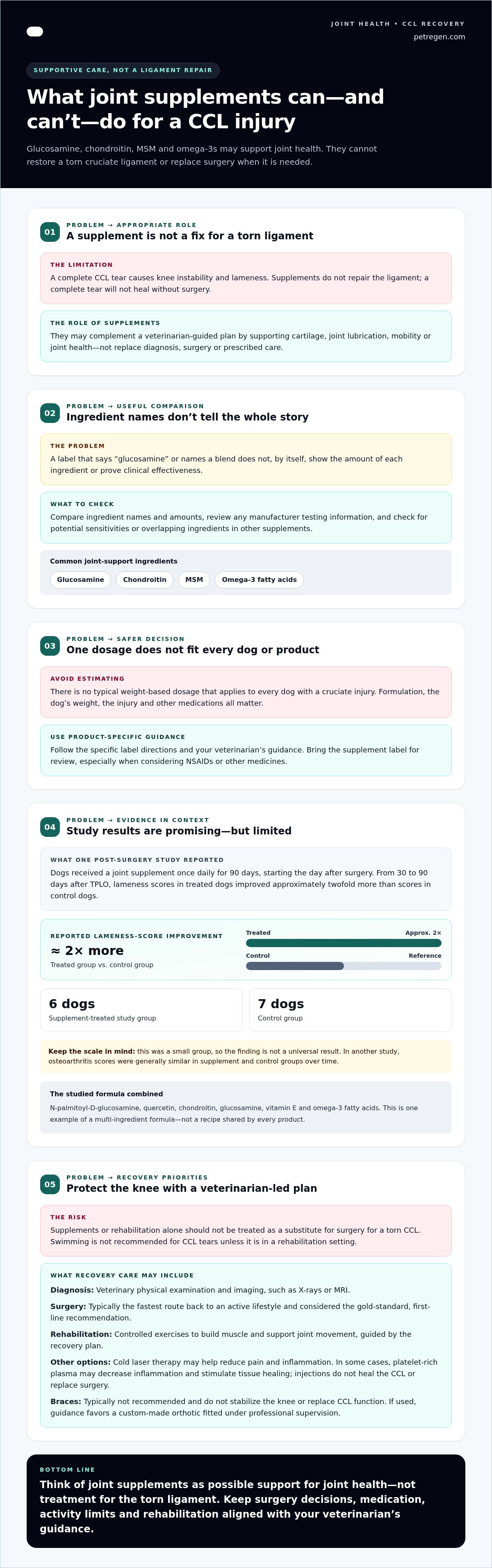
After surgery, supplements may be considered alongside pain management and controlled recovery. In one study, dogs received a joint supplement once daily for 90 days, starting the day after surgery. From 30 to 90 days after TPLO, lameness scores in treated dogs improved approximately twofold more than scores in control dogs. The study group included 6 dogs, compared with 7 in the control group, so its findings describe a small group rather than a universal result.
The studied supplement contained N-palmitoyl-D-glucosamine, quercetin, chondroitin, glucosamine, vitamin E, and omega-3 fatty acids. That ingredient list illustrates why comparing formulations matters: products can combine several compounds, not just glucosamine and chondroitin. For supplements for dogs with cruciate ligament injury, treat joint support as one part of recovery, alongside the veterinarian’s surgical, medication, and activity guidance.
Canine cranial cruciate ligament rupture
A canine cranial cruciate ligament (CCL) rupture can cause knee instability and lameness. Many CCL injuries develop through gradual wear during everyday movement rather than one dramatic accident. A supplement may support joint health, but it cannot restore a torn ligament.
Arrange a veterinary assessment if your dog is limping or struggling to use a hind leg. Veterinarians diagnose CCL injuries through a physical examination and imaging, such as X-rays or MRI. A complete tear will not heal without surgery, so diagnosis helps guide the next step.
Surgery is typically the fastest route back to an active lifestyle and is considered the gold-standard, first-line recommendation. Rehabilitation may help support mobility and muscle strength, but it should not be treated as a replacement for surgery for a torn CCL. Your dog’s injury and treatment plan determine which recovery activities are appropriate.
- Rehabilitation: A rehabilitation program may include controlled exercises to build muscle and support joint movement.
- Cold laser therapy: This is one rehabilitation option used to help reduce pain and inflammation.
- Injections: Platelet-rich plasma may decrease inflammation and stimulate tissue healing in some cases. Intra-articular injections may support joint health, but they don’t heal the CCL or replace surgery.
Swimming is not recommended for CCL tears unless it takes place in a rehabilitation setting. Market sources note that braces are typically not recommended for dogs with CCL tears and do not stabilize the knee or replace the function of the CCL. If a brace is used, guidance favors a custom-made orthotic, fitted under the supervision of a rehabilitation veterinarian or experienced orthotic specialist.
Ingredient names alone don’t show how much glucosamine a canine supplement provides. For a product described as “PLUS” glucosamine or a “CJ” blend, compare the full ingredient panel and amounts rather than relying on the name. One studied joint supplement combined N-palmitoyl-D-glucosamine, quercetin, chondroitin, glucosamine, vitamin E, and omega-3 fatty acids. That list is an example of a multi-ingredient formula, not a recipe shared by every product.
Use supplements as an addition to the recovery plan, not as a substitute for diagnosis, surgery, or prescribed care. Follow veterinary guidance on medications and dosages, and keep rehabilitation activities aligned with the treatment plan. For an additional perspective on whole-body wellness support, consider how a broader approach may complement, rather than replace, CCL care.
Glucosamine, chondroitin, MSM, and omega-3 fatty acids
Joint formulas often combine several ingredients, each with a different intended role. Compare the ingredient list and consider how the formula fits into your dog’s broader CCL recovery plan.
Key Joint Supplement Ingredients
Veterinarians commonly recommend joint supplements containing glucosamine, chondroitin, MSM, and omega-3 fatty acids for torn ACL recovery. Glucosamine and chondroitin are associated with cartilage and joint lubrication; omega-3s may support inflammation management and flexibility. MSM appears in common joint formulas, but ingredients can differ between products. Read the label to see which compounds are present and whether amounts are provided.
Omega-3s for Inflammation and Flexibility
Omega-3 fatty acids are used to support joint health because they may reduce inflammation and promote flexibility. That potential support concerns comfort and movement, not repair of a torn ligament. Look at the omega-3 ingredient information rather than relying only on broad terms such as “joint support.” Include the supplement in the full recovery discussion, particularly if your dog also takes medication.
Omega-3s and Antioxidants
Some joint formulas include omega-3 fatty acids alongside vitamin E, an ingredient found in a studied supplement combination. Their presence together describes the formula, but it doesn’t prove that the pairing improves CCL outcomes. Check each ingredient separately, including antioxidants named on the label, and avoid treating a longer ingredient list as proof of stronger results.
Other nutrients also relate to connective tissue maintenance. Silicon, minerals, omega-3 fatty acids, and vitamins D, A, and C are identified as nutrients needed for normal development and maintenance of tissues such as tendons and ligaments. This doesn’t mean a dog with a CCL injury needs every nutrient as a separate supplement. A veterinarian can weigh the dog’s diet, current products, and recovery needs when reviewing a nutrition plan.
Evidence varies by ingredient and outcome. In one study, osteoarthritis scores were generally similar in supplement and control groups over time. This helps set expectations: a plausible role in joint support does not guarantee measurable improvement for every dog. Evidence is limited for other types of joint supplements in dogs with CCL tears, so prioritize a clear ingredient list and avoid combining products with overlapping ingredients.
For a practical comparison, write down each product’s active ingredients, note any overlap, and bring the labels to your dog’s veterinary appointment. Keep the distinction clear: supplements may support joint health, while surgery, medication, and rehabilitation address separate aspects of CCL care. A considered formula can complement the plan, but it cannot repair a ligament.
Recovery from a torn ACL without surgery
Non-surgical care can manage your dog’s activity and support function, but it cannot heal a complete cranial cruciate ligament tear. Such tears will not heal without surgery, and rehabilitation is not a substitute. When surgery is not pursued, the plan focuses on protecting the knee, building supportive strength, and managing arthritis over your dog’s lifetime. Veterinary guidance helps tailor that plan to the injury and your dog’s mobility.
Movement restriction is a practical starting point. For dogs managed without surgery, guidance recommends leash walking only for at least 3 months. Keep bathroom breaks on leash, and prevent running, jumping, and stair climbing. Limiting activity may allow scar tissue to form and stabilize the joint, but that does not mean the torn ligament has healed. Swimming isn’t recommended unless it takes place in a rehabilitation setting.
- After walks or exercise: Apply ice to the knee for 20 minutes, if your dog tolerates it.
- During restricted activity: Keep walks controlled and use a leash for bathroom breaks.
- After the initial restriction: Gradually increase leash-walk duration as prescribed, with uphill walking included when appropriate.
- For ongoing care: Plan for lifelong arthritis management and discuss nutrition and weight management with your veterinarian.
Medication can be part of conservative care. NSAIDs are typically recommended for CCL-tear pain unless a dog cannot tolerate them; these medications can relieve swelling and stiffness. Follow your veterinarian’s guidance on medication type and dosage. Joint supplements can complement a broader plan, but they do not stabilize the knee or replace activity control, rehabilitation, or surgery when indicated.
TPLO surgery is one surgical approach used for CCL injuries, and recovery continues beyond the procedure. A client report described a dog returning to running horse trails after 12 weeks of rehabilitation following a ligament procedure. That individual account shows why recovery plans include a gradual return to activity, rather than an immediate return to running. It doesn’t establish a timeline for every dog.
Osteoarthritis remains a long-term consideration after a CCL injury, including for dogs managed without surgery. Track practical changes, such as willingness to rise, comfort during controlled leash walks, and worsening lameness. These observations give your veterinary team useful context when adjusting activity, arthritis management, or rehabilitation. When considering supplements for dogs with cruciate ligament injury, treat them as supportive care within a structured plan, not a substitute for addressing ligament instability.
Dog ACL and CCL injury recovery
Recovery after ACL or CCL surgery involves more than the procedure itself. TPLO changes the mechanics of the knee, while healing, controlled movement, and joint health remain important afterward. Your dog’s recovery plan should address the operation, medication, nutrition, and gradual return to activity. Supplements can play a supporting role, but they do not replace surgery or veterinary instructions.
One postoperative supplement study included 6 dogs in its treatment group and 7 in its control group. The dogs weighed 15-55 kg, and researchers collected synovial fluid before TPLO and at 30 and 90 days after surgery. Treated dogs received the joint supplement once daily for 90 days, starting the day after surgery. From 30 to 90 days after TPLO, their lameness scores improved approximately twofold more than the control group’s scores.
Those results provide a specific example, not a guarantee for every dog. The small study groups and defined postoperative schedule matter when interpreting the findings. The supplement contained N-palmitoyl-D-glucosamine, quercetin, chondroitin, glucosamine, vitamin E, and omega-3 fatty acids. Its findings relate to that formulation and study group, not automatically to every joint supplement or every ACL recovery.
After surgery, a brace may immobilize the joint, but recovery continues after it comes off. Follow the veterinary plan for movement and rehabilitation at each stage. Avoid increasing activity simply because your dog seems more comfortable. A gradual return allows the care team to monitor lameness, mobility, and the knee’s response to changes in activity.
Nutrition also matters in recovery planning. Silicon is important to the formation of articular cartilage and connective tissue. A veterinarian can help create a nutrition and weight-management plan tailored to your dog. Weight management matters because the plan should account for your dog’s body condition and the demands placed on the recovering joint. Review supplement ingredients alongside your dog’s existing diet and care plan.
Prescription anti-inflammatory medication is likely to be used immediately after surgery, with a joint supplement recommended over time. Follow veterinary guidance on medication types and dosages, and do not confuse supplements with ligament repair. They may support joint health as one part of postoperative care, but they do not replace medication, rehabilitation, or surgery.
Use the study details as a basis for a practical conversation about ingredients, timing, and recovery goals. For broader nutritional considerations alongside veterinary care, explore whole-body wellness support.
PetREGEN: PetREGEN Stem Cell Activator Supplement
PetREGEN Stem Cell Activator Supplement is a broader wellness option for owners supporting a dog through recovery. Its formula is designed to support the body’s natural regenerative function by enhancing immune function, with the aim of supporting mobility, recovery, and healthy aging. It is not a substitute for surgery, prescribed medication, or your veterinarian’s recovery plan.
The supplement uses USA-made, human-grade ingredients, including amino acids, omega 7, collagen, real liver, and phytonutrients. This whole-body approach may suit owners looking beyond a single joint ingredient while keeping their dog’s cruciate ligament care grounded in veterinary guidance. Review its ingredients as part of your companion’s overall nutrition and recovery routine.
Explore PetREGEN Stem Cell Activator Supplement or contact PetREGEN to learn more about supporting your dog’s wellness.
Build a thoughtful next step for your dog
Your dog’s recovery is a shared effort, shaped by careful observation and choices that fit everyday needs. Keep a short record of appetite, energy, and comfort during ordinary routines. These details can make conversations about nutrition and wellness more specific and help you notice what supports your companion’s quality of life.
When considering supplements for dogs with a cruciate ligament injury, look beyond a single ingredient and consider how a product fits your dog’s broader wellness routine. PetREGEN Stem Cell Activator Supplement offers a whole-body approach using ingredients such as amino acids, omega 7, collagen, real liver, and phytonutrients. It can be considered as nutritional support alongside, not instead of, your dog’s veterinary recovery plan.
If you’d like to explore whether this supplement fits your dog’s wellness routine, contact PetREGEN for support. Small, considered steps can help you care for the companion who means so much.
Frequently Asked Questions
What Supplements Help With Torn ACL Recovery?
Joint supplements containing glucosamine, chondroitin, MSM, and omega-3 fatty acids are commonly used during torn ACL recovery. These ingredients support joint health, but they don’t repair a torn ligament. Supplements belong alongside the veterinary treatment plan, which may include surgery, pain management, or rehabilitation. A complete CCL tear won’t heal without surgical intervention, so supplements shouldn’t delay assessment of the injury or replace treatment aimed at knee stability.
Which supplements may help dogs with a cruciate ligament injury?
Supplements for dogs with cruciate ligament injury often contain glucosamine, chondroitin, MSM, or omega-3 fatty acids. Some formulas combine these with other ingredients, so compare labels and note what your dog already receives. Omega-3s may support flexibility and inflammation management, while glucosamine and chondroitin are used for joint support. No supplement should be treated as ligament repair; its role is supportive within the broader recovery plan.
What evidence supports glucosamine and chondroitin for dogs with cruciate ligament injuries?
Evidence is limited, and one study found osteoarthritis scores were generally similar between the supplement and control groups over time. The postoperative study included 6 dogs receiving a supplement and 7 control dogs, so the results came from a small group. Its findings don’t establish that every glucosamine-and-chondroitin product produces the same outcome. Consider the specific formulation and study result separately from broad ingredient claims.
Can omega-3 fatty acids reduce pain or inflammation in dogs with a cruciate ligament injury?
Omega-3 fatty acids may help reduce inflammation and promote flexibility, supporting joint comfort and movement. That potential role doesn’t establish that omega-3s relieve pain from a torn ligament or stabilize the knee. NSAIDs are typically recommended for CCL-related pain unless a dog cannot tolerate them. Medication decisions and dosages should follow veterinary guidance, and supplements should be considered as support rather than a replacement for pain management.
Should supplements be used before or after cruciate ligament surgery in dogs?
A joint supplement may be recommended over time after surgery, while prescription anti-inflammatory medication is likely to be used immediately afterward. One postoperative study began supplementation the day after surgery, but its findings apply to the specific formula and dogs studied. Before surgery, discuss any supplements your dog takes as part of the nutrition and recovery plan. Keep supplement decisions separate from surgical and medication instructions.
What diet, weight management, and rehabilitation support recovery from a dog's cruciate ligament injury?
A tailored nutrition and weight-management plan can support joint health, while canine rehabilitation may help reduce inflammation, strengthen supporting muscles, and improve mobility. Ask your veterinarian for a plan that fits your dog’s condition and current treatment, rather than changing food or exercise all at once. Controlled activity is important during recovery, and rehabilitation should complement, not replace, surgery when a complete CCL tear requires it.
How do common dog joint supplements compare by ingredients and cost?
Formulas vary: glucosamine and chondroitin support cartilage and joint lubrication, omega-3s may support inflammation management and flexibility, and MSM appears in common joint formulas. Compare ingredient amounts on the labels.


