

What if a supplement’s “natural” label tells you less about its long-term safety than the amount your pet receives each day? It’s understandable to look for gentle ways to support a beloved companion’s wellness, especially when product claims sound reassuring. But the long-term effects of natural pet supplements depend on more than a label: ingredients, serving amount, product information, your pet’s health, and other medications can all matter.
This guide explains how to assess a supplement routine over time, what changes to note, and what information to bring to your veterinarian. You’ll also learn to distinguish a product’s stated support claims from guaranteed outcomes. A supplement shouldn’t be treated as a substitute for veterinary care or a promise to prevent or treat disease. With a thoughtful approach and your veterinarian’s guidance, you can make a more informed choice for your pet.
Key Takeaways
- The long-term effects of natural pet supplements can depend on ingredients, serving amount, product information, and your pet’s individual circumstances.
- “Natural” describes a product’s ingredients or marketing, but doesn’t prove it’s risk-free or suitable for ongoing use.
- Record the product, serving, start date, and any other supplements or medications to help review the routine over time.
- Discuss continued use with your veterinarian, especially if your pet has a health condition or takes medication.
- Distinguish a supplement’s stated support claims from guaranteed outcomes.
What Are the Possible Long-Term Effects of Natural Pet Supplements?
The long-term effects of natural pet supplements are outcomes that may be associated with repeated use. They aren’t the same for every animal. A pet might show the kind of wellness support described on a product label, show no noticeable change, or experience an unwanted response. The ingredients, serving amount, product information, and pet’s health all shape what may happen.
“Natural” describes an ingredient’s origin or a product’s marketing, not a guarantee of safety, suitability, or effectiveness. An ingredient’s effects can depend on how much a pet receives and what else is part of its routine, including food and medications. General background on the regulation of animal feed and pet supplements can help explain why product category, label, and intended use matter. It doesn’t establish that a particular supplement is appropriate for your pet.
What Does Long-Term Use Mean for a Pet Supplement?
Long-term use means a supplement is given repeatedly as part of a routine, with its suitability considered over time. There’s no single duration that defines “long term” for every product or pet. The right review period depends on the product’s directions and the animal’s circumstances, so don’t assume that a routine suitable for one pet automatically fits another.
Follow the product’s stated directions and consider them alongside veterinary guidance. Your veterinarian can help assess whether continued use makes sense given your pet’s age, health, diet, and other products or medications. Keep track of how your companion is doing, and share any changes or concerns rather than assuming they are or aren’t related to the supplement.
Potential Support Is Not the Same as a Guaranteed Result
A product may be intended to support wellness, but that stated purpose doesn’t mean every pet will experience a particular benefit. It also doesn’t establish that a supplement can diagnose, treat, cure, or prevent disease. Even a clearly described ingredient and serving direction can’t guarantee an individual outcome from continued use.
If a pet seems unwell, a supplement shouldn’t delay veterinary evaluation or replace care recommended by a veterinarian. If you’re considering a supplement alongside treatment, or your pet has a medical condition or takes medication, discuss it with your veterinarian before use. Their guidance can help weigh the intended support against your pet’s health context.
Look beyond a supplement’s natural label. Consider its ingredients, serving directions, product information, and fit with your pet’s needs. Revisit the decision with your veterinarian if your pet’s health or routine changes. Regular use doesn’t guarantee better health.
What Determines the Long-Term Effects of Natural Pet Supplements?
There isn’t one answer that applies to every supplement or animal. The long-term effects of natural pet supplements depend on the product’s ingredients, how much a pet actually receives, how clear the product information is, and the pet’s health and care routine. A useful rule of thumb is: Long-term suitability depends on product-specific information and your pet’s circumstances.
Look beyond a familiar ingredient name or a broad wellness claim. The species, serving directions, health conditions, and other products involved all shape the questions worth asking.
Ingredient, Amount, and Evidence for the Intended Use
Start with the full ingredient list and the amount the label directs you to give. Then consider whether available information applies to the specific ingredient, species, amount, and intended use. Information about an ingredient in one context may not explain whether a complete formula is suitable for ongoing use in your pet.
Species matters, too. Information involving dogs shouldn’t automatically be treated as relevant to cats, birds, or horses. Likewise, information about one ingredient doesn’t validate every ingredient or the combined formula. If the details don’t clearly match your pet and the product’s directions, don’t fill in the gaps with assumptions. Your veterinarian can help you assess what’s relevant.
Product Quality and the Pet’s Health Context
A label is a starting point, not a complete quality assessment. Read the full ingredient list, serving directions, and storage instructions. Clear details make it easier to understand what a product contains and how it’s intended to be used. Consistency matters for ongoing use, but don’t assume a particular testing process or quality standard unless reliable product information specifically supports it.
PetREGEN describes its supplement as a daily powder containing AFA algae, reishi mushrooms, and other botanicals, intended to be sprinkled onto food once or twice daily. These details explain the product’s listed ingredients and intended use; they don’t establish long-term outcomes for every pet. Explore PetREGEN’s supplement details as part of your label review.
Your pet’s circumstances matter as much as the product. A current or changing health condition, as well as other supplements and medications, can affect whether adding something to the routine is appropriate. Bring the product label and a list of everything your pet takes to your veterinarian, and discuss the intended use before starting or continuing it.
This product is intended for supplemental use only. It is not intended to diagnose, treat, cure, or prevent any disease. If your pet has a medical condition or is on medication, consult your veterinarian before use.
Does 'Natural' Mean a Pet Supplement Is Safe for Long-Term Use?
No. “Natural” may describe an ingredient’s origin or a product’s marketing, but it doesn’t establish that the product is suitable for your pet or safe to use over time. A synthetic ingredient isn’t automatically harmful, either. Consider what the product contains, how it’s intended to be used, and whether the information applies to your pet.
A label’s origin claim does not replace serving-specific safety information. Read claims in context, and look for clear directions, a complete ingredient list, and information about the intended species. Broad assurances like “natural” or “safe” aren’t enough by themselves to show what ongoing use may mean for an individual animal.
How to Read Natural and Safety Claims on a Label
Separate ingredient descriptions from statements about use. A label naming a botanical tells you what the product says it contains. A claim that it supports wellness describes an intended purpose, not a guaranteed result. Neither statement alone shows that the complete formula is appropriate for every pet or for indefinite use.
Use this table to put common label language in perspective:
| Marketing language | Information it provides | What it cannot prove |
|---|---|---|
| “Natural” | The product is presented as having natural-origin ingredients. | That it’s risk-free, effective, or suitable for your pet. |
| “Supports wellness” | The stated purpose or intended support. | A guaranteed benefit or a disease-related outcome. |
| “Safe” or “gentle” | A broad reassurance from the label. | Safety at every amount, for every species, or with every health condition. |
| Species-specific directions | The species and serving guidance the label identifies. | That the directions account for your pet’s full health history or other products. |
Clear directions and species information make a label more useful, but they don’t replace advice tailored to your pet. If a claim is broad and the supporting details aren’t clear, treat it as a reason to ask questions, not as proof.
Routine Use Versus Accidental Overconsumption
Following a product’s directions is different from a pet getting into the container and consuming an unknown amount. Don’t assume an accidental excess is harmless because the product is natural, and don’t use routine directions to judge an unexpected ingestion. The amount, ingredients, species, and individual circumstances all matter.
If your pet gets into a supplement or may have consumed more than directed, contact your veterinarian promptly for guidance. Keep the package available so you can share its ingredients and directions. Don’t try home treatment based on a general online threshold; the right response depends on the product and pet.
This product is intended for supplemental use only. It is not intended to diagnose, treat, cure, or prevent any disease. If your pet has a medical condition or is on medication, consult your veterinarian before use.
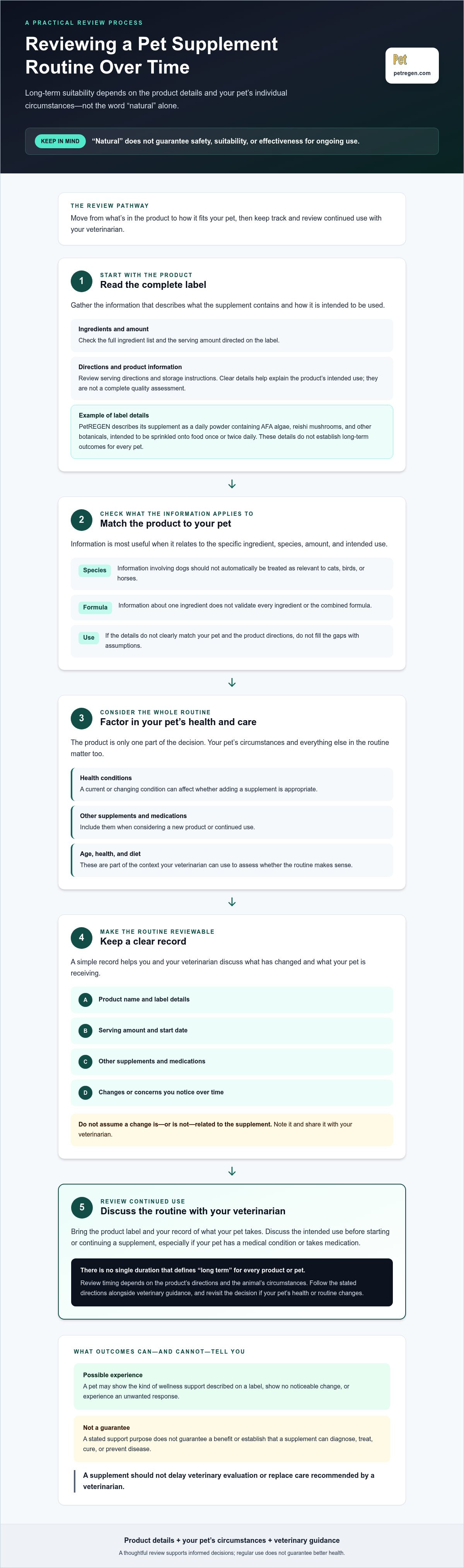
How Can Pet Parents Review a Supplement Routine Over Time?
A simple record makes a routine easier to review and helps your veterinarian see the full picture. It can also keep you from assuming that every change in your pet’s energy, appetite, or behavior is caused by a supplement. The goal is to notice patterns and share useful details, not to diagnose a reaction at home.
Use these steps to keep the information organized:
- Record the product. Write down its name and keep the package or a clear copy of the full ingredient list and directions.
- Note the serving and start date. Record how much you give, how often, and when the routine began. Note any changes to the serving or schedule.
- List everything else your pet takes. Include other supplements and medications, along with relevant health conditions.
- Track relevant changes. Briefly note changes you observe and when they occur. A timeline can guide a conversation, but it doesn’t establish that the supplement caused the change.
- Review the routine with your veterinarian. Ask whether the product and its directions fit your pet’s health circumstances, particularly if their condition or care routine changes.
A Simple Supplement Review for the Next Veterinary Conversation
Bring the package or a clear copy of the full ingredient list and directions, plus notes on serving, start date, other supplements, medications, and current conditions. Ask whether the ingredients and directions are appropriate for your pet’s species and situation, and whether continued use should be reviewed. This makes the conversation specific to your companion, rather than relying on a general claim or label phrase.
When to Pause and Seek Veterinary Guidance
Get veterinary input before use if your pet has a medical condition or takes medication. Reach out if you notice a concerning change during the routine. Don’t try to diagnose the cause yourself or change prescribed care without veterinary guidance. If your pet may have eaten more than the directed serving, contact your veterinarian promptly and keep the product label available.
For a routine review, focus on what you can report clearly: product, serving, timing, other items in your pet’s routine, and observed changes. That record won’t prove whether the supplement is responsible, but it can help your veterinarian assess whether continuing makes sense. This careful approach helps you consider the long-term effects of natural pet supplements without mistaking a wellness claim for a guaranteed outcome.
If you’re reviewing a daily supplement option, explore PetREGEN supplement details and discuss suitability with your veterinarian.
This product is intended for supplemental use only. If your pet has a medical condition or is on medication, consult your veterinarian before use.
How PetREGEN Describes Its Natural Pet Supplement, and Its Limits
Product details help explain what a supplement is intended to offer, but they don’t establish what every pet will experience over time. PetREGEN is a daily natural powder supplement for dogs, cats, birds, and horses, and pets of all ages and sizes. Its listed ingredients are AFA algae, reishi mushrooms, and other botanicals. The powder is intended to be sprinkled onto food once or twice daily, following the weight-based serving directions.
PetREGEN describes its formula as supporting healthy joints, mobility, comfort, and recovery; helping maintain a healthy inflammatory response; and promoting energy, vitality, and healthy aging. It also states that the supplement supports digestive health, nutrient absorption, and gut balance, and helps maintain healthy skin, coat, and immune function. These are stated support claims, not guarantees that every pet will experience the same results. They aren’t claims to diagnose, treat, cure, or prevent disease.
What PetREGEN States About Its Formula and Intended Support
PetREGEN also states: No artificial colors or flavors; No preservatives; No added sugar; No fillers or unnecessary additives; Gluten-free; GMO-free. These statements describe the product, but they don’t prove a particular long-term effect or determine whether it’s right for an individual animal. Your pet’s health, other products, and veterinary guidance remain important to that decision.
When considering the long-term effects of natural pet supplements, use product claims as a starting point for informed questions, not as a promise. Pay attention to your pet’s response and discuss ongoing use with a veterinarian, especially if your pet has a medical condition or takes medication.
Published Serving Directions and Important Boundaries
PetREGEN’s published serving directions are based on weight. Follow the listed category and serving amount. Consult your veterinarian if you’re unsure whether the directions are suitable for your pet.
This product is intended for supplemental use only. If your pet has a medical condition or is on medication, consult your veterinarian before use.
- Up to 25 lb: ¼ scoop, 1-2 times per day.
- 25-60 lb: ½ scoop, 1-2 times per day.
- 60-90 lb: ¾ scoop, 1-2 times per day.
- 90 lb+: 1 scoop, 1 time per day.
Each jar contains 30 full scoops. These directions describe the intended serving, not a guaranteed outcome. Don’t use a supplement in place of veterinary evaluation or care, and don’t change prescribed care based on a product claim. If your pet may have consumed more than directed, contact your veterinarian promptly and keep the label available.
For a careful review, explore PetREGEN’s product information and share the label and serving directions with your veterinarian. The product page also states a 30-day money-back guarantee (risk-free trial).
Make Your Pet’s Next Wellness Decision With Confidence
Your next step can be simple. Before adding or continuing a supplement, review the label and your pet’s current routine with your veterinarian. That conversation can help you weigh the product’s intended purpose against your companion’s individual needs and decide what makes sense now. If anything changes, revisit the plan rather than assuming the same routine will always be right.
The long-term effects of natural pet supplements aren’t guaranteed by a “natural” label or a hopeful promise. A thoughtful choice starts with clear information, realistic expectations, and veterinary guidance when your pet’s health or medications are involved. Keep care centered on your companion’s needs, and make adjustments with professional help when appropriate.
To review PetREGEN’s product information as part of your research, explore PetREGEN’s natural pet supplement.
Frequently Asked Questions
Does natural mean a pet supplement is safer than a synthetic one?
No. “Natural” describes an ingredient’s origin or how a product is marketed; it doesn’t establish safety for every pet or serving. Synthetic ingredients aren’t automatically harmful, either. The specific ingredient, amount, product information, and animal’s health all matter. Compare the full label and intended use rather than judging by one word. If you’re unsure about a product’s suitability, ask your veterinarian to review its ingredients.
Can natural pet supplements interact with prescription medications?
A supplement may be relevant to a pet’s medication routine, so discuss both with your veterinarian before combining them. Bring the supplement label and a current medication list, including non-prescription products, to make the review specific. Don’t change a prescribed dose on your own. This product is intended for supplemental use only. If your pet has a medical condition or is on medication, consult your veterinarian before use.
How long can a pet take a natural supplement?
There isn’t one duration that’s right for every supplement or pet. Follow the product’s directions, then ask your veterinarian whether continued use fits your pet’s health and care plan. Bring it up at a routine appointment or sooner if your pet’s condition, diet, or medications change. Record when use began and any serving changes so you can review the routine rather than relying on memory.
What should I do if my pet eats too much supplement?
Contact your veterinarian promptly if your pet consumes more than directed or you’re unsure how much is missing. Keep the container or label nearby, and be ready to share the product name, ingredients, estimated amount, time of ingestion, and your pet’s species and approximate weight. Don’t wait for symptoms or try to induce vomiting or give a home remedy unless a veterinary professional specifically instructs you to do so.
Can I give my pet a supplement made for people?
Don’t give a human supplement to your pet unless your veterinarian has reviewed it and advised you to do so. A product made for people may have ingredients, concentrations, or serving directions that aren’t appropriate for your animal. “Natural” doesn’t make a product suitable across species. Keep the package available for your veterinarian, and never estimate a pet serving by scaling down a human serving.
How soon should I expect to notice a supplement’s effects?
There’s no dependable timeline that applies to every product or pet, and some supplements may produce no obvious change. The long-term effects of natural pet supplements can’t be judged by an assumed schedule or a single good or bad day. If you’re monitoring a routine, note specific observations, such as activity or appetite, and when they occur. Discuss concerns or worsening signs with your veterinarian instead of waiting for a supplement to work.
Should I stop a pet supplement before a procedure?
Ask the veterinarian or procedure team caring for your pet, and tell them about every supplement your animal receives. Whether to pause one, and when, depends on the product and your pet’s situation. Don’t assume a supplement can be continued because it’s natural, or stop prescribed care without instruction. Share the package or ingredient list early enough for the veterinary team to give you clear, procedure-specific directions.


