

A USA-made label can tell you where a pet supplement was made, but it doesn’t guarantee that every ingredient came from the United States or that the product was independently tested. To understand why USA-made pet supplements may be safer, look beyond the label at the safeguards behind the product.
It makes sense to want clear answers when choosing a supplement for a beloved companion. A domestic manufacturing claim can be a useful starting point, but audits, quality seals, ingredient rules, and product regulation each provide different information about quality and safety.
This article explains what “Made in the USA” means, what independent audits and the NASC Quality Seal can tell you, and how ingredient approvals and FDA oversight apply to animal supplements. You’ll also learn why a label or seal is only one part of assessing a product, helping you make a more informed choice for your pet.
Key Takeaways
- Learn what a “Made in the USA” claim can tell you about a supplement’s production and ingredient sourcing.
- Understand how independent audits and the NASC Quality Seal can offer useful quality-control signals.
- See why ingredient status, including food-additive approval and GRAS, matters when evaluating product safety.
- Distinguish animal-food regulation from the rules for products marketed as pet supplements before deciding what questions matter for your companion.
Independent audits and the NASC Quality Seal
Understanding why USA-made pet supplements may be safer means looking beyond origin to the controls behind production. Independent audits and testing provide different information: one can assess quality processes, while the other reports on product samples.
Third-party testing reports what a laboratory found in a sample, while a certificate of analysis records those results. GMP certification relates to manufacturing practices, but each document or seal has a specific scope.
Independent Quality-Control Audits
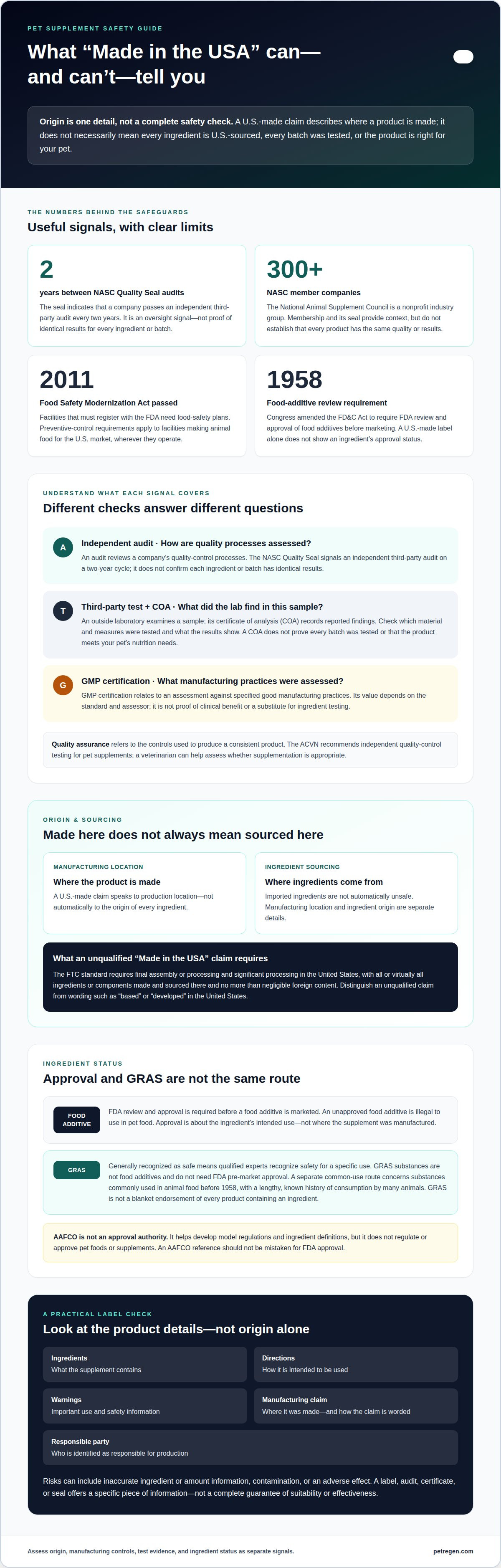
An independent audit reviews a company’s quality-control processes rather than relying only on its own description. The NASC Quality Seal indicates that a company passes an independent third-party audit every two years. The National Animal Supplement Council is a nonprofit industry group with more than 300 member companies. For pet owners asking why USA made pet supplements are safer, the seal can offer a defined oversight signal, though it doesn’t establish identical results for every ingredient or batch.
Third-Party Testing and Certificates
Third-party testing means an outside laboratory examines a sample; a certificate of analysis, or COA, records the reported findings. A COA can show which ingredients or quality measures were examined and the results for that sample. It’s most useful when it clearly identifies the tested material and findings. It doesn’t prove that every batch was tested or that the supplement meets a particular pet’s nutrition needs.
GMP Certification and Quality Assurance
GMP certification describes an assessment against specified good manufacturing practices, while quality assurance covers the controls used to produce a consistent product. The value of certification depends on the standard and assessor. Treat it as information about manufacturing systems, not proof of clinical benefit or a substitute for ingredient testing. The ACVN recommends independent quality-control testing for pet supplements; a veterinarian can help assess whether supplementation is appropriate.
What Does ‘Made in the USA’ Labeling Mean?
A U.S.-made claim describes where a product is made, not necessarily where every ingredient originates. For pet supplements, manufacturing location and ingredient sourcing are separate details.
U.S. Animal-Food Safety and Labeling
Animal-food safety and labeling rules address product safety, sanitary production, harmful substances, and truthful labels. The FDA states that animal food sold in the United States must meet these standards. Under the Food Safety Modernization Act, passed in 2011, facilities that must register with the FDA need food-safety plans. Preventive-control requirements apply to facilities making animal food for the U.S. market, wherever they operate.
The FTC’s unqualified “Made in the USA” standard requires final assembly or processing and significant processing in the United States. It also requires all or virtually all ingredients or components to be made and sourced there, with no more than negligible foreign content. On a label, distinguish an unqualified claim from wording such as “based” or “developed” in the United States.
Imported Ingredients and Safety Standards
An imported ingredient isn’t automatically unsafe, and domestic production alone doesn’t establish effectiveness. The FDA’s preventive-control requirements apply to facilities making animal food for the U.S. market, including facilities outside the country. Manufacturing location and ingredient origin are separate pieces of information, not shortcuts for judging quality.
Risks can include inaccurate information about ingredients or amounts, contamination, or an adverse effect. Read the ingredient list, directions, and warnings; note the stated manufacturing location and the party responsible for production. These label details help you understand what the supplement contains and how it’s intended to be used.
U.S. and International Rules
FDA requirements apply to animal food sold in the United States, while other countries have their own rules. This comparison doesn’t establish that one country’s system is stricter; the relevant question is whether products made abroad and sold here meet U.S. requirements.
There’s no single cost comparison that applies to every U.S.-made and imported supplement. Ingredient sourcing, manufacturing, testing, and packaging can all affect price, so origin alone doesn’t determine value. Before buying, review the product identity, ingredients, directions, warnings, and manufacturing claim. Discuss supplementation with a veterinarian when considering your pet’s nutrition or treatment needs.
Food-additive approval and GRAS status
Ingredient safety depends partly on how a substance is classified for animal food. Congress amended the FD&C Act in 1958 to require FDA review and approval of food additives before marketing. An unapproved food additive is illegal to use in pet food. This approval process is distinct from a product’s manufacturing location, so a USA-made label alone doesn’t show whether each ingredient is approved for its intended use.
Some substances are considered generally recognized as safe, or GRAS, for a specific use when qualified experts recognize their safety. Animal-food substances with GRAS status don’t count as food additives and don’t need FDA pre-market approval. A separate route relies on common use: the substance must have been commonly used in animal food before 1958, with a lengthy, known history of consumption by many animals. GRAS status is use-specific, not a blanket endorsement of every product containing that ingredient.
AAFCO helps develop model regulations and ingredient definitions, but it has no regulatory authority. It doesn’t approve pet foods or supplements. That distinction matters: an AAFCO reference shouldn’t be mistaken for FDA approval of an ingredient or product. For pet owners, the useful question is whether an ingredient’s intended use has a lawful basis, such as food-additive approval or applicable GRAS status. A substance added to animal food cannot be considered GRAS when its intended use is to prevent or treat disease.
Recalls and contamination incidents have affected animal products, but the available examples don’t establish a U.S.-made versus imported supplement comparison. In the 2007 U.S. pet food recalls, wheat flour adulterated with melamine and cyanuric acid was used to fake a higher protein reading; pets became sick or died. A separate dog jerky treat outbreak involved more than 5,000 animals becoming sick and more than 1,000 dying. These incidents show why ingredient identity and intended use matter, but they don’t prove that country of manufacture alone predicts safety.
Regulation of products marketed as animal dietary supplements
U.S. rules classify animal products as food or drugs according to their intended use. The FDA generally doesn’t review pet supplements before sale, and AAFCO has no regulatory authority. A USA-made label doesn’t mean FDA or AAFCO pre-market approval is required.
Federal Oversight of Animal Supplements
Federal oversight turns on whether a product is legally considered animal food or an animal drug. The FDA determined in 1996 that the Dietary Supplement Health and Education Act does not apply to products for animals. So the “dietary supplement” category for people doesn’t automatically give an animal product the same regulatory treatment.
Under the FD&C Act, animal food generally doesn’t need FDA pre-market review unless it contains a food additive. Most animal drugs sold in the United States must receive FDA approval before marketing. A product’s intended use matters: a substance added to animal food cannot be considered GRAS if its intended use is to prevent or treat disease. These distinctions explain why a supplement label isn’t proof of FDA review.
Rules and Enforcement for Pet Supplements
U.S. requirements depend on a product’s category and ingredients, not simply its manufacturing origin. An unapproved food additive is illegal to use in pet food, while most animal drugs require FDA approval before marketing. These rules establish the basis for federal oversight: USA-made products aren’t exempt, and imported products sold in the United States are also subject to applicable requirements.
The FDA finalized a Compliance Policy Guide in April 2016 addressing complete pet-food diets intended to treat or prevent disease. It later withdrew the companion-animal nutritional supplements compliance policy, CPG 690.100, on February 20, 2020. The American College of Veterinary Nutrition states pet-supplement labels should say products aren’t intended to diagnose, treat, cure, or prevent disease. This disclaimer clarifies intended use; it isn’t evidence of FDA approval.
PetREGEN: PetREGEN Stem Cell Activator Supplement
PetREGEN Stem Cell Activator Supplement supports the body’s natural regenerative function in dogs, cats, and horses. Its multi-system approach is designed to clean, nourish, and support whole-body wellness, with the goal of supporting mobility, recovery, and healthy aging.
The formula uses USA-made, human-grade ingredients, including collagen, real liver, and phytonutrients. It also includes amino acids and omega 7. These details can help you understand what the supplement is formulated with, while the earlier sections explain why country-of-origin wording alone doesn’t establish every aspect of safety or effectiveness.
Consider this supplement as nutritional support, not a substitute for veterinary care or a treatment for disease. Your veterinarian can help assess whether supplementation fits your companion’s needs and diet. For more information about PetREGEN Stem Cell Activator Supplement, contact PetREGEN.
Make Your Next Choice With Confidence
Understanding why USA-made pet supplements may be safer is a starting point, not the whole decision. Consider what your companion needs, how a supplement fits into their daily nutrition, and what you hope to support. A veterinarian can help you weigh those needs and monitor your pet’s response over time.
PetREGEN Stem Cell Activator Supplement is an option for pet owners exploring nutritional support for dogs, cats, or horses. Keep the goal practical: choose support that makes sense for your animal, and pay attention to changes in comfort, mobility, and energy. Your observations can help guide an informed conversation about your pet’s wellbeing.
If you have questions about whether PetREGEN Stem Cell Activator Supplement fits your companion, contact PetREGEN with your questions. A thoughtful next step can help you feel more prepared to support the pet who depends on you.
Frequently Asked Questions
What Makes USA-Made Supplements Stand Out?
A USA-made claim can indicate where a supplement’s final production took place, but it doesn’t prove every ingredient is domestic or establish the product’s effectiveness. The claim is clearer when the label distinguishes manufacturing from ingredient origin. For example, a product can be made in the United States using imported ingredients. Consider origin alongside quality-control information and whether the supplement suits your pet’s needs.
What quality-control and manufacturing standards should U.S.-made pet supplements follow?
Look for clear product and ingredient labeling, documented manufacturing controls, and independent quality testing. These are different forms of evidence: manufacturing controls describe processes, while a test report describes results for the sample analyzed. A certificate tied to a specific batch can be more informative than a general quality statement. Neither certification nor a test result establishes that a supplement is appropriate for every animal.
How can consumers verify where a pet supplement is made and where its ingredients come from?
Read the exact origin wording instead of treating “made,” “based,” or “developed” as interchangeable. Then review the ingredient list and any manufacturer information that distinguishes the production location from ingredient sourcing. If a certificate of analysis is available, note which sample it covers and what it tests. These details help separate a manufacturing claim from evidence about the ingredients in a particular product.
Are U.S.-made pet supplements safer in independent studies, or is evidence limited?
Country of manufacture alone doesn’t establish that a supplement is safer, and the quality-control examples discussed here don’t compare U.S.-made products with imported ones in clinical safety studies. Independent testing can report what was measured in a sample, while a study comparing safety would need to examine relevant outcomes across products. For an individual pet, discuss a supplement’s intended use and potential suitability with a veterinarian.
How do FDA and state rules for pet supplements compare with regulations in other countries?
FDA requirements apply to animal food sold in the United States, including products made abroad for the U.S. market. Other countries have their own rules, and there’s no basis here for comparing them as stricter or less strict; state-specific rules aren’t covered.


