

What if a certificate of analysis looks reassuring but doesn’t match the supplement in your hand? Understanding a pet supplement’s certificate of analysis starts with knowing what it represents: laboratory results for one production batch, also called a lot. It shows which tests were run, the methods and results, and whether those results meet stated specifications. It describes what was measured, not how your pet will respond.
It’s natural to want clear evidence that a supplement has been tested before giving it to a beloved companion. This guide explains how to read test results, assess methods and specifications, and match a document to the product’s batch details. You’ll also learn to spot warning signs, such as missing lot information or results without useful context, so you can interpret a COA with greater confidence.
Key Takeaways
- Use a certificate of analysis to understand what was tested and whether results meet the stated specifications, not to predict how your pet will respond.
- Look for test methods, clear units, and results for relevant contaminants, then interpret each result against its acceptance limits.
- Match the report’s product details and lot number to the package so you know it applies to the supplement in your hands.
- Missing batch details, unclear testing information, or an outdated report can be warning signs worth weighing before choosing a supplement.
What is a certificate of analysis?
A certificate of analysis (COA) records laboratory results for one production batch, also called a lot. It shows which product qualities were measured and whether the results met stated specifications.
Testing Categories
Testing categories describe what a laboratory measures, including identity, potency, purity, composition, contaminants, and microbiology. Identity testing checks whether an ingredient is what its label says; potency and composition testing assess amounts and makeup. These results help you compare a product’s actual contents with its specifications, while contaminant and microbial tests look for unwanted substances or organisms.
Raw Ingredient and Finished-Product Testing
Raw-ingredient testing examines individual ingredients before production; finished-product testing examines the supplement after formulation. The reports are not interchangeable: ingredient results don’t establish the final product’s composition or quality. For example, a COA for one ingredient can’t show whether the finished supplement meets its own potency or microbiological specifications.
Batch-Specific Testing Information
A batch-specific COA reports results for a defined lot, not every batch of a product. Match the report’s lot number to the number on the package, then compare the product description and report details. To request testing information, give the manufacturer the package’s lot number and ask for the COA for that lot.
For microbiology, a finished-product report may list total aerobic plate count, yeast and mold, E. coli, or Salmonella. USP <61>/<62> are examples of microbial testing methods. Heavy-metal results may cover lead, arsenic, cadmium, and mercury. For products sold in California, the California Office of Environmental Health Hazard Assessment identifies California Proposition 65 as a consideration when evaluating those results.
Are pet supplement manufacturers in the United States legally required to provide a COA? U.S. dietary supplement requirements address product specifications and quality records, but don’t establish a blanket requirement to provide every consumer with a COA. The FDA recommends contacting a manufacturer for product information beyond the label.
Test methods and results
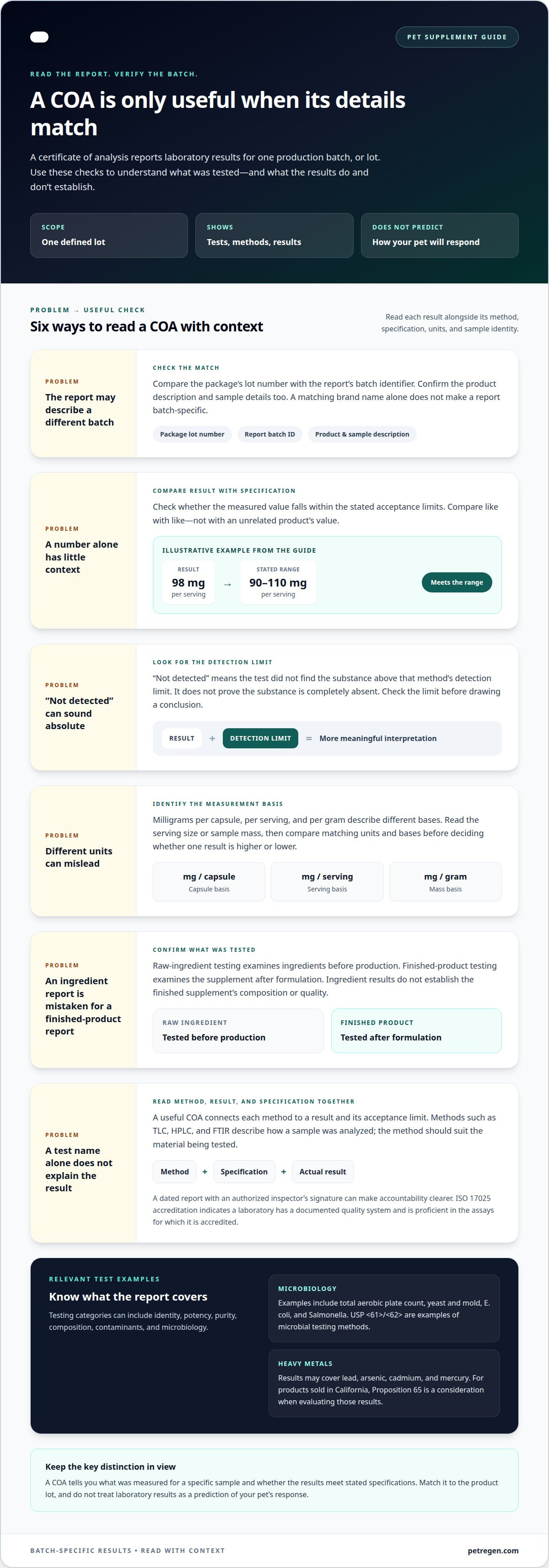
A useful COA connects each test method to a specification and an actual result. Read them together: a number alone gives little context.
Comparing Results with Specifications
Comparing results with specifications means checking whether each measured value falls within its stated acceptance limits. This helps distinguish a passing result from a number that merely looks favorable. For example, a hypothetical result of 98 mg per serving meets a stated range of 90-110 mg per serving. Compare the result with that range, not with an unrelated product’s value.
To compare COAs across brands, focus on the same ingredient or measure, matching units, test methods, and specification limits. Formulas and serving sizes can differ, so a higher number doesn’t automatically mean better quality. Check that each report identifies the test date and gives a clear pass or fail outcome. ISO 17025 accreditation, according to the International Organization for Standardization, indicates a laboratory has a documented quality system and is proficient in the assays for which it is accredited.
Detection Limits for Not-Detected Results
A “not detected” result means the test didn’t find the substance above the method’s detection limit. It doesn’t prove the substance is absolutely absent. The limit matters because methods can detect different amounts. Look for the detection limit beside the result, then consider whether it supports the conclusion you’re drawing about that substance.
Methods such as TLC, HPLC, and FTIR describe how a laboratory analyzed a sample. A finished-product COA should connect each method to its test result and specification. A dated report with a qualified, authorized inspector’s signature makes accountability clearer. The chosen method must suit the material being tested, since its name alone doesn’t show whether it was appropriate.
Units need equal care. Milligrams per capsule, milligrams per serving, and milligrams per gram describe different bases; the serving size or sample mass determines how to relate them. Before drawing conclusions, identify the unit, read the stated serving basis, and compare like with like. This helps prevent an accurate result from being misread as a stronger or weaker formulation.
Product identification and batch traceability
A COA links laboratory findings to a defined product and production lot. Its identifiers show which material was tested and whether the results apply to the package you have.
Product and Batch Details
A traceable COA identifies the tested material with details such as its trade name, description, production date, lot number, or product code. It may also include a sample description and report date. These details matter because results describe a particular sample and batch, not every version of a product. Without clear identification, you can’t tell what the laboratory tested.
Matching a COA to a Product Batch
To match a COA, confirm that its product description and lot number correspond to the supplement package. Start with the printed lot number, then compare it with the report’s batch identifier and sample description. If the package has a different lot number, the report doesn’t establish that its results apply. A generic product name alone doesn’t make a report batch-specific.
For example, a report that names a supplement but omits its lot number leaves the tested batch unclear. A report identifying the material as a raw ingredient also doesn’t describe the finished product. Check that the document’s sample and product details match the item, rather than relying on a matching brand name alone.
Keep the COA with the package’s lot number and expiration date. Together, these details preserve a record of which batch was tested and which product you have. When requesting documentation, give the manufacturer the package’s lot number and ask for the report covering that specific lot. A refusal or a generic report without a lot number is a warning sign.
Red flags in a certificate of analysis
A polished COA can still leave important questions unanswered. Look for gaps in batch details, dates, testing scope, and the report’s issuer. A pass result applies only to the tests and specifications shown; it doesn’t guarantee that unlisted contaminants are absent or that the supplement produces a health effect.
Missing lot numbers, test dates, or manufacturing dates make it difficult to connect a report to a product. A COA dated two years before its stated batch was made raises a clear timing concern. The document should be reviewed, signed, and dated by a qualified, authorized inspector. Check that the issuing laboratory or authority is identifiable and its credentials are clear.
Testing information can also be too limited to evaluate. A report that gives results without methods or acceptance limits doesn’t clearly explain how the product was assessed. Consider whether the laboratory is independent and whether its tests suit the supplement. A small sample can’t, by itself, guarantee consistency across every unit in a production run. A contract manufacturer also isn’t required to test every listed ingredient each time it makes a product.
Review the scope, not just the word “passed.” A result that meets its specification doesn’t establish that unlisted substances are absent or that the specification is appropriate. Check whether the COA covers the finished product and relevant tests. For expiration dates, look for real-time or accelerated stability data; a date based only on an assumed shelf life offers less product-specific support.
For dietary supplements, treat a generic report without a lot number, missing dates, or an unidentified issuer as warning signs. Compare the report with the product’s label and batch details. If a result or signature is unclear, ask the manufacturer to explain the document and its testing basis before relying on it.
For clearer product information alongside your quality review, explore supplement details.
PetREGEN: PetREGEN Stem Cell Activator Supplement
PetREGEN Stem Cell Activator Supplement is a natural supplement for dogs, cats, and horses, designed to support the body’s natural regenerative processes and whole-body wellness. If you’re considering nutritional support for mobility, recovery, or healthy aging, it may be an option to explore alongside your review of a supplement’s test results.
Its multi-system approach combines human-grade ingredients, including collagen, real liver, and phytonutrients. The formulation also includes amino acids and omega 7. These ingredients are intended to support whole-body wellness, rather than address only one symptom. A certificate of analysis can help you understand testing for a specific batch, but it can’t predict how an individual pet will respond.
For questions about PetREGEN Stem Cell Activator Supplement and whether it suits your companion, contact PetREGEN.
Make Your Next Choice With Care
Understanding a pet supplement’s certificate of analysis can help you ask more focused questions as you consider what belongs in your companion’s routine. A document is one part of the decision, alongside your pet’s needs, the product’s intended role, and advice from a veterinarian who knows their health history. No single report can tell you what choice is right for every animal.
If you’re exploring nutritional support for your dog, cat, or horse, PetREGEN Stem Cell Activator Supplement is one option to learn about. Consider whether it fits your goals for your pet’s wellbeing. Thoughtful choices start with clear information and an understanding of the animal who depends on you.
Contact PetREGEN with your questions, and take your next step with care and confidence.
Frequently Asked Questions
Heavy Metals: Are You Testing Correctly?
A meaningful heavy-metal result identifies the metals tested, the sample, method, units, and limits used for evaluation. Look for lead, arsenic, cadmium, and mercury, then distinguish ingredient testing from finished-product testing. Units such as mg/kg describe the measured amount by mass. For products sold in California, heavy-metal findings may also need consideration alongside California Proposition 65.
Identity Testing: Is It Actually the Ingredient?
Identity testing determines whether a material matches the ingredient it is claimed to be. Look for the method used and the criteria applied, not just the ingredient name. For example, a raw ingredient’s identity result doesn’t establish the identity or composition of every component in the finished formula. The test’s sample description helps show what the finding covers.
What Does a Supplement COA Test For?
A COA may cover identity, potency, composition, microbial levels, heavy metals, and other contaminants. Tests vary with the material and product, so read the report’s scope rather than assuming every concern was assessed. A probiotic report, for example, may include colony-forming units per serving. Those findings describe the listed measurements, not every aspect of product quality.
What Are the Red Flags on a Report?
Be cautious of reports without a clear product description, lot identifier, test date, method, or acceptance limits. A broad potency range, such as 90-110%, may also merit a closer look. These gaps don’t prove a supplement is defective, but they can make it difficult to tell what was tested and how the reported result was judged.
Which Sections Should You Check?
To understand a pet supplement's certificate of analysis, begin with the product and sample description, then find the lot identifier and report date. In the results table, connect each measurement with its test method, units, specification, and actual result. Review the compliance statement and authorized reviewer’s signature as well. This reading order helps you assess whether the report applies to the item.
Why Is the COA Important?
Understanding a pet supplement's certificate of analysis helps you interpret what a batch’s tests can support and where their limits lie. The document can provide useful product-quality information beyond the label, but it can’t predict an individual pet’s response. If a report is a manufacturer’s summary rather than a laboratory-issued document, knowing the distinction helps you understand its role.


