

A human-grade label sounds reassuring, but it doesn’t automatically mean a supplement is more nutritious or easier for a cat to digest. The human grade vs feed grade pet supplements distinction mainly concerns ingredient and processing standards: human-grade ingredients meet standards for human consumption and are handled under human-food requirements, while feed-grade ingredients are intended to be safe and suitable for animal feed.
It makes sense to care about what goes into your cat’s supplement, especially when you want to support their well-being. But the label alone can’t tell you everything about a product’s quality or how your cat will respond.
This guide explains what human-grade means, how human-food and feed-grade processing differ, and what those differences may mean for a cat’s digestion and nutrient absorption. You’ll also learn what to look for beyond the label so you can make a more informed choice for your companion.
Key Takeaways
- Read a human-grade claim as information about ingredients and processing, not proof that a supplement is automatically healthier.
- Feed-grade ingredients are intended for animal feed; their suitability depends on the product’s formulation, handling, and quality controls.
- For cats, consider whether a supplement’s ingredients support their specific nutritional needs rather than assuming a label predicts digestion or absorption.
- PetREGEN Stem Cell Activator Supplement uses human-grade ingredients as part of a multi-system approach to support pets’ natural regenerative function.
Are Human-Quality Ingredients Better for Cats?
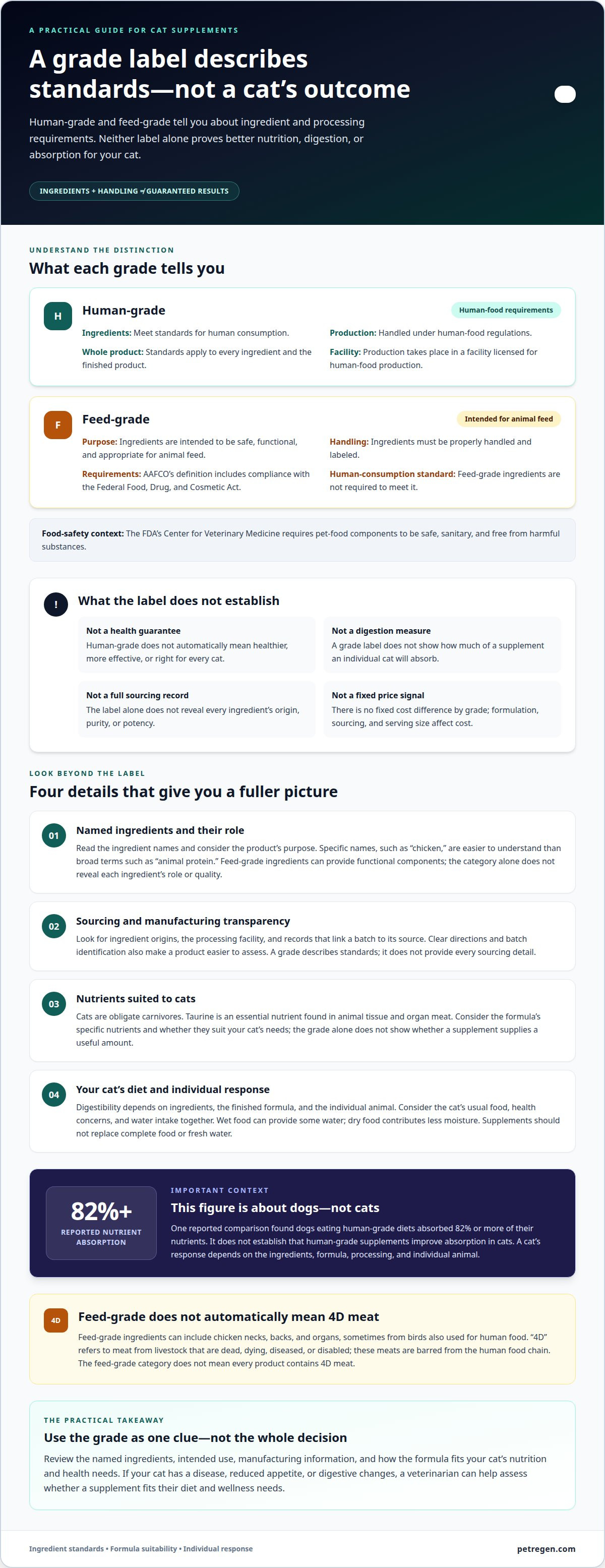
The human grade vs feed grade pet supplements comparison describes ingredient and processing standards, not guaranteed health outcomes. Human-grade labeling alone does not tell you whether a supplement is the right choice for your cat. AAFCO defines feed-grade ingredients as safe, functional, appropriate for animal feed, properly handled and labeled, and compliant with the Federal Food, Drug, and Cosmetic Act. The FDA’s Center for Veterinary Medicine requires pet-food components to be safe, sanitary, and free from harmful substances.
Human-Grade Production Standards
Human-grade production means ingredients and manufacturing meet human-food requirements. AAFCO’s standard requires every ingredient and the finished product to be handled under federal human-food regulations. Production must take place in a facility licensed for human-food production. These standards apply to the complete product and process, not just one ingredient. They describe handling conditions, not proof of better results for every cat.
Feed-Grade Ingredient Tradeoffs
Feed-grade ingredients are intended for animal feed and can provide functional components in a supplement formula. They aren’t required to meet human-consumption standards. With human grade vs feed grade pet supplements, the category alone doesn’t reveal each ingredient’s role or quality. Read the ingredient names and consider the product’s purpose, rather than assuming feed-grade means unsafe or human-grade means more effective.
Sourcing and Manufacturing Transparency
Transparency means a brand can explain where its ingredients come from and how its product is made. Useful details include ingredient origins, the processing facility, and records linking a batch to its source. A grade label describes standards, but doesn’t reveal every sourcing detail or establish purity and potency. Specific ingredient names, such as chicken rather than a broad animal-protein term, make a formula easier to understand.
Feed-Grade Ingredients and 4D Meats
Feed-grade ingredients can include chicken necks, backs, and organs, which may come from birds also used for human food. The feed-grade category doesn’t mean every product contains 4D meat. “4D” describes meat from livestock that are dead, dying, diseased, or disabled; these meats are barred from the human food chain. That distinction helps clarify what the grade label does, and doesn’t, tell you.
Digestibility and nutrient absorption
A human-grade label doesn’t tell you how much of a supplement a cat absorbs. Digestibility depends on the ingredients, the finished formula, and the individual animal. Cats are obligate carnivores, and taurine is an essential nutrient found in animal tissue and organ meat. Ingredient composition matters, but a supplement’s grade alone can’t show whether it supplies a useful amount or suits a cat’s needs.
One reported comparison found dogs eating human-grade diets absorbed 82% or more of their nutrients. That figure concerns dogs, not cats, and doesn’t establish that human-grade supplements improve feline absorption. A powder’s composition and how it’s processed can affect its digestibility; the label’s manufacturing standard doesn’t measure a cat’s response. Nutritional value also depends on whether ingredients provide nutrients cats need, rather than simply sounding familiar to people.
Hydration matters alongside food and supplements. Cats may get some water from wet food, while dry food contributes less moisture, so overall water intake depends partly on diet. A supplement shouldn’t replace complete food or fresh water. If a cat has a disease, reduced appetite, or digestive changes, a veterinarian can help assess whether a supplement fits their diet and wellness needs.
Use labels to understand ingredients, serving directions, and intended use, not as a promise of absorption. A practical approach is to consider the cat’s usual food, the supplement’s specific nutrients, and any health concerns together. Facility standards and food-safety regulations address how products are made; they don’t demonstrate that every cat will digest every formula equally. For broader whole-body wellness support for pets, consider how a supplement fits alongside your cat’s established nutrition.
What Does “Human-Grade” Mean in Pet Nutrition?
For pet supplements, “human-grade” describes ingredient and production standards, not a guaranteed health benefit. The label helps frame a product’s claims, but the ingredients and documentation still matter.
There’s no fixed cost difference between human-grade and feed-grade supplements. Formulation, sourcing, and serving size affect a product’s cost; the grade label alone doesn’t determine its value.
Human-grade means ingredients meet human-consumption standards and production follows human-food requirements. Good manufacturing practices for human-edible foods are specified in 21 CFR 117, according to the Electronic Code of Federal Regulations.
Identifying Products and Red Flags
To assess a human-grade claim, look for clear ingredient names and details about sourcing and manufacturing. The designation applies to the entire product, so its ingredients and production must meet the standard. A vague ingredient list, unclear directions, or missing batch identification makes it harder to understand what’s in a supplement. Clear labeling helps you evaluate its intended use and composition.
Human-Grade and Natural Claims
“Natural” and “human-grade” describe different things: natural refers to ingredient characteristics, while human-grade concerns suitability and handling for human food. Neither term alone proves that a formula is complete, more effective, or right for a particular cat. Treat broad claims as prompts to examine the named ingredients, purpose, and manufacturing information, not as substitutes for those details.
AAFCO describes animal-food by-products as secondary products made alongside a principal product. Rendered meals and broad terms such as “animal by-product meal” can obscure the specific source; a named protein, such as chicken, is more informative. A by-product term alone doesn’t establish that a supplement is unsafe or unsuitable.
For safer supplement decisions, review the ingredient list, serving directions, and batch number, then discuss the product’s purpose with your veterinarian. Share your cat’s current diet and any health concerns, including disease or ongoing treatment. This gives the veterinarian useful context to consider the supplement alongside your cat’s overall nutrition.
Human-food versus feed-grade processing requirements
Processing standards distinguish human-food handling from production intended for animal feed. That difference clarifies what a grade label says about manufacturing, and what it doesn’t establish.
Processing Requirements
Human-grade processing means ingredients and the finished product are handled under federal human-food regulations. Production must take place in a facility licensed for human-food production. The standard covers the full process, not just one ingredient. By contrast, feed-grade pet-food components must meet animal-food safety requirements rather than human-food handling standards.
Manufacturing and Inspection
Human-grade pet products are prepared in facilities inspected by the FDA or another relevant food-safety authority. Food inspection responsibilities can depend on the type of product and the standards that apply. Feed-grade products are made for animal consumption, with safety rules focused on their intended use. These differences help explain manufacturing and inspection, but a facility’s type alone doesn’t prove a formula is nutritionally superior.
In 2024, the FDA’s Center for Veterinary Medicine required pet-food components to be safe, made under sanitary conditions, and free from harmful substances. Those requirements speak to component safety and cleanliness. They don’t mean feed-grade manufacturing follows human-food standards. Pet parents benefit from understanding which standard a product’s claims describe, rather than treating “human-grade” as a guarantee of effectiveness.
The USDA uses “edible” for food legally fit for people to eat. Food intended for people must remain in the human-food chain and comply with FDA guidelines. This helps explain why human-food and animal-feed pathways differ. A supplement’s processing claim should clarify whether its ingredients and production meet human-food requirements, rather than suggesting that one ingredient’s origin determines the whole product’s grade.
Transparency is useful when brands explain ingredient sourcing, facility standards, and handling practices. A clear explanation helps consumers distinguish a human-food production claim from a general safety statement for animal products. The practical takeaway: grade describes a standard, while ingredient quality and the finished formula need separate consideration.
PetREGEN: PetREGEN Stem Cell Activator Supplement
PetREGEN Stem Cell Activator Supplement supports pets’ natural regenerative function by enhancing immune function. For cat owners considering a supplement to support healthy aging, mobility, or recovery, it offers a whole-body approach rather than targeting a single symptom.
Its formula uses USA-made, human-grade ingredients, including collagen, real liver, and phytonutrients. It is also formulated with amino acids and omega 7. These ingredients are part of a supplement, not pet food or veterinary treatment, and the human-grade designation describes ingredient and manufacturing standards rather than a guaranteed result for every cat.
Review the ingredients and intended use with your veterinarian, especially if your cat has a health condition or takes other products. For questions about PetREGEN Stem Cell Activator Supplement, contact PetREGEN.
Choose the Next Step That Fits Your Cat
Guide your cat’s supplement choice with a practical question: does the product’s purpose match your companion’s needs and your priorities for ingredient sourcing and production? The human grade vs feed grade pet supplements decision is one part of that judgment, not a substitute for considering your cat’s diet, health, and response over time.
If you’re considering a supplement to support your cat’s wellness, discuss its intended use with your veterinarian and consider how it fits into your pet’s care. PetREGEN offers PetREGEN Stem Cell Activator Supplement for pet owners seeking natural support for their companion’s regenerative function.
Contact PetREGEN with your questions about the supplement and whether it aligns with your goals for your cat. Thoughtful choices can help you feel more confident as you support the wellbeing of a much-loved companion.
Frequently Asked Questions
Can Human-Grade Apply to Supplements Too?
Yes, human-grade claims can apply to pet supplements, not only pet food. For a powder, the claim concerns its ingredients and production, while the directions identify it as an animal supplement. Human-grade doesn’t mean the product is made for people to take, nor does the label establish that a supplement delivers a specific health effect for your cat. Check that the product’s intended animal use is clear.
What Does Feed Grade Mean for Pet Supplements?
Feed grade identifies ingredients intended and evaluated for use in animal feed; it doesn’t mean every formula is low quality. A supplement may use a specific ingredient or a less descriptive blend, so consider the ingredient statement and intended purpose together. The grade distinguishes animal-feed standards from human-food standards, but doesn’t guarantee how an individual cat will respond.
What Quality Testing and Certifications Should Buyers Look for in Pet Supplements?
Look for clear batch identification, serving directions, and information about testing for contaminants such as heavy metals and bacteria. A brand’s documentation should connect testing to the product or batch, rather than relying only on broad quality claims. A certification or human-grade claim doesn’t replace details about purity and potency, and doesn’t establish that a supplement suits every cat.
How Do Ingredient Sourcing and Labeling Differ Between Human-Grade and Feed-Grade Supplements?
Human-grade claims refer to human-food standards, while feed-grade labels describe ingredients intended for animal feed. For either type, look for sourcing details that identify an ingredient’s origin and production facility. Batch records can help link a finished product to its source. A grade label alone may not explain where each ingredient came from or how its supplier was assessed.
What Risks Can Come From Contaminants, Inaccurate Dosing, or Poor-Quality Pet Supplements?
Contaminants can introduce unwanted substances, while unclear directions make accurate serving difficult. Poor-quality products may also fail to match their stated composition. This product is intended for supplemental use only. It is not intended to diagnose, treat, cure, or prevent any disease. If your pet has a medical condition or is on medication, consult your veterinarian before use.


