

A human supplement from a health food store or pharmacy isn’t automatically suitable for a cat. Supplements for cats with stiff joints should be formulated for cats, and evidence that glucosamine and chondroitin provide definite benefits remains limited. If your cat hesitates to jump, plays less, or overgrooms their hips and legs, have a veterinarian assess these changes before choosing a supplement.
It’s understandable to hope joint support could help your cat move more comfortably. This guide explains what glucosamine and chondroitin may do, what the evidence says about supplements, and why a cat-specific formula matters. You’ll also learn how other ingredients are used in joint-support products and what to consider when choosing one, so you can make a more informed decision.
Key Takeaways
- Glucosamine and chondroitin may offer joint support, but evidence of definite benefits is limited; ingredient choice matters.
- Have a veterinarian assess signs of joint pain before starting a supplement, and consider how it fits into your cat’s broader care plan.
- Human supplements aren’t automatically suitable for cats. Learn what to consider in cat-specific products and joint-support diets.
- See how PetREGEN Stem Cell Activator Supplement may fit into a whole-body approach to supporting mobility and healthy aging.
Glucosamine and chondroitin
Glucosamine, chondroitin, and omega-3 fatty acids appear in joint-support formulas for cats. Their roles differ, and evidence for supplements varies by ingredient.
Glucosamine for Cartilage Support
Glucosamine is used to support cartilage, the tissue that cushions the ends of bones. It may improve activity levels in some cats, but research hasn’t established definite benefits from glucosamine supplements. When comparing products, check the ingredients and whether the formula is designed for cats. A supplement can’t determine why your cat’s movement has changed.
Combining Joint-Support Ingredients
Some formulas combine glucosamine with omega-3 fatty acids, chondroitin, MSM, hyaluronic acid, or green-lipped mussel. These ingredients have different roles, so a longer ingredient list alone doesn’t show how well a product may suit a cat. Check the label for each ingredient, then discuss the combination with your veterinarian, especially if your cat takes medication.
Chondroitin sulfate helps cartilage retain water and absorb shock. Low-molecular-weight chondroitin may help some cats, although evidence of definite benefits remains limited. Check whether the label identifies chondroitin sulfate and its form. These details help you compare ingredients rather than treating all joint supplements as interchangeable.
Green-lipped mussel naturally contains glucosamine, chondroitin, omega-3s, ETA, glycosaminoglycans, and other nutrients. Studies have found reduced orthopedic pain with its use. It can therefore contribute several joint-support nutrients in one ingredient, but it doesn’t make every product equivalent. Look at the full formula and the amount and form of each listed ingredient.
Joint stiffness can have causes beyond cartilage wear. For example, immune-mediated arthritis occurs when the immune system inflames joints and damages cartilage and underlying bone. That’s why ingredient choices should follow an assessment of your cat’s symptoms, not replace attention to the cause.
Do joint supplements for cats really work?
Joint supplements may support some cats, but they aren’t a stand-alone answer to stiffness. Supplements for cats with stiff joints are one possible part of a broader care plan, not a way to diagnose the cause. A veterinary evaluation can help identify what may be affecting your cat’s mobility and whether a supplement fits.
Veterinary-Strength Joint Formulas
The phrase “veterinary-strength” doesn’t explain a formula’s ingredients or evidence. Look for a product made specifically for cats, whose dietary and metabolic needs differ from those of other animals. Nutraceuticals aren’t tested and regulated to the same extent as pharmaceuticals, so assess the label rather than relying on a strength claim.
A veterinarian can assess your cat’s symptoms and consider whether a supplement belongs alongside other therapies or lifestyle changes. Share the full ingredient list and your cat’s current medications with the clinic team. When comparing supplements for cats with stiff joints, this information helps focus the discussion on the formula and your cat’s needs.
Risks, Side Effects, and Interactions
Joint supplements can harm cats or interact with their medications, so consult a veterinarian before starting one. If your cat has an existing health condition, an ingredient review can help assess whether a formula suits their care. Don’t assume a product labeled natural is automatically appropriate for every cat.
There isn’t one joint supplement that works for every cat, and noticeable effects may take several weeks. Track changes in activities such as jumping, playing, or moving between resting spots. This record can help you and your veterinarian assess whether the supplement suits your cat.
Joint care also involves everyday habits. Regular, appropriate exercise and maintaining a healthy weight support joint health, while excess weight can add strain. Routine veterinary check-ups help monitor mobility and overall health, so you can discuss changes as part of an ongoing care plan.
Can I get nutraceuticals/supplements for my cat at my health food store or pharmacy?
When shopping at a health food store or pharmacy, choose a supplement formulated specifically for cats. A human product or an oil from the pantry isn’t automatically appropriate for feline needs.
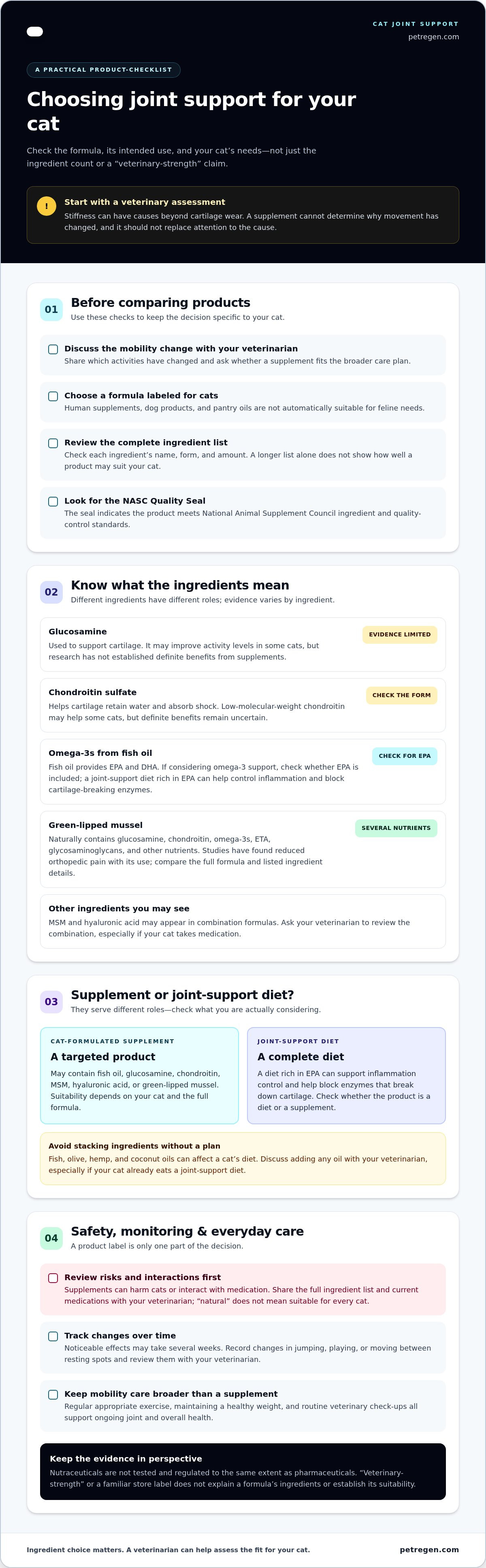
For joint support, fish oil provides the omega-3 fatty acids EPA and DHA. A joint-support diet rich in EPA can help control inflammation and block enzymes that break down cartilage. Check whether a product is a cat-formulated supplement or a complete diet, since they serve different roles.
Which supplements may help cats with stiff joints? Cat formulas may contain fish oil, glucosamine, chondroitin, MSM, hyaluronic acid, or green-lipped mussel. The best fit depends on your cat’s needs and the full ingredient list, not simply the number of ingredients.
Use these practical checks when comparing products:
- Choose a formula labeled for cats, not a human or dog product.
- Review whether EPA is included if you’re considering omega-3 support.
- Look for the NASC Quality Seal, which indicates the product meets the National Animal Supplement Council’s ingredient and quality-control standards.
Oils such as fish, olive, hemp, and coconut oil can affect a cat’s diet. Discuss adding any oil with your veterinarian first, especially if your cat already eats a joint-support diet. This helps you avoid layering ingredients without considering the overall feeding plan.
Joint discomfort can affect movement, but a supplement shouldn’t be treated as a targeted fix for weak hind legs. If your cat struggles to rise, jump, or walk steadily, note which activities have changed and share those examples with the veterinarian. This context can guide an evaluation and broader mobility plan.
Review the product’s testing and label details before choosing. Nutraceuticals don’t undergo testing and regulation to the same extent as pharmaceuticals, so a familiar store or appealing label alone doesn’t establish suitability. Keep the package handy when discussing ingredients with your veterinarian.
Joint supplements for cats with arthritis
Feline arthritis can cause joint pain, swelling, and stiffness. Over time, damage to cartilage and soft tissues may make everyday activities, such as climbing onto a favorite chair, uncomfortable. Changes in jumping or grooming habits can signal a mobility problem, but a veterinarian should assess suspected arthritis.
For a cat with arthritis, joint health involves more than choosing a supplement. A veterinarian can consider the pattern of discomfort, your cat’s overall health, and whether a supplement belongs alongside other therapies or lifestyle adjustments. Supplements may support care, but they don’t diagnose the cause of pain or replace an arthritis assessment.
Ingredients used in feline joint supplements include fish oil, glucosamine, chondroitin, MSM, and hyaluronic acid. Fish oil provides omega-3 fatty acids, while hyaluronic acid is part of joint fluid and helps lubricate joints. MSM supplies sulfur, which plays a role in connective tissue formation. These ingredients have different functions, so compare labels rather than treating them as interchangeable.
Supplements also come in different forms. Capsules, powders, liquids, and chewables can make a difference for a cat that refuses medication mixed into food. Choose a cat-formulated product and consider whether its format fits your cat’s routine. Your veterinarian can review the ingredients and how a supplement fits into your cat’s existing care.
Alongside any supplement plan, focus on daily habits that support comfortable movement:
- Keep your cat at a healthy weight to reduce repeated stress on joints.
- Encourage regular, gentle activity suited to your cat’s mobility.
- Notice specific changes, such as avoiding stairs or stopping play, and share them during veterinary visits.
For broader wellness support, explore PetREGEN Stem Cell Activator Supplement. It supports the body’s natural regenerative function and immune function, promoting mobility, recovery, and healthy aging. It isn’t arthritis treatment, so discuss its place in your cat’s care with your veterinarian.
PetREGEN: PetREGEN Stem Cell Activator Supplement
PetREGEN Stem Cell Activator Supplement supports the body’s natural regenerative function by enhancing immune function. For cat owners considering broader wellness support alongside joint-care decisions, it offers a whole-body approach, not a product positioned as arthritis treatment.
The formula uses human-grade ingredients, including collagen, amino acids, omega 7, and phytonutrients, to support healthy aging and recovery. Its multi-system approach is designed to clean, nourish, and support pets, with mobility and vitality among its intended areas of support. Discuss adding any supplement with your veterinarian, particularly if your cat has a health condition or takes medication.
To learn more about PetREGEN Stem Cell Activator Supplement, contact PetREGEN.
Take the next step toward easier movement
Your cat’s comfort is part of everyday life: the familiar leap to a favorite perch, a stretch after a nap, or an invitation to play. Let these routines guide your next conversation about care. Note what you hope to support, what changes you’ve noticed, and what matters most for your companion’s quality of life. This gives you a thoughtful starting point when weighing supplements for cats with stiff joints alongside your cat’s wider wellness needs.
PetREGEN Stem Cell Activator Supplement supports the body’s natural regenerative function. It may be worth exploring if you’re looking beyond a single joint-focused ingredient and considering support for healthy aging and mobility. Keep your cat’s individual needs at the center of the decision, and choose an informed next step that feels right for your companion.
Contact PetREGEN about your cat to learn more about the supplement. A little thoughtful support can help you keep moving forward together.
Frequently Asked Questions
What causes OA in cats?
Osteoarthritis develops as joint cartilage and surrounding soft tissues deteriorate, leading to discomfort and reduced activity. Excess body weight raises risk by repeatedly loading the joints, while body fat also has inflammatory effects. A cat that stops jumping onto a familiar surface may be showing a change in mobility, but that behavior alone doesn’t identify the cause.
Is there evidence that glucosamine and chondroitin help cats with arthritis?
Evidence of definite benefits from glucosamine and chondroitin supplements in cats remains limited. Low-molecular-weight chondroitin may help some cats, but that doesn’t establish a benefit for every ingredient form or product. When comparing labels, note the specific type of chondroitin and discuss how it fits your cat’s arthritis care rather than relying on a broad joint-support claim.
Do omega-3 fish oil supplements reduce joint pain in cats, and what dose is safe?
Fish oil contains EPA and DHA, and EPA-rich joint-support diets can help control inflammation and block enzymes that break down cartilage. A safe amount depends on the product’s EPA and DHA concentration, your cat’s existing diet, health, and medications. Ask your veterinarian for a cat-specific dosing recommendation rather than estimating from a human supplement label.
Are green-lipped mussel, UC-II, or other joint supplements effective for cats?
Green-lipped mussel has been studied for orthopedic pain and supplies several nutrients, including omega-3s and glycosaminoglycans. Other ingredients have different roles: hyaluronic acid helps lubricate joints, while MSM supplies sulfur used in connective tissue formation. Don’t assume evidence for one ingredient proves another, such as UC-II, works the same way in cats; review its feline evidence and formula with your veterinarian.
How can I choose a safe, high-quality joint supplement for my cat?
Choose a product labeled specifically for cats, and assess its ingredients, format, and quality indicators together. For example, a powder mixed with food may suit a cat that refuses capsules, while a selective eater may need another format. The NASC Quality Seal indicates ingredient and quality-control standards. Don’t combine products without reviewing their ingredients with your veterinarian.
When should a cat with stiff joints see a veterinarian instead of trying supplements?
Arrange a veterinary evaluation if you notice joint pain, swelling, fever, lethargy, or loss of appetite. These signs need assessment, not a supplement trial. A veterinarian can also investigate changes such as refusing to jump or moving less, since these behaviors may reflect joint disease or another problem. Seek advice before adding a supplement, especially if your cat takes medication.


