

A label can look reassuring while hiding a key detail: how much of each active ingredient your pet receives. A proprietary blend isn’t automatically harmful, but if it lists only a combined amount, you can’t tell how much of each ingredient is in a serving. That’s one of the red flags to look for in pet supplements, along with unusually high vitamin or mineral levels and claims that sound like a cure.
It’s understandable to want a supplement that feels safe and may support your companion’s well-being. In the United States, the FDA generally doesn’t require supplement makers to prove their products are safe or effective before sale, so clear labeling matters. This guide explains how to assess blends, recognize risky claims, and evaluate nutrient amounts. You’ll also learn when to seek veterinary guidance, especially if your pet takes prescription medication or receives multiple supplements. A careful label review can help you make a more informed choice for your pet.
Key Takeaways
- Look for labels that identify active ingredients and their individual amounts, rather than relying on a blend’s total weight alone.
- Treat cure promises and broad claims like “all natural” or “vet approved” as reasons to examine the label more carefully.
- Consider how a supplement’s vitamins and minerals add to your pet’s complete diet, since high levels can be a concern.
- Talk with your veterinarian before adding a supplement if your pet takes prescription medication or already uses other supplements.
1. Are proprietary blends bad in pet supplements?
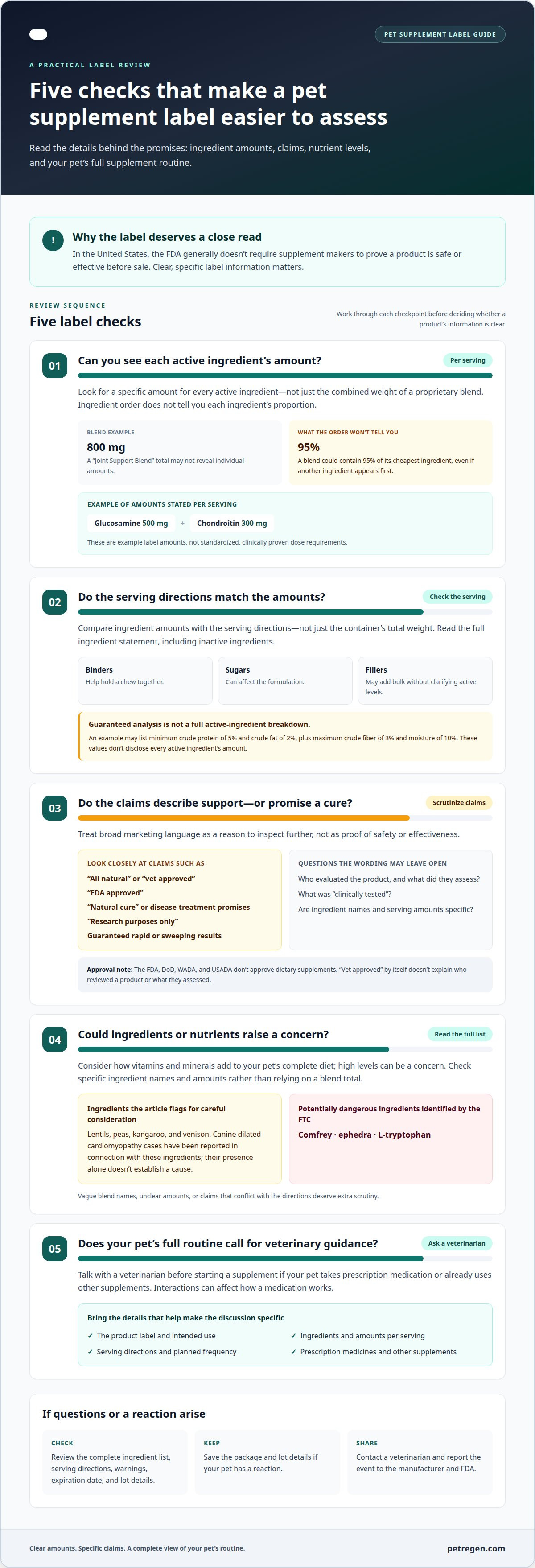
A proprietary blend isn’t automatically unsafe, but it can hide useful details. For example, a label might show an 800 mg Joint Support Blend without listing each ingredient’s amount. A blend could contain 95% of its cheapest ingredient, even if another ingredient appears first. Ingredient order doesn’t reveal the proportion of each component. Look for amounts per serving for every active ingredient.
Compare those amounts with the serving directions, not just the container’s total weight. A label might list 500 mg of glucosamine and 300 mg of chondroitin per serving. Those figures tell you what the product promises to provide, but there’s no standardized, clinically proven dose requirement for supplements. A guaranteed analysis may show minimum crude protein of 5% and crude fat of 2%, plus maximum crude fiber of 3% and moisture of 10%. Those values don’t disclose every active ingredient’s amount.
Read the full ingredient statement, including inactive ingredients. Binders help hold a chew together, sugars can affect its formulation, and fillers may add bulk without clarifying active ingredient levels. Lentils, peas, kangaroo, and venison deserve careful consideration because cases of canine dilated cardiomyopathy have been reported in connection with these ingredients. Their presence alone doesn’t establish a cause. The Federal Trade Commission identifies comfrey, ephedra, and L-tryptophan among potentially dangerous supplement ingredients.
To spot hidden ingredients or unsafe amounts, compare the complete ingredient list and per-serving amounts with the directions. Avoid vague blend names and cure promises. Claims such as “research use only” or “natural cure” can signal unapproved ingredients or substances missing from the Supplement Facts panel. To check for potentially harmful ingredients, consult the FDA’s Tainted Supplements page. For recalls, review FDA recall notices. If your pet has a reaction, save the package and lot details, contact a veterinarian, and report the event to the manufacturer and FDA.
2. What are common red flags I should avoid on pet supplement labels?
“Vet approved” sounds reassuring, but the phrase alone doesn’t say which veterinarian reviewed the product or what they assessed. “All natural” also doesn’t establish that ingredients are safe, effective, or suitable for your pet. Treat both as marketing language, not proof. Red flags to look for in pet supplements include vague endorsements that don’t explain who evaluated the product or how.
In the United States, the U.S. Food and Drug Administration generally doesn’t require dietary supplement makers to prove safety or effectiveness before sale. Be wary of labels promising to cure, treat, or prevent a disease, such as arthritis or cancer. Supplements may support health, but cure claims suggest a product is intended to act like a drug. Promises to prevent unrelated diseases or deliver rapid results are also warning signs.
Some red flags to look for in pet supplements are claims that a product is “FDA approved.” The FDA, DoD, WADA, and USADA don’t approve dietary supplements. Phrases such as “natural cure,” “alternative to an FDA-approved drug,” or “for research purposes only” may signal unapproved ingredients, drug analogs, or substances omitted from the Supplement Facts panel. Be cautious of sweeping performance claims, such as guaranteed improvements in cognition, strength, or stamina, without clear supporting evidence. “Clinically tested” should say what was tested, not imply a proven benefit for every pet.
To assess a label, read the full ingredient statement, serving directions, warnings, and expiration date. Confirm that the intended animal and serving amount match your pet, and look for specific ingredient names rather than broad promises. Note the manufacturer and lot details, which can help identify a product if questions arise. Misspellings, foreign-language text on an otherwise English label, or claims that contradict the directions deserve extra scrutiny. A polished design can’t replace specific, understandable information.
3. Consulting a physician before using high-risk supplements
Some supplements need a closer safety discussion before anyone takes them. For people, bodybuilding, weight-loss, and sexual-enhancement supplements are identified as high-risk categories. Consult a physician before considering them, especially if you use prescription medication or manage an ongoing health condition. A “natural” label or independent testing doesn’t establish that a supplement suits your personal health needs.
Bring the product label, serving directions, and a list of medications and other supplements to your physician. Include the exact ingredients, amounts, and how often you plan to take the product. This gives the physician concrete information to assess possible interactions. Supplements can contain ingredients that interfere with medications and prevent those drugs from protecting health as intended.
For pets, the right professional is a veterinarian, not a human physician. Seek veterinary guidance before starting a supplement if your dog, cat, or horse takes prescription medication. Do the same before giving your pet multiple supplements. A veterinarian can consider the animal’s medications, existing supplements, and health needs together.
Side effects depend on the ingredients and the individual taking them. Interactions can change how a medication works, including preventing it from doing its job. For pets, ask a veterinarian about risks alongside the animal’s prescription medicines.
Make the conversation specific: identify the product, its intended use, and the amount listed per serving. Mention when you plan to start it and whether another supplement is part of the same routine. If an adverse reaction appears after starting a product, contact your veterinarian or physician and share the label and timing details. Keep the container available, since its ingredient statement can help guide next steps.
Independent testing may assess whether ingredients match label claims, but it doesn’t answer every question about interactions for a particular person or pet. A physician or veterinarian can weigh the listed ingredients against medications and existing health concerns. That review is especially useful when a product promises rapid results or targets several unrelated conditions.
4. Excessive vitamin and mineral levels
A supplement can add nutrients your pet already gets from a complete diet. Compare the formula’s vitamin and mineral amounts with the food label, then consider every other supplement given each day. The total matters more than any one product viewed alone. For example, a multivitamin combined with fortified food can raise daily intake beyond what either label suggests on its own.
Read the serving directions alongside the nutrient analysis. Note the amount per chew, scoop, or measured serving, then check how many servings match your pet’s weight. Don’t assume a larger dose will improve mobility or energy. A serving designed for a larger animal may deliver a different amount per pound to a smaller pet. Follow the stated directions rather than adjusting the amount by guesswork.
AAFCO sets pet nutrition standards based on current scientific research. For dog food, a “complete and balanced” label and nutritional adequacy statement help identify food formulated to meet nutritional needs. That statement concerns the food’s nutritional adequacy; it doesn’t prove that adding extra vitamins or minerals is beneficial. Supplements don’t replace a healthy diet, regular exercise, or medical drugs.
Watch for ingredients that overlap across products. If a joint chew, skin supplement, and multivitamin all list the same mineral, record each serving’s amount and frequency. Include the pet’s regular food in that review. Keep package labels together, since units and serving sizes can differ between formulas. If an amount is unclear or several products overlap, consult a veterinarian with the labels and your pet’s weight. The veterinarian can consider the full diet, intended use, and existing medications before advising on changes.
Before adding a product, identify each listed vitamin and mineral, note its amount per serving, and add up servings from all daily sources. Then compare the overall pattern with the feeding directions and your pet’s usual food. A strikingly high amount, unclear units, or repeated nutrients deserves a closer review, not an assumption that “more” means better support.
PetREGEN: PetREGEN Stem Cell Activator Supplement
PetREGEN Stem Cell Activator Supplement is a nutritional option for pet parents seeking support for mobility, recovery, and healthy aging. Formulated for dogs, cats, and horses, it supports the body’s natural regenerative function by enhancing immune function.
The formula uses human-grade ingredients, including amino acids, omega 7, collagen, real liver, and phytonutrients. Consider it when you’re looking for broad wellness support rather than a product intended to diagnose or treat disease. If your pet takes prescription medication or already receives supplements, discuss any addition with your veterinarian first. Share the label and serving directions so they can consider the full routine alongside your pet’s needs.
For a closer look at whether it fits your companion’s wellness goals, contact PetREGEN.
Make label reading part of your pet’s care routine
Choosing a supplement is one part of supporting a pet’s well-being. Make each new addition deliberate: keep the label, note when you introduce it, and watch for changes in your companion’s routine. That record can help you and your veterinarian make informed decisions over time, especially as your pet’s diet or medications change.
Keeping the red flags to look for in pet supplements in mind can help you assess new products carefully while focusing on what your pet needs. If you’re considering support for mobility, recovery, or healthy aging, explore how PetREGEN may fit your pet’s wellness goals.
For questions about PetREGEN Stem Cell Activator Supplement, contact PetREGEN. Thoughtful choices can help you keep moving forward with care for the companion you love.
Frequently Asked Questions
Are proprietary blends bad in pet supplements?
Not necessarily, but proprietary blends make it harder to judge what each serving contains. A blend’s total weight may be clear while the amount of each active ingredient remains undisclosed, limiting meaningful comparisons between products. If you’re considering a blend, look for separately stated ingredient amounts and serving directions. A blend name alone doesn’t tell you how much of each component your pet receives.
How can I tell if a pet supplement has been third-party tested?
Look for a named independent testing or certification program, then find out what its seal covers. The National Animal Supplement Council (NASC) quality program addresses manufacturing practices, adverse event reporting, and label accuracy. A seal can indicate an audit or testing process, but it doesn’t prove a supplement will benefit every pet. Note the certifier’s name and the specific quality checks described on the label or packaging.
How do I choose a good supplement for my dog?
Start with your dog’s intended need, then consider the full daily diet and any medications. Choose a label that clearly identifies the ingredients, serving directions, and intended animal. For food, rather than a supplement, look for a “complete and balanced” statement and an AAFCO nutritional adequacy statement. Ask your veterinarian to review a supplement if your dog has a medical condition or takes prescription medication.
What are common red flags I should avoid on pet supplement labels?
Be cautious of claims to cure or prevent disease, promises of rapid results, or claims of FDA approval. “Vet approved” and “all natural” don’t explain what was reviewed or establish effectiveness. Also watch for unclear ingredient amounts, misspellings, and “research use only” wording. The U.S. Food and Drug Administration generally doesn’t require supplement makers to prove safety or effectiveness before sale.
What does cGMP mean on a dog supplement?
cGMP means Current Good Manufacturing Practice. It refers to manufacturing controls intended to support product identity, purity, strength, and composition. Relevant controls can include cleanliness, written procedures, records, and consistent production between batches. A cGMP statement concerns how a supplement is made, not proof that it works for a specific condition or is suitable for every dog.
What ingredients in pet supplements may be harmful or toxic to dogs and cats?
Some ingredients can pose safety concerns, depending on the substance and the animal. The Federal Trade Commission identifies comfrey, chaparral, lobelia, germander, aristolochia, ephedra, and stimulant laxative ingredients among potentially dangerous supplement ingredients. This doesn’t mean every listed ingredient affects every pet the same way. Before giving your pet a product with an unfamiliar ingredient, share its label with your veterinarian, especially if your pet takes medication.


