

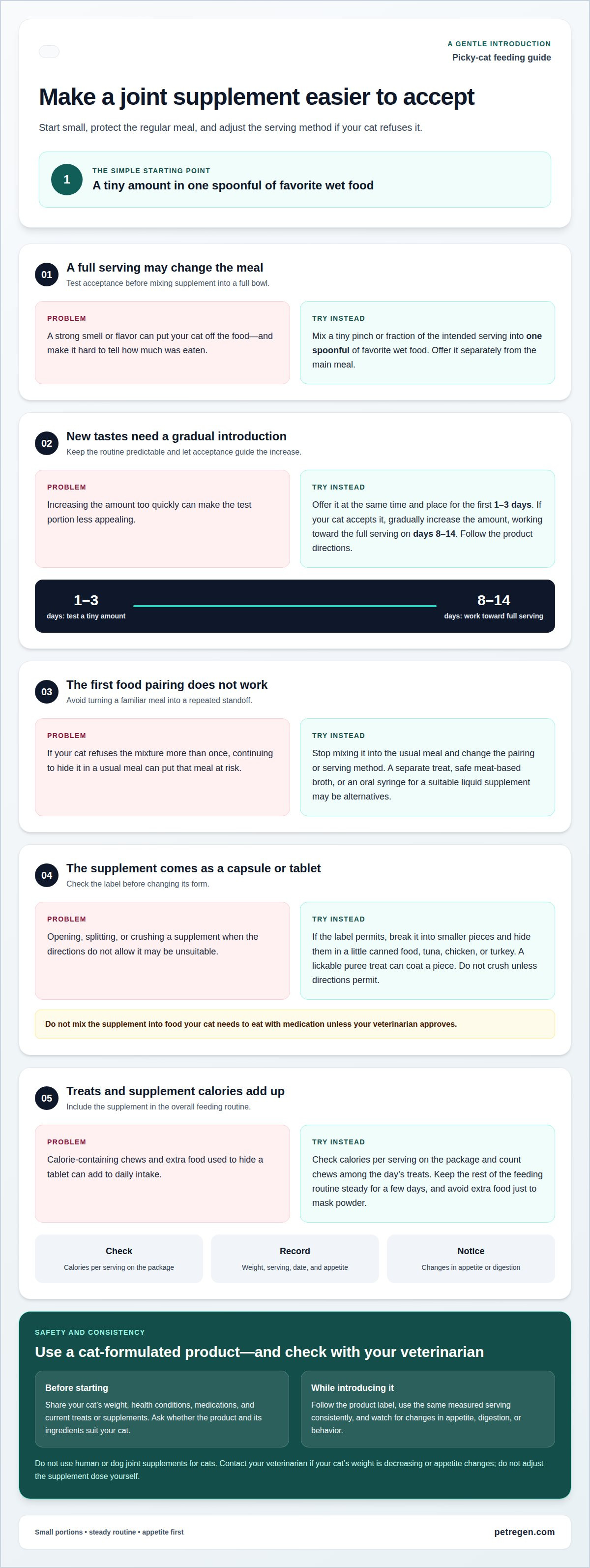
A tiny taste can be the first win. Learning how to give joint supplements to a picky cat starts with mixing a very small amount into a spoonful of favorite wet food, then offering it at the same time and place for the first 1-3 days. If your cat accepts it, gradually increase the amount, working toward the full serving on days 8-14.
It’s frustrating when a helpful routine turns mealtime into a standoff, especially when you want to support your cat’s comfort and mobility. This guide explains how to give joint supplements to a picky cat without putting regular meals at risk, choose a food pairing or format your cat may accept, and account for treats and calories. You’ll also learn what to do if your cat refuses the mixture and why patience and consistency matter.
Key Takeaways
- Choose a supplement form your cat can accept, and change the food pairing or format if the first approach puts them off.
- Use a small portion of strongly appealing wet food so you can tell whether your cat has eaten the full supplement serving.
- Include supplement treats in your cat’s overall food routine, keeping calories and weight in mind.
- Try practical alternatives such as a separate treat, a safe meat-based broth, or an oral syringe for suitable liquid supplements.
1. How do I give cat vitamins and supplements?
Start with your veterinarian, especially if stiffness, reduced mobility, or unusual behavior could signal an underlying medical issue. Share your cat’s weight, current medications, health conditions, and any treats or supplements they already receive. This helps your veterinarian assess whether a joint supplement may suit your cat and whether its ingredients could interact with treatment.
Choose a cat-formulated supplement and a delivery method your cat will accept. A powder can be mixed into a small portion of wet food, while a chewable may work for cats that enjoy treats. If your cat rejects one form, try another rather than repeatedly disguising the same supplement in a favorite meal. Introduce it gradually and give it consistently at the same time and place. Joint supplements may take many weeks to show effects, so steady use matters.
For safety, choose products intended for cats, not human or dog joint supplements. Cats can respond differently to ingredients, so ask your veterinarian to assess a product before use, particularly if your cat has health concerns or takes medication. In the United States, cat joint supplements do not require FDA approval for safety and efficacy. Species-specific labeling and veterinary guidance are therefore important considerations.
There’s no single price for every cat joint supplement in the United States. Cost varies with the format, ingredients, and number of labeled servings in a package. To compare value, look at the cost per serving at the dose listed for your cat, not just the package price. A product your cat consistently accepts may be more practical than one that goes unused.
Glucosamine and MSM are ingredients to discuss with your veterinarian when considering a feline joint supplement. Research on joint supplements in cats is still developing, and no ingredient guarantees a particular result. If you’re considering fish oil, choose a product labeled for cats; its EPA and DHA content is more informative than the total oil volume.
Yes, health conditions and possible interactions matter. Tell your veterinarian about every medication and supplement before adding another, since ingredients may affect a treatment plan or an existing condition. Follow the product label and watch for changes in appetite, digestion, or behavior after starting it.
2. Starting with a small amount mixed into wet food
Start with a tiny pinch or fraction of the intended serving mixed into one spoonful of your cat’s favorite wet food. Offer it at a consistent meal and see whether your cat finishes it. A small portion helps you tell whether the supplement changes the food’s smell or flavor without risking an entire meal.
Powdered supplements can be stirred into wet food, especially if the powder has little noticeable taste or odor. Mix it thoroughly into a moist bite rather than sprinkling it over a full bowl, where the scent may be more noticeable. If your cat readily eats the test portion, gradually increase the amount over several days, following the product’s directions for the full serving.
For a capsule or tablet, check the label before opening, splitting, or crushing it. If the instructions allow, break it into smaller pieces and hide them in a little canned food, tuna, chicken, or turkey. A lickable puree treat can also coat a piece and mask its taste. Don’t crush a supplement unless its directions permit it, and don’t mix it into food your cat needs to eat with medication unless your veterinarian approves.
Yes, a cat joint supplement may be mixed with wet food when its format and label allow. Powder is often practical in wet food; dry food or water may not mask the taste as well, and some forms aren’t intended to dissolve. Start with a small portion, separate from the main meal. If your cat refuses that food more than once, stop mixing the supplement into a usual meal and try another pairing or serving method. Protecting your cat’s appetite helps avoid food aversion and skipped meals.
Joint ingredients such as glucosamine, chondroitin, and omega-3s don’t determine whether a mixture will appeal to your cat; smell and texture matter too. If you’re considering a broader approach to your cat’s vitality, explore whole-body wellness support as a separate option.
3. Considering supplement calories and a cat’s weight
Joint supplements can add calories to your cat’s regular meals and treats. Check the package for calories per serving, then account for that amount when considering your cat’s daily food intake. A soft chew, for example, may contribute more calories than powder mixed into a small portion of wet food. The format matters, especially if you offer extra treats to help your cat accept the supplement.
There isn’t one joint supplement dose that applies to every cat by weight. Serving instructions vary by product and its ingredients, so follow the directions for that feline supplement rather than estimating from your cat’s weight or adapting a dog’s dose. Your veterinarian can help assess the label alongside your cat’s weight, diet, health, and other supplements.
When adding a new product, keep the rest of your cat’s feeding routine steady for a few days. This makes it easier to notice whether the supplement affects appetite or digestion. If it comes as a calorie-containing chew, count it among the day’s treats. For a powdered product, follow the labeled serving and avoid adding extra food just to mask its flavor.
Weight changes can be gradual, so record your cat’s weight and the amount of supplement given. A simple note of the date, serving, and appetite can help you spot a pattern instead of relying on memory. If your cat’s weight is increasing, review all extras, including joint chews, training treats, and food used to hide tablets. If weight is decreasing or appetite changes, contact your veterinarian to discuss possible causes rather than adjusting the supplement dose yourself.
Consistency can help you track how your cat responds, but a supplement shouldn’t replace a balanced diet or veterinary care. Keep the package directions handy and use the same measured serving each day. This makes it easier to track calorie contributions and mobility without changing several parts of your cat’s routine at once.
4. Ways to give a supplement to a picky cat
If you’re figuring out how to give joint supplements to a picky cat, change one part of your approach at a time. Try a different food pairing first, then consider another format if refusal continues. Your cat may reject an unfamiliar smell or texture. Pay attention to what may be prompting the refusal, and avoid turning every meal into a struggle.
Use a small amount of a favorite cat-friendly food to mask the supplement’s smell or taste. A spoonful of wet food or lickable puree can provide a tasty coating. Plain meat-based broth is another option, but choose one without onion or garlic. Offer the mixture separately before the main meal if adding it to dinner could put your cat off familiar food.
Some cats respond to scent. Sprinkle catnip or silvervine over supplement pieces, or pair the serving with a treat your cat already enjoys. Keep the portion small enough to finish completely, so you can tell whether the full serving was eaten. Some liquid products can be given with an oral syringe; follow the product label for that format.
Offer the supplement in the same place and around the same time each day. Your cat may need time and calm repetition to get used to the routine. Notice whether your cat continues eating regular meals comfortably. If refusal persists, switch the pairing or serving method instead of repeatedly hiding it in the same food. A steady routine is a practical way to give joint supplements to a picky cat without making every meal a test.
PetREGEN: PetREGEN Stem Cell Activator Supplement
PetREGEN Stem Cell Activator Supplement offers a broader wellness option for cat owners seeking support beyond a single joint ingredient. Formulated for cats, dogs, and horses, it supports the body’s natural regenerative function by enhancing immune function, which promotes mobility, recovery, and healthy aging.
Its formula uses USA-made, human-grade ingredients, including collagen, real liver, and phytonutrients. The supplement is designed to support whole-body wellness, rather than serve as a veterinary treatment or prescription medicine. If your cat already takes medication or another supplement, discuss additions with your veterinarian to account for health needs and possible interactions.
Consider this option when you’re exploring general support for your companion alongside a thoughtful feeding routine. For questions about PetREGEN Stem Cell Activator Supplement, contact PetREGEN.
Make the next step a calm one
Knowing how to give joint supplements to a picky cat is less about winning one meal and more about building a routine your companion can accept. Keep the experience gentle, and let your cat’s response guide how you serve the supplement. If eating becomes stressful or mobility changes concern you, pause and discuss your cat’s needs with a veterinarian. A supplement can be one part of a broader wellness plan, not a substitute for care tailored to your cat.
For a natural approach to supporting whole-body wellness, PetREGEN offers PetREGEN Stem Cell Activator Supplement. Consider whether it fits your cat’s needs and existing care routine, then take the next step at your pace.
Explore support for your cat’s wellness, and keep making thoughtful choices for a happier, more comfortable life together.
Frequently Asked Questions
How do I give cat vitamins and supplements?
Use only supplements formulated for cats, and follow the product label. Human multivitamins can contain ingredients unsafe for cats, including certain forms of vitamin D, iron, and alpha-lipoic acid. Before introducing a new supplement, tell your veterinarian what your cat already takes. Share the names of medications and supplements, along with any existing health concerns, so your veterinarian can assess possible interactions.
Does My Cat Need Joint Supplements?
Not every cat needs a joint supplement, and stiffness or reduced mobility deserves attention rather than guesswork. A veterinarian can assess changes such as hesitating before jumping, moving less, or seeming uncomfortable during normal activity. Research on joint supplements in cats is still developing, so recommendations depend on your cat’s signs, health, and current care. A supplement isn’t a substitute for finding the cause of a mobility change.
How can I get a picky cat to take vitamins?
Make the new routine low-pressure and predictable. Your cat may refuse something unfamiliar simply because it’s new, not because of its flavor. Offer a tiny taste beside a familiar meal, and let your cat approach voluntarily. If your cat avoids that food, don’t keep making the same meal a test. Preserve the familiar meal and try a different pairing or serving method.
How can I make a cat supplement taste better?
Use a small amount of a cat-safe flavor your pet already enjoys, such as lickable puree or a little plain meat-based broth. The broth must contain no onion or garlic. A cat’s nose strongly influences food acceptance, so changing the scent or texture may help. Introduce one adjustment at a time to see what your cat accepts.
How long does it take to see results?
Joint supplements are typically given consistently for four to six weeks before changes in mobility may be noticed. Keep a simple record of movement, such as whether your cat still jumps onto a familiar chair. If your cat’s mobility worsens, appetite changes, or the supplement causes digestive upset, contact your veterinarian rather than increasing the serving or adding another product.
Powder, paste, chew, or liquid?
Choose a format your cat accepts and that you can serve according to its label. Powder is easy to blend into a small portion of food; a chew may suit a cat that readily takes treats. Paste offers a different texture, while some liquids can be given with an oral syringe. If a format repeatedly leads to refusal, try another approach instead of risking your cat’s regular meals.


