

Holistic alternatives for dog joint care work best as part of a veterinary-guided plan, not as a substitute for diagnosis or pain management. A healthy body weight can reduce stress on joints, while avocado and soybean unsaponifiables (ASUs) and omega-3 fatty acids are nutritional options to discuss with your veterinarian. Arthritis can’t be cured, but supportive care may help manage symptoms and preserve mobility.
It’s hard to watch a beloved dog move stiffly or hesitate over everyday activities. Before trying holistic alternatives for dog joint care, including herbs or supplements, talk with your veterinarian. Joint pain can have different causes, and the right approach depends on your dog’s health and current treatment.
Here, you’ll learn how veterinary advice, weight management, ASUs, and omega-3s fit into joint care, along with practical considerations for discussing these options. The goal is a thoughtful, nourishing plan that supports your companion’s comfort and everyday movement.
Key Takeaways
- Have a veterinarian assess your dog’s joint symptoms and review supplements; according to the U.S. Food and Drug Administration, the 1994 Dietary Supplement and Health Act allows manufacturers to sell dietary supplements without FDA approval if they follow good manufacturing practices.
- Keep your dog at a healthy weight and active to help reduce unnecessary strain on their joints.
- Learn what avocado and soybean unsaponifiables are, and consider the limits of the dog study when weighing this option.
- Explore omega-3 sources such as fish oil and salmon, and see how PetREGEN Stem Cell Activator Supplement fits into a broader wellness approach.
1. Veterinary consultation before supplementation
Start with a veterinary assessment: signs of arthritis can resemble those of other medical conditions, so a diagnosis helps guide the plan. Holistic options, veterinary medications, and physical therapy serve different roles. Nutrition and supplements may support joint health, while medications address pain and rehabilitation focuses on movement and function. A veterinarian can coordinate these approaches, rather than treating a supplement as a replacement for care.
Before adding turmeric, boswellia, glucosamine, or another supplement, review your dog’s health conditions and current medicines with a veterinarian. Turmeric and boswellia are anti-inflammatory herbs; omega-3 fatty acids occur in krill, sardine, and flaxseed oils. Dogs with diabetes, kidney disease, or a low-potassium diet especially need veterinary guidance before glucosamine. Read the label for ingredients, amounts, directions, and warnings so the veterinarian can assess the specific product.
According to the U.S. Food and Drug Administration, the 1994 Dietary Supplement and Health Act allows manufacturers to sell dietary supplements without FDA approval if they follow good manufacturing practices. Dogs taking arthritis pain medication often need regular bloodwork to monitor liver and kidney values. Give the veterinarian the supplement label and medication list before combining them.
Acupuncture, hydrotherapy, and rehabilitation may complement a care plan. Acupuncture may help relieve pain through effects on nerves, circulation, muscle spasms, and endorphin release; benefits may begin after multiple visits. Massage may stimulate circulation, reduce stress effects, and ease muscle trigger points. In the United States, costs for these services vary with location, treatment type, visit length, and care plan. Glucosamine, chondroitin, and MSM may help preserve and nourish damaged cartilage; omega-3s support lubrication and mobility.
At home, add non-slip rugs on hardwood floors, ramps for beds or cars, and warm bedding that isn’t too hot. Don’t give your dog human pain relievers or use essential oils without veterinary direction. Arrange an assessment for joint pain or limping; sudden severe pain or an inability to stand calls for urgent veterinary care.
2. Weight management for joint health
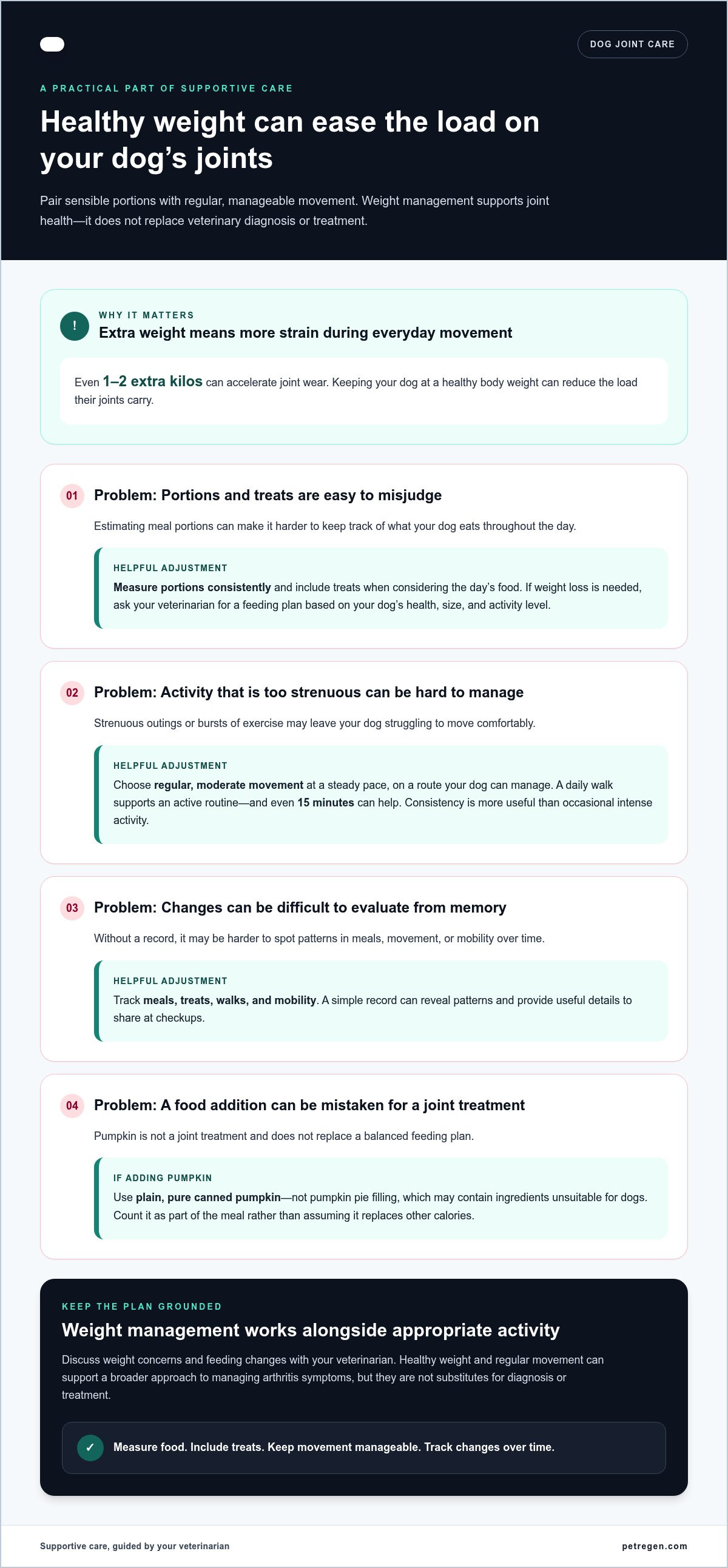
A healthy body weight can reduce the load a dog’s joints carry during everyday movement. Even 1-2 extra kilos can accelerate joint wear, making weight management one of the practical holistic alternatives for dog joint care. It works alongside appropriate activity, not as a replacement for diagnosis or treatment. Keeping your dog active and at a healthy weight supports a broader approach to managing arthritis symptoms.
Review your dog’s meals and daily routine. Measure portions consistently rather than estimating, and include treats when considering the day’s food. If your dog needs to lose weight, discuss a feeding plan with your veterinarian based on their health, size, and activity level. Make changes thoughtfully, then track meals, treats, walks, and mobility over time. A simple record can reveal patterns and provide useful details to share at checkups.
Regular, moderate movement helps keep activity part of the routine. A daily walk can support an active lifestyle, and even 15 minutes can help. Choose a steady pace and a route your dog can manage. Avoid strenuous outings or bursts of exercise that leave your companion struggling to move comfortably. Consistency is more useful than occasional intense activity, especially when you’re building habits to support joint health.
Pure canned pumpkin can be added to meals, but it isn’t a joint treatment or a substitute for a balanced feeding plan. Choose plain pumpkin, not pumpkin pie filling, which may contain ingredients unsuitable for dogs. Count pumpkin as part of the meal rather than assuming it replaces other calories. It may be one of several holistic alternatives for dog joint care, but it should complement sensible portions and regular activity, not replace them.
For additional nutritional support alongside healthy weight and activity habits, explore PetREGEN Stem Cell Activator Supplement, formulated to support healthy aging and mobility.
If you add pumpkin to your dog’s meals, use pure canned pumpkin, not pumpkin pie filling.
3. Avocado and soybean unsaponifiables
Avocado and soybean unsaponifiables, often shortened to ASUs, are a combined supplement ingredient. The term refers to oil fractions from avocado and soybean that don’t become soap during saponification, a chemical process. ASUs are therefore different from simply adding avocado or soybean foods to a dog’s meals. Research on ASUs concerns the extracted supplement, not these whole foods.
One study included 16 dogs with experimentally created anterior cruciate injuries. Half received ASUs, while the other half received a placebo. This design offers a comparison between groups, but the number of dogs was small. An experimentally created injury also differs from the varied joint problems dogs develop naturally. The study details alone don’t establish how well ASUs support every dog with arthritis.
That distinction matters when interpreting supplement claims. A finding in dogs with a specific injury may not apply equally to a dog with age-related stiffness or another joint condition. The study design alone also doesn’t show the size or duration of any effect. Keep the research question precise: it examined ASUs in dogs with anterior cruciate injuries, not every cause of canine joint discomfort.
If you’re considering an ASU product, read the label and note its exact ingredients and directions. Share that information with your veterinarian, along with your dog’s diagnosis, medications, and other supplements. This helps you assess whether the product fits the overall care plan, rather than treating an ingredient name as proof of a particular outcome. Products can have different formulations even when they share the ASU label.
ASUs may be one nutritional option to discuss as part of a broader joint-care approach. Keep expectations tied to the evidence: the reported study involved 16 dogs and a particular experimentally created injury. Your dog’s symptoms, diagnosis, and current care remain important context when weighing any supplement.
4. Fish oil and omega-3 fatty acids
Fish oil and salmon provide omega-3 fatty acids that support joint lubrication and mobility. These fats are a nutritional support option, not a replacement for veterinary diagnosis or prescribed treatment. Add them thoughtfully: the product type, serving, and your dog’s overall diet all matter. A fish-oil supplement and salmon are different ways of including omega-3s, but portions still need consideration.
A commonly stated fish-oil amount for dogs is 1 teaspoon per 20 pounds of ideal dog weight daily. The calculation uses ideal weight, not necessarily the number on the scale. Treat this as a specific dosing recommendation, not a universal instruction for every fish-oil product.
Check the label before measuring. Concentrations and serving instructions vary between products, so a teaspoon of one oil may not match a teaspoon of another. Record the product name and serving amount, along with any other supplements your dog takes. This gives your veterinarian clear details to consider alongside your dog’s diet and care plan.
Salmon can provide omega-3s as food, while fish oil offers a measured supplement option. Keep any food additions balanced within the dog’s usual meals. Avoid assuming that more oil means better joint support; the stated daily amount is based on ideal body weight. Note changes in your dog’s routine and mobility as you assess how the overall plan fits.
Omega-3s are one piece of nutritional joint support. For a separate, broader wellness option, explore PetREGEN Stem Cell Activator Supplement, formulated with human-grade ingredients including omega 7 and collagen.
The page says that strong muscles can reduce pressure on dogs’ joints and lists chicken, fish, and eggs among the protein foods fed to its dogs.
PetREGEN: PetREGEN Stem Cell Activator Supplement
PetREGEN Stem Cell Activator Supplement offers a nutritional option for supporting your dog’s overall wellness alongside a joint-care plan. Its multi-system approach is designed to support the body’s natural regenerative function by enhancing immune function, with the aim of supporting mobility, recovery, and healthy aging. Ingredients include collagen, real liver, phytonutrients, amino acids, and omega 7.
Consider nutritional support alongside weight management and individual joint ingredients, not as a replacement for veterinary diagnosis, pain medication, or rehabilitation. Share the supplement’s ingredients with your veterinarian, especially if your dog takes medication or other supplements, so it can be considered as part of the overall care plan.
For details, visit petregen.com.
Make your dog’s next step a thoughtful one
Choose a practical goal for your dog’s daily life, such as getting up more comfortably or enjoying a familiar walk. This gives you and your veterinarian a way to assess whether the care plan supports the activities that matter to your companion. The best holistic alternatives for dog joint care are considered in the context of your dog’s diagnosis, routine, and overall wellbeing, rather than as isolated fixes.
For additional nutritional support, PetREGEN offers its Stem Cell Activator Supplement for pets. The supplement supports the body’s natural regenerative processes and healthy aging as part of a broader approach to wellness. Keep your veterinarian involved when considering how supplements fit alongside your dog’s existing care.
Contact PetREGEN about your dog to learn about the supplement. With a thoughtful plan and steady attention to your dog’s needs, you can keep supporting their comfort and vitality.
Frequently Asked Questions
How can weight management and low-impact exercise support canine joint health?
Maintaining a healthy weight and choosing gentle movement can help reduce strain while keeping a dog active. Swimming or walking in shallow water are low-impact options that allow movement without repeated hard landings. Match activity to your dog’s comfort and mobility, and avoid rough, jerky play if it aggravates movement. Track which activities your dog tolerates and share your observations during veterinary visits.
What are the risks, side effects, and drug interactions of natural joint supplements for dogs?
Risks depend on the ingredient, product, amount, medications, and your dog’s health. “Natural” doesn’t automatically mean suitable for every dog. Before starting a supplement, show your veterinarian the full label and share details of all medicines and other supplements your dog takes. Glucosamine needs particular consideration for dogs with diabetes, kidney disease, or a low-potassium diet. Keep a record of product changes and any new symptoms to discuss with your veterinarian.
What evidence supports glucosamine, chondroitin, omega-3s, and turmeric for dogs?
Glucosamine and chondroitin may help preserve and nourish damaged cartilage, omega-3s support joint lubrication and mobility, and turmeric is described as an anti-inflammatory herb. These are supportive options to discuss with a veterinarian, not replacements for diagnosis or prescribed care.


