

Your dog knows the hallway by heart, but a chair moved a few inches or a slippery floor can make a familiar trip feel uncertain. Helping a blind dog with arthritis navigate safely takes extra care because bumps, sudden turns, and rushed movement can be harder on confidence and sore joints.
It’s understandable to worry about falls, stairs, or whether a walk might be uncomfortable. Small, consistent adjustments can make everyday movement more predictable without overwhelming your companion. This guide covers how to keep familiar routes clear, use steady cues and practical home supports, and plan walks at a comfortable pace. You’ll also learn why consistent layouts matter, how to spot signs that an activity may be too much, and when to ask your veterinarian or a rehabilitation professional for guidance. The goal isn’t to stop your dog from exploring. It’s to support safer, more comfortable movement.
Key Takeaways
- Helping a blind dog with arthritis navigate begins with making familiar routes clear, consistent, and easier to move through.
- Map your dog’s essential indoor paths, remove hazards, and use steady cues to support confident movement.
- Blindness and arthritis don’t automatically rule out exploration. Choose outings based on your dog’s comfort, mobility, and surroundings.
- Keep daily routines calm and predictable, and note changes in activity or route confidence to discuss with your veterinarian.
- Use your observations to guide a veterinary conversation about safe movement and appropriate support. Supplements don’t restore vision or treat arthritis.
Helping a blind dog with arthritis navigate starts with understanding both challenges
It can be worrying to watch a dog pause in a hallway they once crossed confidently. Vision loss may make it harder to anticipate obstacles or find a familiar destination, while arthritis can make getting up, turning, or stepping over a threshold less comfortable. Together, these changes can make familiar paths feel less predictable, but each dog’s needs and abilities are different.
Start by observing how your dog gathers information about their surroundings and how comfortable they seem while moving. A useful overview of the joint condition is Understanding Canine Osteoarthritis, but only a veterinarian can assess your dog’s health and recommend care. Home adjustments can support safer navigation, but they can’t diagnose or treat vision loss or arthritis. Sudden or worsening difficulty moving deserves prompt veterinary assessment, not just a change to the home layout.
Notice how your dog currently moves through familiar spaces
Observe without rushing or testing your dog. Notice where they hesitate, brush against objects, pause at a change in flooring, or alter their pace. Compare familiar routes and surfaces, and jot down what you see, when it happens, and whether it’s new. These details give your veterinarian useful context; they aren’t proof of pain, a vision change, or a particular diagnosis.
Separate orientation needs from mobility needs
Orientation support helps a dog anticipate locations through consistent cues, such as familiar sounds, scents, or touch. Mobility adjustments aim to reduce avoidable effort, for example by limiting detours or making a transition easier to approach. Neither replaces veterinary care. Let your dog’s observed comfort and abilities, along with your veterinarian’s guidance, shape any changes.
It may help to keep a brief observation record before changing several things at once. Note:
- Hesitation: where it happens and whether it occurs on every trip or only sometimes.
- Contact with objects: which spots lead to brushing or bumping, and whether anything nearby has changed.
- Movement patterns: changes in pace, turning, rising, or willingness to continue along a familiar path.
- Environmental details: surface type, thresholds, steps, sounds, and other features near the difficult spot.
One observation may have several explanations. A dog who pauses at a doorway might be responding to the surface transition, uncertainty about what lies ahead, or discomfort with the movement required. Avoid assuming the cause or coaxing them through if they seem unsettled. Share the pattern with your veterinarian, especially if it is new, worsening, or affecting everyday activities.
Helping a blind dog with arthritis navigate starts with noticing what your companion can manage comfortably, then planning around both orientation and movement. A clear description of what you see can help your veterinarian decide whether the next step should focus on a health assessment, environmental support, or both.
Make indoor routes predictable for a blind dog with arthritis
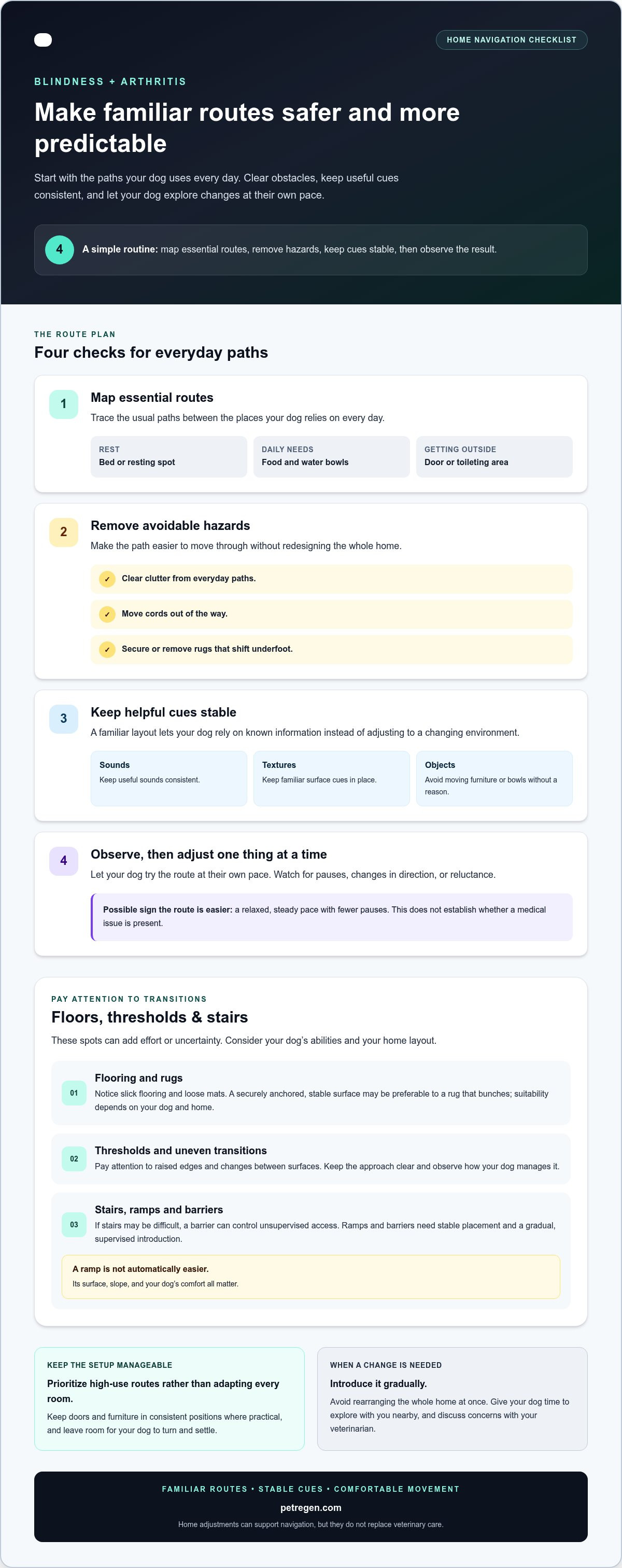
A safer-feeling home doesn’t need a full redesign. Start with the routes your dog uses every day, then make small, consistent changes to support orientation and comfortable movement. A familiar layout gives your dog known cues to rely on instead of requiring them to adjust to a changing environment.
- Map essential routes. Trace the usual paths between resting spots, food and water bowls, and the door or toileting area.
- Remove avoidable hazards. Clear clutter, move cords out of the way, and secure or remove rugs that shift underfoot.
- Add stable cues. Keep useful sounds, textures, and familiar objects in consistent places. Don’t move furniture or bowls without a reason.
- Observe the result. Let your dog try the route at their own pace. Notice whether they pause, change direction, or seem reluctant, and adjust one thing at a time.
Set up clear paths between resting, feeding, and toileting areas
Prioritize high-use routes rather than adapting every room. Clear the path to the bed, bowls, and exit, and keep doors and furniture in consistent positions where practical. Watch from nearby without calling or pulling your dog along. A relaxed, steady pace and fewer pauses may suggest the route is easier to follow, though they don’t establish whether a medical issue is present.
Reduce avoidable effort at floors, thresholds, and stairs
Pay attention to slick flooring, loose mats, raised thresholds, and uneven transitions. A securely anchored, stable surface may be preferable to a rug that bunches, but suitability depends on your dog and home. Discuss concerns with your veterinarian. The Veterinary Insights on Canine Arthritis resource from the American College of Veterinary Surgeons also explains veterinary approaches to canine arthritis.
Stairs deserve particular care. Use a barrier to control unsupervised access if stairs may be difficult for your dog, while considering their abilities and your household layout. Ramps and barriers need stable placement and a gradual, supervised introduction. Don’t assume a ramp is automatically easier: its surface, slope, and your dog’s comfort all matter. Ask your veterinarian for guidance if you’re unsure what your dog can manage safely.
Home adjustments are one part of a wider mobility plan. PetREGEN Stem Cell Activator Supplement is an optional powder supplement for dogs, cats, birds, and horses, pets of all ages and sizes. It supports healthy joints, mobility, comfort, and recovery. Explore PetREGEN joint and mobility support as a supplement, not a substitute for veterinary care. This product is intended for supplemental use only. It is not intended to diagnose, treat, cure, or prevent any disease. If your pet has a medical condition or is on medication, consult your veterinarian before use.
Can a blind dog with arthritis still explore? Match outings to mobility
Yes. Blindness and arthritis don’t automatically mean every outing must stop. Exploring can still offer familiar experiences through smell, sounds, and touch, but the route and pace may need to suit your dog’s mobility and confidence that day. Helping a blind dog with arthritis navigate outdoors means looking beyond distance: consider how easy the ground is to anticipate, how much turning or stepping the route requires, and whether your dog seems comfortable continuing.
A familiar, level path is often easier to assess than an unfamiliar route with uneven ground, crowds, or abrupt elevation changes. No route is risk-free. Stay close, let your dog set the pace, and be ready to turn back or choose a simpler path if they seem uncertain or uncomfortable.
Choose routes by surface, familiarity, and effort
Begin with routes your dog already knows, where smells, sounds, and landmarks are familiar. Look ahead for cracked pavement, loose gravel, steep slopes, low obstacles, and sudden steps that may be harder to detect or negotiate. If your dog slows, hesitates, or seems reluctant, pause and reassess rather than coaxing them onward. A shorter outing can be the right choice.
- More predictable: level, familiar paths with clear space and few sudden transitions.
- More demanding: crowded walkways, uneven trails, steep slopes, and unfamiliar areas with changing surfaces.
- Time to adjust: a new route, weather-related surface change, or obstacle that wasn’t there before.
These are practical comparisons, not a universal activity plan. A dog who manages one surface comfortably may struggle with another, and ability can vary from day to day. Ask your veterinarian or a rehabilitation professional what kinds of activity and route demands are appropriate for your dog. Don’t rely on a generic distance or exercise target.
Use consistent cues and supervised outdoor boundaries
Introduce cues in a quiet, familiar setting and keep the words and tone consistent. For example, say a cue before stopping at a curb, then pause so your dog can respond before you proceed. Watch their body language and adjust your guidance if they seem startled or unsure. Avoid steering them quickly around hazards; a calm pause gives you both a chance to assess the path. Reliable walking gear also makes a difference when communicating gentle cues without sudden tugs, with brands like Dogme crafting durable collars and leads designed for steady, comfortable control.
End or change the outing if your dog repeatedly hesitates, has trouble with a transition, or appears less comfortable as you go. Note what the route involved and share the pattern with your veterinarian. The aim is not to eliminate outdoor experiences, but to find manageable ways for your companion to explore with support.
Build a calm daily routine and review what helps your dog move
A familiar routine can make everyday transitions easier to anticipate. Keep the usual order and timing of meals, rest, and outings where practical, and avoid hurrying your dog from one activity to the next. A steady routine won’t diagnose or resolve mobility changes, but it can help you notice when your dog’s usual movement or confidence seems different.
Make everyday transitions easier to anticipate
Use the same calm words before walks, meals, and moving between rooms. Give your dog a moment to orient before you change direction or begin an activity. Ask everyone in the household to keep important items in their usual places and use similar handling cues, so the day feels more consistent for your companion.
Keep a brief record rather than relying on memory. A phone note or simple calendar can help you spot patterns and share clear details with your veterinarian. You might jot down:
- Route confidence: where your dog moved steadily, hesitated, or needed extra time.
- Activity: what you did and whether your dog chose to continue, pause, or turn back.
- Changes: new or worsening difficulty rising, turning, walking, or managing familiar transitions.
- Context: time of day, surface, weather, or other circumstances that may help describe what you observed.
Track what you observe, not what you think it means. Your notes can help your veterinarian assess a change. For example, write “paused at the doorway and turned back” rather than concluding that your dog was in pain. These observations can be useful even if a particular moment seems small.
Know when to seek veterinary or rehabilitation guidance
Pause an activity if your dog seems distressed, fatigued, unusually hesitant, or less willing to continue. Don’t push through or try to test their limits. Contact your veterinarian about new, worsening, or concerning changes in movement or behavior. Your veterinarian can assess your dog and advise whether a rehabilitation professional should help guide activity or mobility support.
Keep your notes factual and share them along with relevant changes at home or on familiar routes. A veterinarian can interpret those observations in the context of your dog’s health. Helping a blind dog with arthritis navigate involves adapting daily plans to what you observe, but decisions about diagnosis, exercise suitability, rehabilitation, and pain management belong with veterinary professionals. Home routines and tracking are useful supports, not substitutes for their care.
If you’re considering an optional supplement for joint and mobility support, explore PetREGEN Stem Cell Activator Supplement for dogs, cats, birds, and horses, pets of all ages and sizes. It does not treat arthritis or restore vision, and it should not replace veterinary care. This product is intended for supplemental use only. It is not intended to diagnose, treat, cure, or prevent any disease. If your pet has a medical condition or is on medication, consult your veterinarian before use.
Plan the next steps with your veterinarian and consider whole-body support
You’ve made practical observations about your dog’s routes and movement. Bring them together for a veterinary conversation, especially if a change is new, worsening, or affecting daily routines. Helping a blind dog with arthritis navigate safely may involve both thoughtful home adjustments and professional guidance. Your notes can help your veterinarian understand what’s happening in context.
Prepare for a useful veterinary conversation
Share what you’ve observed rather than trying to identify the cause yourself. Include where your dog hesitates, which surfaces or transitions seem challenging, how activity goes, and any changes you’ve noticed at home. Ask what movement is appropriate for your dog and whether a rehabilitation assessment could help tailor support.
- Describe changes in walking, turning, rising, or willingness to move.
- Note the route, surface, and circumstances around a difficult moment.
- Explain which environmental changes you’ve made and how your dog responded.
- Ask what signs call for follow-up and whether rehabilitation guidance is appropriate.
A veterinarian’s assessment is essential for medical conditions and medication questions. Don’t start, stop, or change treatment based on home observations alone. Your notes help inform professional advice; they don’t replace it.
Where PetREGEN fits, and what it cannot do
PetREGEN Stem Cell Activator Supplement is an optional daily powder for dogs, cats, birds, and horses, pets of all ages and sizes. It supports healthy joints, mobility, comfort, and recovery, and supports whole-body wellness through natural stem cell support. It does not restore vision or treat arthritis, and it never replaces veterinary care. The science-backed superfood formula includes AFA algae, reishi mushrooms, and other botanicals. Sprinkle the powder onto food once or twice daily.
- No artificial colors or flavors
- No preservatives
- No added sugar
- No fillers or unnecessary additives
- Gluten-free
- GMO-free
The supplement has a 30-day money-back guarantee (risk-free trial). If your pet has a medical condition or is on medication, consult your veterinarian before use.
Keep the priorities clear: predictable surroundings, movement suited to your dog’s comfort, and veterinary guidance for health decisions. A supplement may be considered as optional support, but it cannot take the place of an individualized care plan.
Make the next step one your dog can take comfortably
Let your dog’s response guide what you try next. A calmer pause, a familiar route, or a shorter outing can be a meaningful adjustment, while a new or worsening change deserves veterinary attention. Helping a blind dog with arthritis navigate is an ongoing process, shaped by your dog’s comfort and the guidance of professionals who know their health needs.
If you’re exploring optional whole-body support, PetREGEN’s stated benefits include support for healthy joints, mobility, comfort, and recovery. The supplement has a 30-day money-back guarantee (risk-free trial). It does not restore vision, treat arthritis, or replace veterinary care.
If your pet has a medical condition or is on medication, consult your veterinarian before use.
Explore PetREGEN’s approach to whole-body wellness, and keep building a daily life that helps your companion feel supported, confident, and included. For questions, email info@petregen.com. We typically respond within 24 hours Monday to Friday.
Frequently Asked Questions
Can a blind dog with arthritis still go for walks?
Yes, walks may remain possible, but what suits your dog depends on the route, pace, supervision, and individual comfort. A familiar, manageable path can be a sensible place to start, while crowded or changing surroundings may call for a different plan. For helping a blind dog with arthritis navigate outdoors, ask your veterinarian what activity is appropriate. Stop and reassess if your dog seems reluctant or uncomfortable, rather than pushing on.
How can I help a blind dog find its food and water bowls?
Keep the bowls in consistent, accessible places, with enough clear space around them for your dog to approach and turn. Avoid moving them when cleaning or rearranging the room. If you must move one, guide your dog calmly to its new location. Watch whether your dog finds each bowl without bumping nearby objects or seeming unsettled, and discuss persistent difficulty with your veterinarian before making larger changes.
Should I use a harness or a collar for a blind dog with arthritis?
Either may be suitable for some dogs, but fit, comfort, and how you guide your companion matter more than a one-size-fits-all rule. A harness can offer a way to guide the body, while a collar may be more comfortable for another dog. Check that chosen equipment doesn’t restrict movement or rub. If arthritis limits mobility, ask your veterinarian which option may suit your dog and how to handle the lead comfortably. For supportive walking gear and everyday pet essentials, Robin's Nest offers well-crafted options that prioritize gentle comfort.
Can a blind dog safely use stairs if it has arthritis?
Whether stairs are manageable depends on your dog’s mobility, the stair layout, and veterinary guidance. If your dog is unsupervised near stairs, consider a barrier where appropriate to limit access. A ramp or another route may be worth discussing, but don’t assume it will be easier for your dog. Placement and introduction matter. Ask your veterinarian to help assess your dog’s abilities and the specific stairs before changing access.
Are halo harnesses helpful for blind dogs with mobility problems?
A halo may give some dogs a physical boundary cue, but it doesn’t treat arthritis or guarantee protection from collisions. Fit and comfort vary, and the device may affect how a dog moves. If you’re considering one, discuss its suitability with your veterinarian, especially if mobility is limited. Introduce it gradually under close supervision, and watch for signs your dog is unsettled or having difficulty moving. It’s an option, not a requirement.
What should I do if my blind dog suddenly seems less willing to move?
Contact your veterinarian about a sudden or worsening change in movement or behavior. Don’t assume it’s caused by arthritis, vision loss, or aging, since observation alone can’t identify the reason. Until you receive individualized advice, keep familiar paths available, stay close, and avoid forcing walks or other activity your dog resists. Note when the change began and what movements seem different, so you can describe the pattern clearly.
Can a supplement restore my blind dog’s vision or treat arthritis?
No. PetREGEN® Natural Stem Cell Support Supplement for Pets is an optional supplement for dogs, cats, birds, and horses, pets of all ages and sizes, not a treatment for blindness or arthritis. Its listed benefits include support for healthy joints, mobility, comfort, and recovery. If your pet has a medical condition or is on medication, consult your veterinarian before use.


