

What if the most useful mobility score isn’t the one that tells you what’s wrong, but the one that helps you notice what’s changing? It can be hard to tell whether your dog is having an off day or finding everyday movements more difficult. A dog mobility score chart gives you a consistent way to record what you see, but charts may ask different questions and use different scoring systems. Treat the score as a snapshot of your observations, not a diagnosis.
You’re right to want something more reliable than memory when you’re concerned about your dog’s movement. This guide explains how to choose and use a tracking approach, score repeatable activities such as rising after rest or using familiar steps, and look for patterns over time. You’ll also learn how veterinary questionnaires differ, when a worsening trend calls for a vet conversation, and how brief notes or videos can help you describe changes clearly. The goal is a useful record to share with your veterinarian, not a number you have to interpret alone.
Key Takeaways
- Use a dog mobility score chart to record observable movement and everyday function, not to identify a diagnosis.
- Choose one chart and follow its original questions, response options, and scoring instructions each time.
- Compare dated entries made with the same chart to spot patterns without overinterpreting a score change.
- Keep a simple log of scores, activities, and brief notes to make changes easier to describe.
- Bring your observations to your veterinarian and ask how to interpret the chart and what to do next.
What a Dog Mobility Score Chart Measures, and What It Cannot Tell You
A dog mobility score chart is a structured record of visible movement and everyday function. It can help you track changes over time, but it cannot identify a medical condition or explain what caused a change. It turns impressions into observations you can revisit: how your dog walks, gets up after resting, manages familiar steps, or responds to an invitation to play. Used consistently, the chart can help you describe what you’ve noticed during a veterinary appointment instead of relying on memory alone.
Think of it as a record, not a verdict. A general home chart might ask you to rate or describe a few activities using its own response options. A validated clinical questionnaire has a more defined purpose and scoring method. For example, the Liverpool Osteoarthritis in Dogs (LOAD) Scale is a 13-item owner-completed questionnaire used to assess dogs with osteoarthritis. It isn’t interchangeable with every informal mobility chart, and its score should be understood using the questionnaire’s own instructions.
Which mobility changes can owners observe at home?
Focus on actions you can see, and describe them without assigning a cause. For instance, note whether your dog takes longer to stand after a nap, pauses before climbing familiar stairs, walks at a slower pace, plays for less time, or seems less willing to start moving. A brief, specific note is more useful than a label such as “stiff.” Record what happened and when.
Useful observations may include:
- Whether your dog rises smoothly or needs extra time after resting.
- How your dog walks on a familiar route, including any change in pace or stride.
- Whether stairs, jumping into a usual resting spot, or play seem different from your dog’s normal routine.
- Whether your dog starts an activity willingly or hesitates before joining in.
One unusual moment may reflect a temporary variation, not a lasting pattern. Note it, then keep observing rather than treating a single entry as conclusive. Repeated changes across familiar activities are more useful to share with your veterinarian.
Why a score is not a diagnosis
Charts don’t all ask the same questions or use the same scales. One may describe specific activities, while another may assign numbers to your responses. A score from one tool can’t automatically be compared with a score from another, and a higher or lower number doesn’t prove that a particular condition is present.
A veterinarian considers your observations alongside your dog’s clinical history and examination. Depending on the situation, the assessment may include observing your dog move and checking how your dog responds during an examination. A home score can make that conversation clearer, but it can’t show on its own whether a change comes from arthritis, an injury, or another cause. If you’re concerned about a new or worsening movement change, share what you’ve observed with your veterinarian rather than waiting for a chart to provide an answer.
How to Use a Dog Mobility Score Chart Consistently
A score becomes more useful when you can compare it with earlier entries made in a similar way. Keep the process simple: choose one chart, record a starting point, observe your dog during ordinary routines, follow the chart’s scoring instructions, and date each entry. A dog mobility score chart is easier to interpret when you don’t switch tools or change what its numbers mean halfway through tracking.
Consistent conditions make comparisons more useful because they help distinguish a change in your dog’s movement from a change in how or when you observed it. You can’t control every variable at home, but you can note context such as an unusually long walk, a change in routine, or a different surface underfoot.
Set a baseline without changing the chart’s scoring system
Start with your dog’s recent, ordinary behavior rather than an unusually energetic or difficult day. Read the chart’s instructions before answering, then use its response choices and scale as written. Add the date and a brief note about anything that may affect the observation. If you later use another questionnaire, keep its results separate rather than combining scores into a homemade scale.
For example, if a chart asks about rising after rest, answer that item based on the chart’s wording. Don’t create extra categories such as “half a point” or change the scale because one response feels too broad. The chart may not capture every detail, so add a short factual note beside the score instead. That preserves the tool’s original scoring while giving you space to explain what you saw.
Record everyday movement in clear, observable terms
Describe an action, its timing, and how it compared with your dog’s usual routine. “Paused at the bottom of the stairs this morning” is more informative than “seemed worse.” Use the questionnaire’s exact response choices, and don’t force or repeat an activity just to complete a rating. Ordinary, comfortable routines are enough.
A practical entry might say: “Tuesday, after a nap, took longer than usual to stand; no change to the chart response.” If your dog didn’t encounter a particular activity during the observation period, follow the chart’s instructions for that situation rather than guessing or choosing an answer that doesn’t fit.
Try to observe at a similar point in the routine each time, such as during the usual walk or after a familiar rest period. Keep the chart, dates, and notes together. If your schedule or your dog’s routine changes, record that context instead of silently treating the entries as directly equivalent. A short video of a naturally occurring movement may also help you describe what you noticed, but don’t prompt your dog to repeat an activity that seems difficult. The aim isn’t perfect measurement; it’s a clear, repeatable record your veterinarian can understand.
If you’re also considering supplemental support for mobility, PetREGEN Natural Stem Cell Support Supplement for Pets is a daily powder for dogs, cats, birds, and horses, and pets of all ages and sizes. It supports healthy joints, mobility, comfort, recovery, and whole-body wellness. It has a 30-day money-back guarantee. No artificial colors or flavors; No preservatives; No added sugar; No fillers or unnecessary additives; Gluten-free; GMO-free.
This product is intended for supplemental use only. It is not intended to diagnose, treat, cure, or prevent any disease. If your pet has a medical condition or is on medication, consult your veterinarian before use.
How to Interpret a Dog Mobility Score Chart Without Overreading It
A score is most helpful as part of a timeline. Compare entries made with the same chart, using its original questions, response options, and scoring rules. Don’t assume that a particular number is universally “good” or “bad.” Unless the chart’s own validated instructions provide defined ranges, there’s no reliable basis for assigning general low, moderate, or high score bands.
Read the number alongside what was happening in everyday life. A dated note such as “hesitated before the usual stairs” can add meaning that a total score alone can’t provide. Look for whether similar observations recur, whether several activities changed, and whether the change affects your dog’s normal routine. The purpose is to notice a pattern, not to explain its medical cause.
What a rising or falling score may mean
A score moving in one direction is a reason to review the entries, not proof of improvement or worsening health. Check the accompanying notes: Was your dog’s activity different? Did the observation happen after an unusually long outing, on a different surface, or at a different point in the daily routine? These details may help put a changed response in context.
If changes persist, concern you, or interfere with daily activities, contact your veterinarian and share the record. Don’t wait for the score to cross a threshold that the chart doesn’t establish. Your observations can help guide a conversation, while your veterinarian considers them with your dog’s history and examination.
Why scores from different charts may not be comparable
Questionnaires can assess different activities, ask questions in different ways, or use different scoring ranges. A total from a home checklist therefore shouldn’t be compared directly with a total from another tool. The Liverpool Osteoarthritis in Dogs (LOAD) questionnaire has its own questions and scoring instructions. Keep its results separate and follow those instructions rather than translating its score onto a home chart’s scale.
For a clearer comparison, review a few entries from the same chart side by side. For example, note the date, score, activity described, and any change in routine. Ask whether the score shift matches the written observations or whether the notes suggest that conditions differed. If the number changes but the recorded behavior looks similar, mention that rather than altering or recalculating the score.
Use this quick review before drawing conclusions:
- Confirm that both entries came from the same chart and use the same scoring rules.
- Read the notes beside each score, including dates and routine changes.
- Look for repeated changes across entries rather than treating one result as a trend.
- Share persistent or concerning changes with your veterinarian, even if the score seems small.
A dog mobility score chart can make change easier to discuss, but it can’t tell you what caused it. If you’re unsure how to read a specific questionnaire or what a pattern means for your dog, bring the completed entries to your veterinarian and ask how to interpret them and what steps make sense next. For broader vet-led guidance on senior dog care and mobility, caninelongevityacademy.com provides educational resources to help owners navigate their dog’s aging years.
A Practical Home Routine for Tracking Dog Mobility Changes
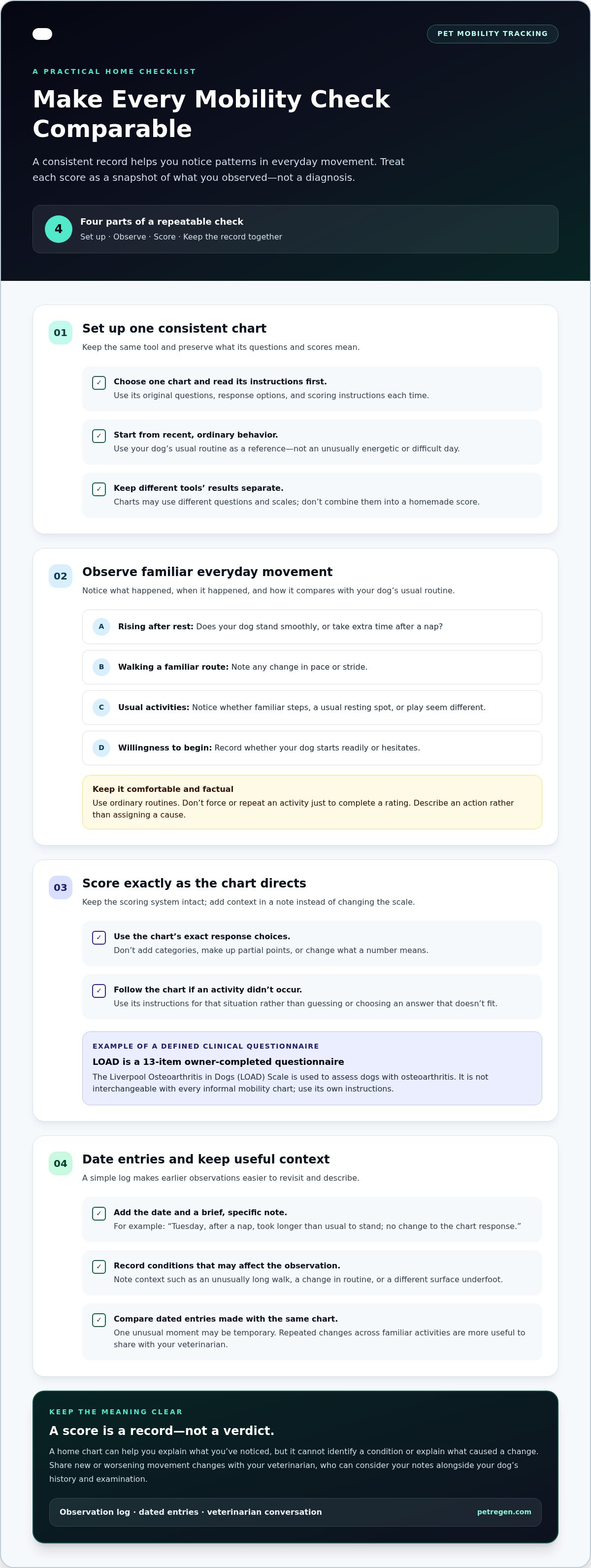
A useful home record doesn’t need to take long. Keep one chart in an easy-to-find place, add dated observations as part of your normal routine, then review the entries together before a veterinary appointment. The goal is to capture what daily movement looks like across time, not to monitor your dog constantly or turn every outing into a test.
What to include in a simple mobility log
Keep the chart and its scoring method unchanged. Beside each entry, note the date, chart name, score or exact response, and one concrete example of everyday movement. Add context if something changed, such as a different walk, an unusually busy day, or a disrupted routine. This helps you and your veterinarian distinguish a possible pattern from a one-off observation.
A compact log might look like this:
- Date: October 12
- Chart and score: Same home chart; record the response exactly as shown
- Observed activity: Usual walk; paused before the front steps
- Owner note: Walk route was longer than usual
This is an example of how to organize an entry, not a suggested score or scoring scale. Follow the response choices on the chart you use. Brief notes are enough; you don’t need to describe every step. If you notice something relevant between planned check-ins, write down what happened and when rather than relying on memory later.
Review the log periodically, looking at entries in date order. Bring the chart and notes to your veterinarian, along with a short description of any everyday activity that seems to have changed. You might ask how to interpret that specific chart, whether the observations suggest any follow-up, and what to watch for next. A score can support the conversation, but it can’t provide a diagnosis or treatment plan.
When observations deserve a veterinary conversation
Contact your veterinarian if a change persists, worsens, concerns you, or begins to affect your dog’s usual activities. Don’t wait for a particular score or a long series of entries if your dog appears distressed or can’t move normally. Seek veterinary guidance promptly in those situations. The chart is there to help you communicate what you see, not to decide what care your dog needs.
If you’re considering supplemental support alongside veterinary guidance, explore whole-body wellness support from PetREGEN. The daily powder supplement is for dogs, cats, birds, and horses, and pets of all ages and sizes. It supports healthy joints, mobility, comfort, recovery, and whole-body wellness. It has a 30-day money-back guarantee. No artificial colors or flavors; No preservatives; No added sugar; No fillers or unnecessary additives; Gluten-free; GMO-free.
This product is intended for supplemental use only. It is not intended to diagnose, treat, cure, or prevent any disease. If your pet has a medical condition or is on medication, consult your veterinarian before use.
Turn Your Dog Mobility Score Chart Into a Helpful Vet Conversation
A completed dog mobility score chart can help you explain what you’ve noticed, especially when changes are gradual and hard to recall in the moment. Bring the chart itself, the dates you completed it, and a few short examples of activities that seem different. The score is a starting point for discussion, not a diagnosis. Your veterinarian can interpret the observations alongside your dog’s history and examination.
Prepare a concise, useful mobility summary
Before the appointment, write down the chart’s name, the dates of your entries, and the pattern you’ve noticed. Keep your summary focused on actions: for example, “takes longer to rise after resting” or “hesitates before using the usual steps.” Describe what you saw rather than naming a condition or assuming what caused the change.
It may help to bring notes on:
- The chart or questionnaire you used, with completed entries in date order.
- Everyday activities that changed, and when you first noticed the difference.
- Relevant changes in routine that might add context to an entry.
- Your dog’s known medical conditions and any medications or supplements being used.
Ask your veterinarian how to interpret that specific chart and whether the pattern calls for any next steps. You can also ask what changes to watch for and when to follow up. If you’re unsure whether a score shift matters, say so and let the veterinarian review both the number and the observations behind it.
Where supplemental wellness fits, and where it does not
Veterinary guidance comes first when you’re concerned about a change in movement. PetREGEN’s natural stem cell support supplement is an optional daily powder for dogs, cats, birds, and horses, and pets of all ages and sizes. The formula includes AFA algae, reishi mushrooms, and other botanicals. The supplement does not replace veterinary care and is not intended to diagnose, treat, cure, or prevent any disease. It has a 30-day money-back guarantee.
No artificial colors or flavors; No preservatives; No added sugar; No fillers or unnecessary additives; Gluten-free; GMO-free.
This product is intended for supplemental use only. If your pet has a medical condition or is on medication, consult your veterinarian before use.
Your notes don’t need to be perfect to help. A dated chart, a clear example, and an honest account of what seems different can give your veterinarian a practical picture of daily life and help shape a more informed conversation about your dog’s care.
Take the Next Step Toward Supporting Your Dog’s Well-Being
Let your dog mobility score chart be the start of a thoughtful conversation, not the final word on your companion’s health. Keep paying attention to the small details of everyday life, and bring new concerns to your veterinarian. If you’re exploring supplemental support, PetREGEN Natural Stem Cell Support Supplement for Pets is a daily powder for dogs, cats, birds, and horses, and pets of all ages and sizes. It supports healthy joints, mobility, comfort, recovery, and whole-body wellness, and has a 30-day money-back guarantee.
No artificial colors or flavors; No preservatives; No added sugar; No fillers or unnecessary additives; Gluten-free; GMO-free.
This product is intended for supplemental use only. If your pet has a medical condition or is on medication, consult your veterinarian before use.
Explore PetREGEN natural stem cell support for pets as one optional part of your pet’s wellness routine. Keep working with your veterinarian, stay attentive to changes, and take each next step with care.
Frequently Asked Questions
Is there one universal dog mobility score chart?
No. Available resources include different forms and owner questionnaires, rather than one universally adopted dog mobility score chart or shared scoring scale. Choose a tool that suits your purpose and follow its own instructions; a total from one form may not mean the same thing as a total from another. Use the record to organize what you’ve observed, then ask your veterinarian to interpret persistent or concerning changes.
How often should I score my dog’s mobility?
How often you score depends on the specific chart and its instructions, so there isn’t one interval that fits every tool. Use the same chart consistently and write the date beside each entry so you can review the sequence accurately. If you’re completing a clinical questionnaire, ask your veterinarian when to repeat it. Don’t wait for the next planned check-in if you notice a change that worries you.
Can I use a dog mobility score chart instead of seeing a veterinarian?
No. A chart can help you record what you’ve noticed, but it can’t determine why your dog’s movement changed or replace a veterinary examination. Share persistent, worsening, or concerning changes with your veterinarian. If your dog seems distressed or can’t move normally, seek veterinary guidance promptly rather than waiting to collect more scores. The chart can help you explain the situation, but it can’t decide whether care is needed.
What should I do if my dog’s mobility score changes suddenly?
Note the date, the chart you used, and the specific movement change you observed, such as difficulty getting up or reluctance to walk. Don’t repeatedly test the activity or force your dog to move for another score. Contact your veterinarian promptly about sudden or concerning changes, especially if normal movement is affected or your dog appears distressed. A score can’t identify the cause, so prioritize veterinary guidance over interpreting a number.
Can I compare my dog’s score with another dog’s score?
It’s usually more useful to compare your dog’s entries over time than to compare totals with another dog. Different charts, scoring rules, routines, and observers can all affect the result, so scores aren’t a reliable health ranking between dogs. Keep your own dog’s entries together, note who completed them, and share the dated record with your veterinarian. They can help interpret those observations in the context of your dog.
Does the LOAD questionnaire diagnose osteoarthritis in dogs?
No. LOAD is a 13-item owner-completed questionnaire used to assess reported signs associated with canine osteoarthritis; a score by itself doesn’t establish a diagnosis. Elanco describes the questionnaire as useful in clinical assessment and follow-up, but results need context. If you complete LOAD, keep the answers and total together and have your veterinarian interpret them alongside your dog’s medical history and examination findings.
What should I bring to a vet appointment about my dog’s mobility?
Bring the completed chart or questionnaire, its name, and the dates you filled it out. Add brief examples, such as a change in getting into the car or joining a familiar walk, plus any relevant routine changes. Tell your veterinarian about known medical conditions and medications. Ask how to interpret that specific tool and what next steps are appropriate. Your notes can make the discussion clearer, but they don’t replace a veterinary assessment.


