

A slippery floor can reveal a mobility problem, not just cause a clumsy step. When a dog has trouble on slippery floors, smooth flooring, long nails, or hair covering the paw pads may reduce grip. Repeated slipping, especially alongside sudden weakness, limping, or a change in gait, calls for a veterinary assessment.
It’s unsettling to see a confident companion hesitate at a familiar doorway, and easy to assume the floor is the whole problem. Paw care and changes to walking surfaces may help your dog feel steadier, but changes in movement deserve attention rather than guesswork.
This guide explains why dogs slip, how nail trimming, paw-hair care, rugs, and runners can improve traction, and which signs mean it’s time to seek veterinary guidance.
Key Takeaways
- Notice whether slipping happens only during fast turns or also during ordinary walking, and watch for changes in balance or movement.
- Keep nails trimmed and paw-pad hair neat to help your dog get better contact with the floor.
- Create steady routes through busy areas with rugs or runners that stay securely in place.
- Seek veterinary assessment for repeated slipping, difficulty standing, or a sudden change in gait or strength.
1. Why do dogs slip on the floor?
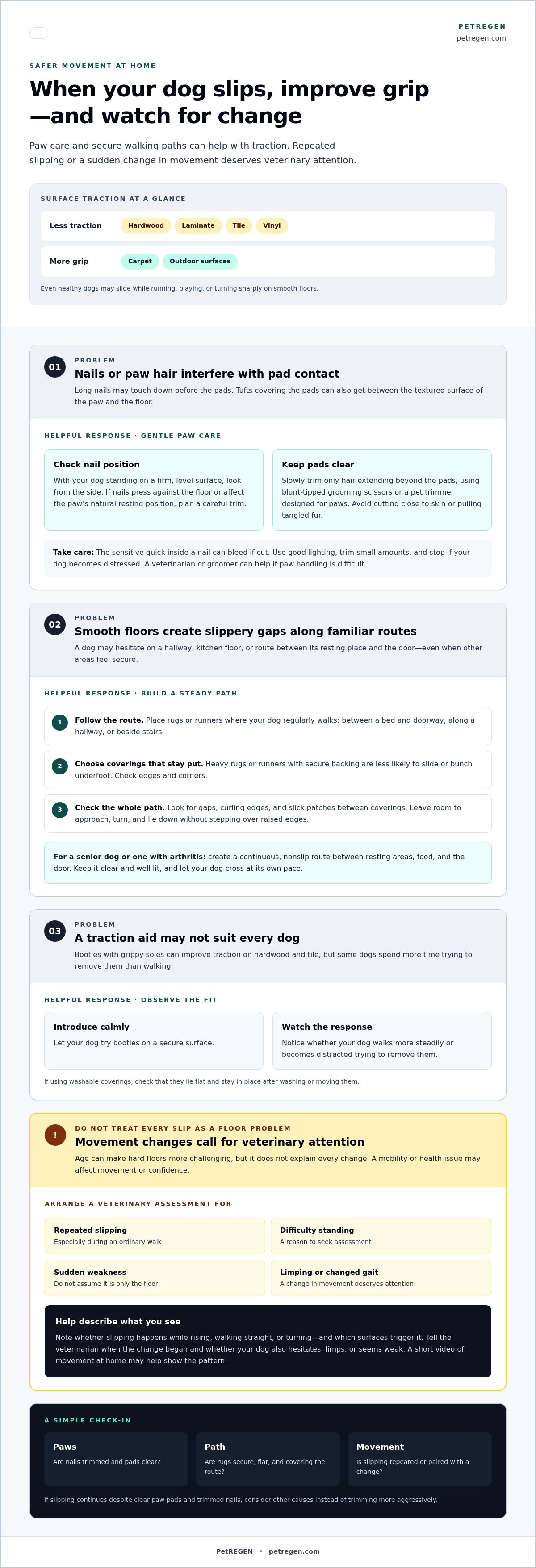
Dogs use their paw pads and nails to grip the ground. Hardwood, laminate, tile, and vinyl offer less traction than carpet or outdoor surfaces. Even healthy dogs may slide while running, playing, or turning sharply. A sudden slip can also make a dog wary of crossing the same room again.
Age can make hard floors more challenging, but it doesn’t explain every change. An older dog may have an orthopedic or neurological issue affecting movement or confidence. If your dog has trouble on slippery floors and the problem starts suddenly, or you notice weakness, limping, or a changed gait, arrange a veterinary assessment. Repeated slipping during an ordinary walk or difficulty standing also deserves attention.
There’s no single typical cost for traction aids, floor coverings, and mobility therapy. The expense depends on the type of aid, how much flooring needs covering, and whether therapy includes an assessment or ongoing supervised sessions. A small paw aid and a room-wide walking path involve different materials and needs.
Dog booties with grippy soles can improve traction on hardwood and tile. They don’t suit every dog: some spend more time trying to remove them than walking. Introduce booties calmly on a secure surface, and watch whether your dog walks more steadily or becomes distracted.
Balance and mobility exercises should suit the reason your dog is slipping. A veterinary professional can assess your dog’s movement and recommend appropriate physical therapy, such as controlled weight shifts or slow sit-to-stands on a nonslip surface. Keep practice gentle and supported, and stop if your dog seems uncomfortable or less steady. Don’t ask your dog to do balance work on the slippery floor causing difficulty.
2. Toenail length and paw-hair trimming
Long toenails can change how a dog’s paw meets the floor. Nails extending past the paw pads may touch down first, limiting the pads’ contact with the surface. Since paw pads help dogs grip, keeping nails trimmed is a practical way to support steadier footing. It won’t address every cause of slipping, but it can remove one avoidable traction problem.
Check your dog’s nails while they’re standing on a firm, level surface. Look from the side to see whether the nails press against the floor or affect the paw’s natural resting position. If they do, plan a careful trim rather than removing a lot at once. The sensitive quick inside each nail can bleed if cut, so use good lighting and stop if your dog becomes distressed. A veterinarian or groomer can help if handling the paws is difficult.
Paw hair matters, too. Long tufts between or over the pads can cover the textured surface that normally meets the floor. On a smooth hallway or kitchen floor, that extra hair may interfere with pad contact. Use blunt-tipped grooming scissors or a pet trimmer designed for paws, and work slowly while your dog is settled. Trim only hair extending beyond the pads; avoid cutting close to the skin or pulling tangled fur.
Make paw care a short routine. First, inspect all four paws after a walk. Check for overgrown nails and hair obscuring the pads. Then trim small amounts in a calm, well-lit spot, rewarding stillness with a treat. Repeat the inspection regularly, since nail growth and paw-coat length vary between dogs. After grooming, watch your dog walk on a safe, nonslip surface. If slipping continues despite clear paw pads and trimmed nails, consider other causes instead of trimming more aggressively. A sudden change in gait, weakness, or limping needs veterinary attention, not a grooming adjustment.
3. Using rugs and runners as safe walking paths
Rugs and runners create a grippier route across smooth flooring. Place them where your dog regularly walks, such as between a bed and doorway, along a hallway, or beside stairs. Covering these high-traffic routes can make movement easier, though uncovered tile or laminate may still feel slippery. Think of the layout as a path connecting your dog’s usual resting and activity spots.
Choose heavy rugs or runners with secure backing so they stay flat underfoot. A lightweight throw rug can slide or bunch when a dog steps on it, creating another obstacle. Check the edges and corners, too. If a rug shifts when you press it with your foot, it may not provide steady footing when your dog turns or gets up.
For a senior dog or one with arthritis, create a continuous, nonslip route between resting areas, food, and the door. Keep it clear, well lit, and wide enough for comfortable turns. Let your dog cross at its own pace rather than pulling it over exposed flooring.
Washable coverings can be practical in homes where muddy paws or accidents are concerns. Some owners have reported using washable yoga mats to help a 16-year-old dachshund walk indoors. Another owner described using toolbox liners as washable coverings for a 16-year-old dog struggling on laminate. These are examples, not a universal fit, so check that any material lies flat and stays in place.
Watch where your dog slips or hesitates, then cover those routes. Walk the path yourself to spot gaps, curling edges, or slick patches between coverings. Recheck after washing or moving a rug, since its backing can shift. A rug should support the route, not block it: leave enough room for your dog to approach, turn, and lie down without stepping over raised edges.
4. Veterinary assessment for slipping and mobility problems
A dog that repeatedly slips during ordinary walking needs more than a floor adjustment. Have a veterinarian assess the problem before trying other interventions. This is especially important when slipping starts suddenly or occurs with weakness, limping, or a changed gait. Difficulty standing is another reason to seek an assessment.
Describe what you see in practical terms. Note whether your dog slips while rising, walking straight, or turning, and which surfaces trigger it. Tell the veterinarian when the change began and whether your dog also hesitates, limps, or seems weak. A short video of your dog moving at home can help show the pattern if it doesn’t happen during the appointment. Mention other changes you’ve noticed in everyday movement.
An assessment can help distinguish a traction challenge from a mobility concern. Fear of a slippery surface may signal an orthopedic or neurological issue, particularly in an older dog. A sudden fear, repeated slips on a normal walk, or trouble standing doesn’t prove one specific condition. The pattern and accompanying signs help guide what needs attention.
Until the appointment, keep your dog’s route clear and limit situations where a slip could occur. Don’t pull or pressure a fearful dog across a smooth floor. Note whether changes to the walking route affect your dog’s confidence, but don’t let improved footing replace an assessment when movement has changed. Clearly tell the veterinarian about sudden weakness or limping.
For severe anxiety about slippery floors, a veterinarian may recommend temporary anti-anxiety medication. Medication alone won’t resolve the fear, so the underlying mobility concern and your dog’s response to the surface still matter. Bring your observations to the appointment and follow the veterinarian’s guidance on next steps. The key point is simple: repeated slipping or a new movement change warrants assessment before you assume the floor is the only cause.
PetREGEN: PetREGEN Stem Cell Activator Supplement
PetREGEN Stem Cell Activator Supplement supports your dog’s natural regenerative function by supporting immune function, mobility, recovery, and healthy aging. Its formulation includes human-grade ingredients such as amino acids, omega 7, and collagen.
PetREGEN may support a broader whole-body wellness routine, but it doesn’t provide traction or diagnose why a dog slips. Keep using practical floor adaptations and seek veterinary assessment for repeated slipping, weakness, limping, or gait changes. A supplement isn’t a substitute for evaluating a possible mobility problem.
For more information about PetREGEN Stem Cell Activator Supplement, contact PetREGEN.
Build a steadier routine for your dog
If your dog has trouble on slippery floors, measure progress by comfort, not speed. Notice which everyday transitions feel easier for your companion, such as getting up to greet you or moving calmly toward a favorite resting place. These observations can help you make thoughtful adjustments over time.
Keep veterinary guidance central if your dog’s movement or confidence changes. For owners considering nutritional support as part of a broader wellness routine, PetREGEN offers its Stem Cell Activator Supplement. It’s a supplement, not a floor-traction aid or a replacement for veterinary assessment when slipping raises concern.
Choose the support that fits your dog’s needs, and give them room to move at a comfortable pace. For information about PetREGEN Stem Cell Activator Supplement, contact PetREGEN. With attentive care and practical support, you can help your companion feel more secure in daily life.
Frequently Asked Questions
Why do dogs slip on the floor?
Dogs slip when their paws can’t get enough grip on a surface. Smooth flooring can be especially challenging during quick turns, play, or getting up from rest. Paw-pad contact, nail length, and movement all affect footing. Notice where and when slipping happens, such as during a turn in the kitchen, to help determine whether the surface or a change in mobility may be involved.
What’s so bad about a dog slipping on the floor?
A slip can cause a dog to fall, strain itself, or become afraid to cross that area. Even without an obvious injury, a frightening slide may change how confidently your dog moves around home. Watch for reluctance to enter a room, difficulty rising, or new limping. If movement changes or slipping repeats during normal walking, arrange a veterinary assessment instead of treating it only as a flooring issue.
Why do dogs slip or struggle to walk on smooth floors?
Smooth floors offer less grip than textured surfaces, so a dog’s paws may slide rather than hold steady. The challenge can become more noticeable when a dog moves quickly, turns, or tries to stand. Hesitation may also follow a previous slip. If your dog suddenly struggles on a surface it used to cross comfortably, watch for other movement changes and share them with a veterinarian.
How can I make slippery floors safer for my dog at home?
Make your dog’s usual route easier to cross, especially between resting spots, food, and the door. Keep pathways clear of toys and loose objects, and make sure your dog can see where it’s going. Encourage voluntary movement by placing a treat near the route, then let your dog approach at its own pace. Don’t pull or coax it into a situation that increases fear.
Which non-slip floor coverings or rugs work best for dogs?
Choose coverings that lie flat and stay firmly in place underfoot. A hallway runner may be more useful than a small mat that ends before your dog reaches its destination. Check the edges after cleaning or moving coverings, since a curled corner can catch a paw. Washable yoga mats or toolbox liners are examples some owners use indoors.
How can I trim dog nails and paw fur to improve traction safely?
Inspect each paw in good light before trimming. If the nails extend beyond the pads, remove only a small amount at a time, avoiding the sensitive quick inside each nail. Carefully shorten fur that covers or extends beyond the paw pads without cutting close to the skin. If your dog resists handling or you’re unsure where to trim, ask a veterinarian or groomer for help.


