

If you’re wondering what to do if my vet is skeptical of supplements, it can feel discouraging to raise an idea for your pet and leave without clear answers. Your veterinarian’s concerns about research, product quality, or possible interactions deserve a thoughtful discussion, not a rushed yes or no. Their skepticism can be a reason to ask more specific questions and understand what would make a supplement appropriate for your pet.
Your vet’s caution can help keep your companion’s health at the center of the decision. You’ll learn how to explain what you hope a supplement might support, review the evidence and safety information, and discuss how it could fit with current medications or treatment. The goal isn’t to win an argument or replace veterinary care. It’s to understand the potential benefits and risks together.
This guide covers common reasons veterinarians may be cautious, what product details to bring to an appointment, and how to agree on a practical next step. A calm, open conversation can help you make a more informed choice alongside the professional who knows your pet’s health.
Key Takeaways
- Vet skepticism can reflect reasonable questions about evidence, product quality, safety, and whether a supplement fits your pet’s needs.
- Compare research on the finished product in your pet’s species with the specific claims being made, and note important study limitations.
- Discuss potential benefits alongside risks, medication interactions, alternatives, and how your pet’s response could be monitored.
- If you’re unsure what to do if my vet is skeptical of supplements, bring the product label, ingredient details, relevant research, and a few clear questions to your appointment.
- A shared decision may be to avoid the supplement, gather more information, or consider monitored use with your veterinarian involved.
Why Might Your Vet Be Skeptical of Supplements?
It can feel disappointing to bring up a supplement because you hope it will support your pet’s comfort or vitality and hear caution instead of encouragement. That response doesn’t necessarily mean your veterinarian is dismissing you or complementary care. It may be a prompt to look closely at what’s known, what remains uncertain, and whether the product fits your individual companion.
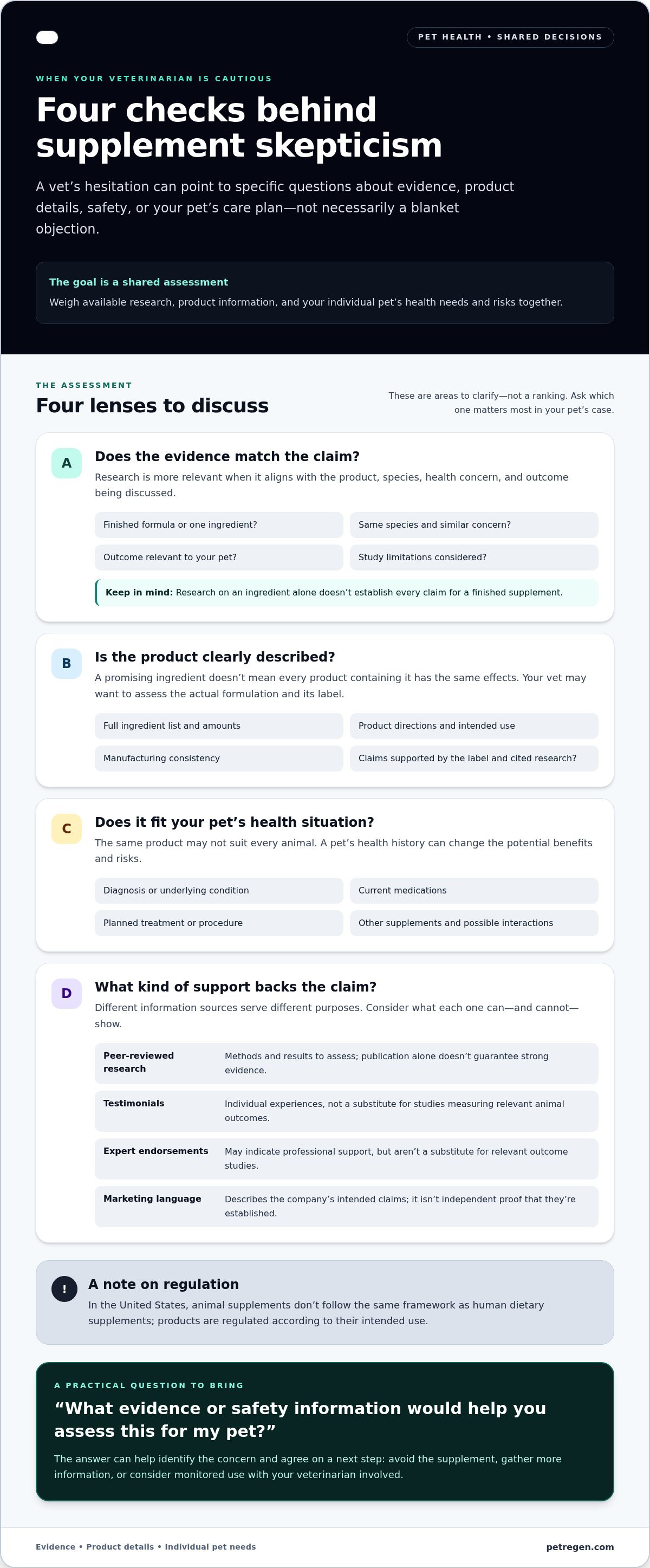
Veterinarians consider more than a product’s headline claim. They may want to know whether research tested the finished formula or just one ingredient, whether the evidence applies to your pet’s species and health concern, and whether the product’s contents match its label. An ingredient with potential benefits doesn’t establish that every product containing it will have the same effects.
Your pet’s health history also matters. A diagnosis, current medications, planned treatment, and other supplements can change the risk-benefit picture. A product that seems reasonable for one animal may not suit another. In the United States, animal supplements don’t follow the same framework as human dietary supplements, and products are regulated according to their intended use. The principles of evidence-based veterinary medicine help explain why clinicians consider research alongside clinical expertise and the needs of the individual patient.
Evidence-informed supplement use is a shared veterinary decision that weighs available research, product details, and an individual pet’s health needs and risks.
What concerns may be behind a veterinarian's hesitation?
Your veterinarian may be unsure whether studies are well designed, whether results apply to your pet’s species or condition, or whether the finished product has been studied at all. They may also have questions about ingredient amounts, manufacturing consistency, or whether the label supports the advertised claims.
Your pet’s circumstances can add another layer. A medication, underlying condition, or upcoming procedure may affect whether a supplement is appropriate or when it could be considered. Ask which factor matters most in your pet’s case rather than assuming the hesitation reflects a general objection to supplements.
Does skepticism mean a supplement is unsafe or useless?
No. A request for stronger evidence isn’t the same as a conclusion that a product can’t help, and caution alone doesn’t prove that it’s unsafe. Evidence about an ingredient may not show that a particular finished formula has the same effect, especially if the formulation, amount, species, or intended outcome differs from what was studied.
To move the conversation forward, ask: “What evidence or safety information would help you assess this for my pet?” The answer can clarify whether the concern is research, product quality, a possible interaction, or a mismatch with your pet’s care plan. It also gives you a practical next step for reviewing the information together.
How to Evaluate Supplement Evidence Before Discussing It
Before bringing a product to your veterinarian, look past the headline and identify what the evidence actually tested. A study of one ingredient may provide useful background, but it doesn’t automatically show that a finished supplement has the same effects. The formulation, amount, preparation, species, and intended use may differ.
Research on an ingredient alone doesn’t establish every claim made for a finished supplement. Keeping that distinction in mind helps you discuss a product accurately, without dismissing promising research or treating it as proof of more than it shows.
What evidence should you look for?
Start with studies that match your pet and the product’s purpose as closely as possible. Check whether the research involved the same species, a similar health concern, and an outcome that matters to your pet. For example, a study measuring one specific marker doesn’t necessarily demonstrate an improvement in everyday mobility or energy.
Then check whether researchers tested the finished formulation or an individual ingredient in a different preparation. Note who was studied, how outcomes were measured, whether there was a comparison group, and what limitations the authors describe. A small or preliminary study can raise a useful question, but shouldn’t be treated as settled proof.
Separate evidence types, too. Peer-reviewed research gives you methods and results to assess, though publication alone doesn’t guarantee strong evidence. Testimonials describe individual experiences, while expert endorsements may indicate professional support. Neither is a substitute for studies that measure outcomes in relevant animals. Marketing language explains what a company says its product is intended to do, but it isn’t independent evidence that the claim is established.
The American Veterinary Medical Association’s guidance on complementary and alternative veterinary medicine can provide useful context as you consider how such approaches fit alongside veterinary care.
How can you review a supplement label and its claims?
Gather the complete label and any research or safety information the manufacturer provides. Write down the full ingredient list, the product’s stated intended use, directions, and the specific benefit claims that interest you. If the company cites a study, check whether it tested the product itself or only one component, and whether the species and outcome match the claim.
- Flag language promising a cure, guaranteed results, or replacement of veterinary diagnosis or treatment.
- Treat statements such as “natural,” “safe,” or “clinically studied” as prompts to ask what they mean and what documentation supports them.
- Note missing details, including unclear ingredient amounts or research that doesn’t match your pet’s species or health goal.
If you’re searching for what to do if my vet is skeptical of supplements, bring this brief evidence review to the appointment and ask which findings are most relevant to your pet. You can also review the PetREGEN Stem Cell Activator Supplement information and note questions about its ingredients, intended use, evidence, and safety. Keep the focus on what is known and what still needs careful consideration.
How to Compare a Supplement's Potential Benefits, Risks, and Alternatives
A useful decision starts with your pet, not the product’s broadest promise. Consider the diagnosis, the change you hope to see, the care already in place, and your veterinarian’s assessment of your companion’s health. A supplement might be considered for general support, but that’s different from using it to treat a diagnosed condition. Keep prescribed care in place unless your veterinarian advises otherwise, and don’t delay an examination or needed treatment while exploring a supplement.
There may be uncertainty even when a potential benefit seems plausible. The question isn’t simply “Could this help?” Consider whether the possible benefit is relevant to your pet, how strong the evidence is, what risks or interactions exist, and whether another option is more appropriate. No outcome can be promised; the decision should reflect the available information and your pet’s individual needs.
Which questions help put possible benefits in context?
Make the hoped-for benefit specific and observable. If your goal is better mobility, ask what change your veterinarian would consider meaningful, such as easier movement during a familiar daily activity. If your goal is general wellness, clarify what you hope to support and how you’d recognize a difference. A clear goal makes it easier to assess whether continued use is worthwhile.
Then ask how well the evidence fits your pet’s species, diagnosis, age, and overall health. Is the proposed use intended to support general wellness, or is it being presented as treatment for a diagnosed condition? That distinction matters. Your veterinarian can help explain whether the evidence and the product’s stated purpose align with your pet’s care needs.
How should you weigh risks and other care options?
Review the full care picture together. Tell your veterinarian about medications, other supplements, planned procedures, and relevant health conditions. Ask whether there may be interactions or reasons to avoid starting something now. “Natural” doesn’t automatically mean risk-free, and adding several products at once can make it harder to identify what caused a change.
- Compare the supplement with options such as further evaluation, established treatment, supportive changes to daily care, or monitoring without adding a product.
- Agree on what to track, such as the specific activity or symptom tied to your goal, and when to reassess whether the approach is useful.
- Ask what adverse signs should prompt you to stop and call the veterinary team. New vomiting, diarrhea, appetite changes, or unusual behavior are examples to report; seek prompt guidance if you’re concerned.
Don’t change medication or substitute a supplement for prescribed treatment on your own. If your pet’s condition worsens or new symptoms appear, contact the veterinarian rather than waiting to see whether a supplement helps. If you’re considering what to do if my vet is skeptical of supplements, ask to compare benefits, risks, and alternatives side by side. That can turn uncertainty into a practical, pet-centered plan.
How to Talk With Your Vet About a Supplement
A productive appointment doesn’t require you to prove that a supplement will help. Start with a shared goal: finding an approach that supports your pet’s wellbeing and fits the care they already receive. If you’re wondering what to do if my vet is skeptical of supplements, try curiosity instead of persuasion. Ask what your veterinarian thinks, listen for the specific concern, and make room for an honest discussion about what is known and what remains uncertain.
Keep the conversation focused on your pet rather than a brand’s strongest claims. You might say, “I’m considering this because I hope to support my pet’s comfort. Could we review whether it’s appropriate with their current care?” This makes your goal clear while inviting clinical guidance.
What should you prepare before the appointment?
A little preparation can make limited appointment time more useful. Note your pet’s main health goal, current symptoms, relevant diagnoses, and any changes you’ve observed. Bring the product’s full label and any research you want to discuss. Include a current list of medications and other supplements, with directions if available, so the veterinary team can consider the full picture.
- Write down what you hope might change, such as your pet’s comfort during a familiar activity.
- Mark the ingredients and product claims you have questions about.
- Bring research details, not just a headline or promotional summary.
- Prepare a short list of questions so you can leave with a clear next step.
What can you say if your vet disagrees?
Start neutrally: “What specifically concerns you about this supplement for my pet?” Then ask what evidence, safety information, or monitoring plan would help clarify the decision. If the answer is “not enough information,” follow up with, “What would you need to see to assess it?” This turns disagreement into a practical discussion rather than a debate.
You can also ask whether the concern relates to your pet’s diagnosis, an ingredient, possible interactions, or limited research on the finished product. If your veterinarian recommends against use, ask what alternative best supports your goal and whether there’s a reasonable way to revisit the question later. Before you leave, summarize the agreed plan: what you’ll do, what you’ll watch for, and when to follow up.
Don’t stop, change, or replace prescribed care without veterinary direction. If you feel you haven’t understood the reasoning, ask for clarification or request time to review the information together. A calm follow-up can be more productive than making a decision while feeling rushed or dismissed.
Before your appointment, you can review PetREGEN Stem Cell Activator Supplement information and bring its ingredients and stated intended use into the conversation. Use that information as a starting point for questions, not as a substitute for your veterinarian’s assessment or a promise of results.
Make a Shared Decision About Supplements and Your Pet's Care
A useful conversation doesn’t have to end with an immediate yes or no. You and your veterinarian can choose a next step that fits your pet’s health, the available evidence, and any safety concerns. That might mean avoiding the supplement, gathering more information before deciding, or considering use with veterinary guidance and a plan to monitor your pet.
Each outcome can be reasonable. Declining a product may make sense if the risks outweigh a possible benefit or it doesn’t fit the care plan. Gathering more information gives you time to review evidence or clarify an ingredient question. If you and your veterinarian consider monitored use, agree on the goal and how you’ll assess whether continuing makes sense. A supplement should not replace prescribed treatment or delay needed veterinary evaluation.
How can you agree on a safe next step?
Before you leave the discussion, summarize the decision together. Write down whether you’ll use the supplement, wait, or set it aside, along with the reason and any questions still to resolve. If use is being considered, follow your veterinarian’s advice about whether it suits your pet and how it fits with current care.
Agree on what you’ll observe and when you’ll check in. If the goal relates to an everyday activity, note how your pet manages it now and watch for changes. Ask which unexpected signs should prompt you to stop and seek veterinary guidance. Keep the veterinarian involved as you monitor your pet, and don’t adjust prescribed care without their direction.
Revisit the decision if your pet’s health changes, a new medication is added, or relevant information becomes available. A plan isn’t a promise that a supplement will work. It’s a way to make a careful choice, notice what happens, and reassess with your pet’s needs at the center.
Where does PetREGEN fit in the conversation?
The PetREGEN Stem Cell Activator Supplement is a supplement to discuss, not veterinary treatment or a replacement for diagnosis or prescribed care. It is formulated to support the body’s natural regenerative function by enhancing immune function, with the aim of supporting mobility, recovery, and healthy aging. PetREGEN describes a multi-system approach using ingredients such as collagen, real liver, and phytonutrients. Product descriptions provide context, but they shouldn’t be treated as proof of a specific clinical outcome for an individual pet.
Review the product information with your veterinarian alongside your pet’s diagnosis, current medications, and care plan. Ask which claims are supported by product-specific evidence, what safety questions remain, and whether the intended use fits your pet. This keeps the conversation transparent and leaves room for a thoughtful decision rather than an assumption based on marketing alone.
If you’re still considering what to do if my vet is skeptical of supplements, remember that shared decision-making may mean waiting or deciding not to use a product. To bring PetREGEN into the conversation, explore the PetREGEN Stem Cell Activator Supplement and review its information with your veterinarian.
Move Forward With Your Pet’s Wellbeing at the Center
Choosing whether to use a supplement doesn’t have to become a contest over whose opinion wins. It can be a thoughtful decision that evolves as your pet’s needs and the available information change. If you’re still asking what to do if my vet is skeptical of supplements, let that question open a conversation, not close one. Your veterinarian’s perspective and your knowledge of your pet can both help shape the next step.
PetREGEN reports endorsements from veterinarians, zoologists, dog trainers, and pet parents. Consider those endorsements as context, not a substitute for reviewing product information and discussing whether a supplement fits your companion’s care. Keep prescribed treatment and veterinary guidance at the heart of any decision.
To learn more before your next conversation, explore the PetREGEN Stem Cell Activator Supplement and bring your questions to your veterinarian. You’re advocating for your pet by asking carefully, staying open to evidence, and making the decision together.
Frequently Asked Questions
Is it normal for a veterinarian to be skeptical of supplements?
Yes, a veterinarian may reasonably ask for evidence before recommending a supplement. Products can vary in their ingredients, research, and relevance to a particular animal, so caution by itself doesn’t show that a product is either harmful or helpful. Ask what specific concern is driving the hesitation. Is it about an ingredient, your pet’s health history, or the quality of available research? The answer can guide a more focused discussion.
Can I give my pet a supplement if my vet disagrees?
Don’t treat disagreement as a reason to disregard your veterinarian’s advice or change prescribed care on your own. Ask what risk, possible interaction, or evidence gap is behind the recommendation. Share the complete product label and explain what you hope it might support. Depending on your pet’s situation, you might agree to gather more information, consider another option, or discuss a monitored approach. If the reason remains unclear, ask your veterinarian to explain it in practical terms.
What evidence should I show my vet about a pet supplement?
Bring the complete label and research that matches the product, your pet’s species, and the intended use as closely as possible. If a paper studies an ingredient rather than the finished formula, point out that difference. Note what outcome researchers measured and any limitations they described. A testimonial can explain why a pet owner is interested, but it can’t establish that the same result will occur for your pet.
How can I ask my vet about a supplement without sounding confrontational?
Begin by describing your goal and showing that you value your veterinarian’s perspective. You might say, “I’m hoping to support my pet’s comfort. What concerns do you have about this product for them?” Then pause and listen before sharing what you’ve found. Ask what information would help clarify the decision, and repeat the agreed next step in your own words. This keeps the conversation collaborative and centered on your companion, not on proving a point.
Can supplements interact with my pet’s medication?
Yes, a supplement may interact with medication or affect a care plan, depending on its ingredients and your pet’s health. Before adding anything, give the veterinary team a current list of prescriptions, over-the-counter products, and other supplements, including how often your pet receives them. Mention relevant health conditions, too. Don’t assume an ingredient is suitable just because it’s described as natural. Your veterinarian can assess the combination in light of your pet’s individual circumstances.
Should I stop my pet's prescribed medication before trying a supplement?
No. Don’t stop, reduce, or replace prescribed medication unless the veterinarian responsible for your pet’s care directs you to do so. A supplement isn’t a substitute for diagnosis or treatment, and changing medication without guidance may affect your pet’s condition. If you’re considering adding a product, explain your goal and ask whether it could interact with current care. Follow the veterinarian’s instructions about any changes and what to watch for afterward.
What should I do if I still disagree with my veterinarian about a supplement?
Ask your veterinarian to clarify the specific concern and what information might change the recommendation. You can request that the reasoning and next steps be added to your pet’s record, which can make future conversations clearer. If you’re still uncertain, seeking another qualified veterinary opinion is an option. Share your pet’s complete medical history, test results, medications, and current care plan so the next veterinarian can assess the question with proper context.


