

Could a daily supplement mean fewer injections for your horse? If you’re wondering, “can supplements reduce my horse's need for injections,” it’s understandable to hope for a gentler routine, especially when procedures recur. But injections and supplements have different roles: a veterinarian selects an injection for a specific diagnosis, while a supplement may provide broader nutritional support.
It’s reasonable to consider supportive nutrition, but don’t rely on a supplement to treat the condition behind an injection or safely reduce injection frequency. Don’t change or delay prescribed treatment without discussing it with your veterinarian.
This article explains what supplements may support, what different injections are intended to do, and why the right plan depends on your horse’s diagnosis. You’ll also find practical questions to bring to your veterinarian so you can weigh the evidence, suitability, and your horse’s needs together.
Key Takeaways
- Start with your horse’s diagnosis: the reason for an injection shapes whether any supportive approach is appropriate.
- Wondering “can supplements reduce my horse's need for injections”? A supplement should not be assumed to change injection frequency or replace prescribed care.
- Compare injections and supplements by their purpose, who guides their use, and how your horse’s response is monitored.
- Bring your veterinarian a record of treatments, diet, observed changes, and the full supplement label to support a tailored discussion.
- Consider PetREGEN as a potential wellness supplement for horses, with human-grade ingredients, within a veterinarian-guided care plan.
Can supplements reduce a horse’s need for injections? Start with the diagnosis
It’s understandable to feel concerned when your horse needs repeated injections. You may wonder, “can supplements reduce my horse's need for injections?” The answer depends first on why each injection is being given. Injections serve different purposes, so a supplement can’t be assumed to replace them or reduce how often they’re needed.
A supplement provides nutritional support. It isn’t a diagnosis, a prescribed treatment, or a substitute for veterinary monitoring. Even if a product is intended to support wellness, that doesn’t establish that it can treat the condition behind an injection. A general supplement claim can’t show that every horse, or every condition, will require fewer injections.
Supportive nutrition may be part of a care plan, but decisions about treatment belong with the veterinarian who knows the horse’s diagnosis.
What kind of injection does your horse receive?
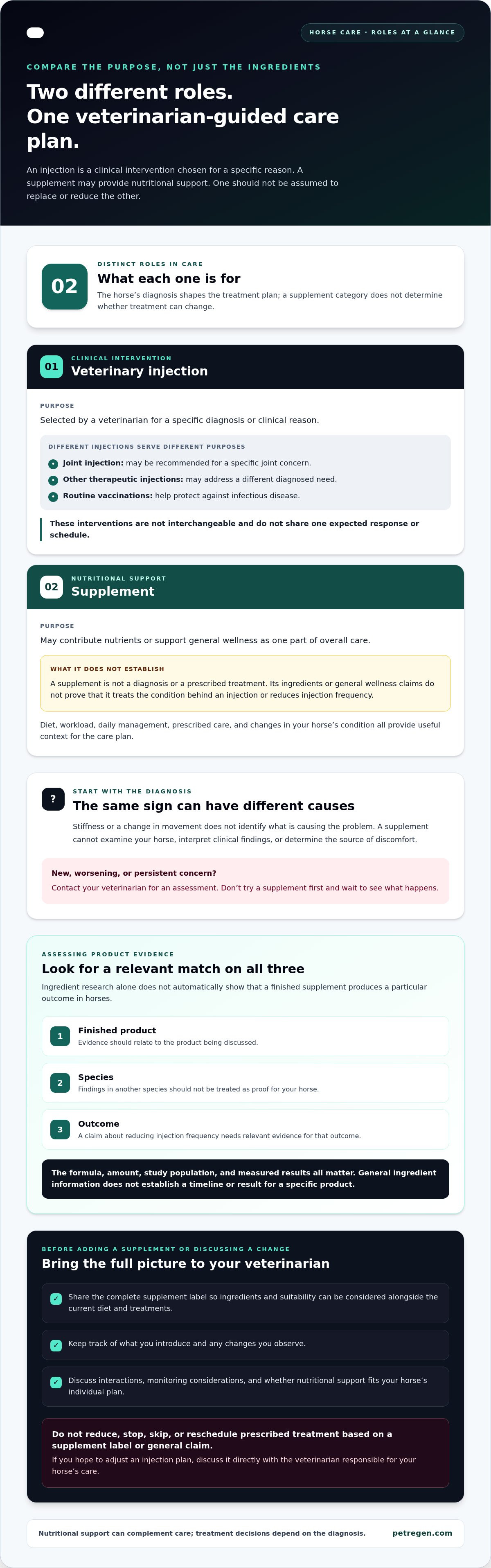
The word “injection” can refer to treatments with very different purposes. A joint injection may be recommended for a specific joint concern. Other therapeutic injections may address a different diagnosed need, while routine vaccinations help protect against infectious disease. These interventions aren’t interchangeable, and they don’t share one expected response or schedule.
Check your horse’s treatment record or ask your veterinarian to clarify the injection’s name, purpose, and intended role in the care plan. That context matters before considering whether a supplement is suitable alongside it. Don’t change, skip, or postpone an injection based on a supplement label or general claim.
Why the diagnosis matters more than the supplement category
Similar outward signs can have different underlying causes. Stiffness or a change in movement, for example, doesn’t identify what’s causing the problem or which treatment is appropriate. A supplement can’t examine your horse, interpret clinical findings, or determine the source of discomfort.
Don’t try a supplement first and wait to see what happens if your horse has a new, worsening, or persistent concern. Contact your veterinarian for an assessment and follow the recommended care plan. Once the cause and treatment goals are clear, you can discuss whether nutritional support fits alongside prescribed care and what changes to monitor.
How supplements may support a horse without replacing veterinary injections
Nutrition is one part of a horse’s overall care, but nutritional support and treatment for a diagnosed condition have different roles. A supplement may contribute nutrients or support general wellness; it doesn’t establish what is causing a health problem or take the place of a veterinarian’s treatment plan. Diet, workload, daily management, prescribed care, and changes in your horse’s condition all provide useful context for that plan.
A supplement can be considered for nutritional support, while injections are clinical interventions selected for a specific reason. Neither a supplement category nor its ingredients determine whether treatment can change.
What evidence can and cannot show
Research on an individual ingredient may help explain its potential role, but it doesn’t automatically demonstrate that a finished supplement produces a particular outcome in horses. The formula, amount, study population, and measured results all matter. Findings in another species or for a different condition shouldn’t be treated as proof for your horse. Claims that a specific product reduces injection frequency require relevant evidence on that product; don’t assume a timeline or result from general ingredient information.
This distinction matters for products with broad wellness positioning. PetREGEN is formulated for horses and is a science-based natural superfood supplement made with human-grade ingredients, including collagen, real liver, and phytonutrients. Its whole-body wellness approach doesn’t establish that it treats a diagnosed condition or reduces the need for injections. When assessing a claim, look for evidence that matches the finished product, species, and outcome being discussed.
Using supplements alongside an existing care plan
Before adding a supplement, share its complete label with your horse’s treating veterinarian. The label helps them assess its ingredients and suitability alongside your horse’s current diet and treatments, and discuss any interactions or monitoring considerations. Keep track of what you introduce and any changes you observe so the veterinarian can interpret them in context.
Don’t reduce, stop, or reschedule prescribed treatment because a supplement label suggests support. If your horse’s condition changes, or you’re hoping to adjust an injection plan, discuss that directly with the veterinarian responsible for care. They can consider the diagnosis, response to treatment, and overall management rather than relying on a broad product claim.
For owners considering a supportive option, whole-body wellness is a useful way to frame the conversation, not a promise of a specific medical result. Ask whether the supplement fits your horse’s individual plan and what signs to monitor. That keeps the focus on informed support alongside veterinary-led decisions.
Injections vs. supplements: compare their roles, not just their ingredients
Comparing an injection and a supplement by ingredient alone can miss the more important question: what role does each have in your horse’s care? An injection is a veterinary intervention selected for a clinical reason. A supplement may be considered as nutritional support, with its suitability depending on your horse’s diet, needs, and evidence for the particular product. Neither option is universally better, and a supplement shouldn’t be assumed to change an injection plan.
| Care option | Purpose | Who guides the decision? | Expected role | Monitoring |
|---|---|---|---|---|
| Veterinary injection | Address a specific clinical need | The veterinarian, based on examination and diagnosis | A treatment selected for the diagnosed problem | Follow the veterinarian’s guidance on response and reassessment |
| Nutritional supplement | Potentially complement the horse’s diet and wellness plan | The owner and veterinarian, considering the horse and product | Supportive nutrition, not a substitute for diagnosis or prescribed care | Review the label, suitability, and observed changes with the veterinarian |
Injections and supplements may have different roles in one care plan; a supplement’s presence doesn’t, by itself, justify changing treatment.
When an injection may remain part of the plan
The veterinarian determines whether an injection is appropriate for the diagnosed problem and whether it remains part of the plan. If signs persist, return, or worsen, the next step is reassessment, not substituting a supplement on your own. Share changes in comfort, movement, or daily function with the treating veterinarian so they can interpret them alongside the diagnosis and treatment response.
When a supplement may be considered as supportive care
A supplement may be worth discussing when you’re reviewing your horse’s overall diet and wellness needs. PetREGEN is formulated for horses and supports the body’s natural regenerative function by enhancing immune function. It is intended to support wellness, not to promise a specific clinical outcome or reduced injection frequency. Ask your veterinarian whether the product fits your horse’s plan and what response, if any, should be monitored.
If you’re asking, “can supplements reduce my horse's need for injections,” focus on purpose and evidence rather than promises. The veterinarian guides treatment decisions; a supplement can be considered only as a possible supportive addition.
How to discuss supplements and injection changes with your veterinarian
A clear, organized conversation can help you explore supportive options without losing sight of your horse’s current treatment needs. Before the appointment, write down the diagnosis, each current injection and medication, your horse’s diet, and any supplements already in use. Note what you’ve observed, including changes in comfort, movement, activity, or appetite, and when they occurred.
Bring the full label for any supplement you’re considering. It gives your veterinarian the ingredient information needed to discuss whether the product may fit your horse’s diagnosis and existing care, and what to monitor. Don’t adjust or stop an injection based on a supplement label; changes to prescribed treatment should be guided by the veterinarian.
Questions to bring to the appointment
Use the discussion to understand the care plan, not just compare ingredients. Questions like these can help:
- What is each injection intended to address, and how will we assess my horse’s response?
- Does this supplement fit my horse’s diagnosis, diet, and current care?
- Are there ingredients or potential interactions we should consider?
- Which changes should prompt a recheck, and what should I record at home?
Report worsening comfort or a sudden change in movement promptly rather than waiting to see whether a supplement makes a difference. Your veterinarian can advise how quickly your horse should be assessed based on the signs and their severity.
Track progress without changing several things at once
A simple log can make observations easier to discuss. Record mobility, comfort, activity, and relevant changes in routine or care. If your veterinarian agrees that a supplement is suitable, introducing one change at a time may make it easier to interpret what happens. A change in your notes doesn’t prove the supplement caused an improvement; your veterinarian can help assess it in context.
If you’re asking, “can supplements reduce my horse's need for injections,” bring that question directly to the veterinarian managing the treatment plan. Ask what would need to change clinically before an injection plan could be reconsidered, and leave any decision to adjust it with them.
For a supportive option to discuss, explore PetREGEN’s horse wellness supplement and bring its complete label to your appointment. It’s intended to support whole-body wellness, not replace veterinary treatment.
Where PetREGEN may fit in a veterinarian-guided horse wellness plan
Once your horse’s diagnosis and treatment goals are clear, you can discuss whether a supplement has a suitable supportive role. PetREGEN is formulated for horses as a science-based natural superfood supplement made with human-grade ingredients. It supports the body’s natural regenerative function by enhancing immune function, and can be considered within a veterinarian-guided plan, not as an alternative to injections or other veterinary care.
What PetREGEN’s supportive approach means
PetREGEN’s multi-system approach is designed to clean, nourish, and support pets. Its ingredient examples include collagen, real liver, and phytonutrients. These details describe the product’s formulation and intended support, but they don’t establish that the ingredients or finished supplement reduce injection frequency or treat a diagnosed condition.
It’s important to distinguish a supplement from veterinary stem cell therapy and prescription medicine. PetREGEN is a supplement, not either of those interventions, and it shouldn’t replace a veterinarian’s examination, diagnosis, monitoring, or treatment recommendations. If your horse already receives injections or medication, the full product label gives your veterinarian information to assess alongside the existing plan.
A practical next step for horse owners
Before adding the supplement, share its label with your treating veterinarian. Ask whether it suits your horse’s diet, diagnosis, and current care, and whether there are ingredients or monitoring considerations to discuss. Keep the current care plan in place unless your veterinarian recommends a change. If your horse’s comfort or movement worsens, report that rather than relying on a supplement to address it.
So, can supplements reduce my horse's need for injections? That can’t be assumed from a product’s ingredients or general wellness positioning. Any decision about changing an injection plan belongs with the veterinarian who understands your horse’s condition and response to care.
If PetREGEN’s supportive approach is relevant to your discussion, explore the horse supplement information and review the product label with your veterinarian before making it part of your horse’s routine.
Make your horse’s care decisions with confidence
If you’re asking, “can supplements reduce my horse's need for injections,” start with the diagnosis and the purpose of each treatment. Supplements may have a supportive nutritional role, but ingredient claims alone don’t show that a finished product can replace an injection or change its frequency. Your veterinarian should guide any adjustment to prescribed care.
Bring your horse’s treatment history, diet, observations, and the full supplement label to the conversation. Together, you can discuss whether a product fits your horse’s needs and what to monitor. PetREGEN offers a supplement formulated for horses, as well as dogs and cats, with a science-based, whole-body support approach. It’s intended as a potential supportive addition, not a substitute for veterinary care.
Explore PetREGEN for horses and review its label with your veterinarian before adding it to your horse’s routine. With a clear diagnosis and a thoughtful care plan, you can make informed choices that keep your horse’s wellbeing at the center.
Frequently Asked Questions
Can supplements replace injections for horses?
No. Supplements may provide nutritional support, but they aren’t a substitute for a veterinarian’s diagnosis or prescribed treatment. Injections are chosen for specific clinical reasons, while a supplement’s role depends on the horse’s needs and evidence for that product. Don’t stop, delay, or change an injection plan based on a supplement claim. Discuss any possible addition or treatment change with the veterinarian managing your horse’s care.
Can supplements reduce how often my horse needs joint injections?
There’s no general basis to assume they will. Whether your horse needs a joint injection depends on the diagnosis and the veterinarian’s assessment of the condition and response to care. A supplement’s ingredients or broad support claims don’t establish that it can reduce injection frequency. If you’re wondering, “can supplements reduce my horse's need for injections,” ask your veterinarian what evidence applies to your horse and what would guide any treatment change.
Is it safe to give my horse supplements with injections?
It depends on the supplement, your horse’s health, diet, and current treatments, so safety shouldn’t be assumed from a “natural” label. Show the full product label to your treating veterinarian before adding it. They can review the ingredients in context, discuss suitability or potential interactions, and advise what to monitor. Keep a record of what you introduce and any changes you notice, and report concerns to the veterinarian.
What happens if I stop my horse’s injections and try supplements instead?
Stopping prescribed injections without veterinary guidance may leave the condition they address unmanaged or delay needed reassessment. A supplement can’t diagnose the cause of discomfort or take over a treatment’s role. Keep following the care plan unless your veterinarian recommends a change. If your horse’s comfort or movement worsens, or changes suddenly, contact the veterinarian promptly rather than waiting to see whether a supplement helps.
How do I know whether a horse supplement is supported by evidence?
Look for evidence on the finished product in horses, not just research about one ingredient or claims based on another species or condition. Check what outcome was studied and whether it relates to the claim being made, such as mobility or injection frequency. Ask your veterinarian to review the label and any cited research. Marketing language, testimonials, and ingredient lists alone don’t prove that a supplement changes a clinical treatment plan.
Can a supplement help my horse’s mobility without injections?
A supplement may be considered for nutritional support, but it can’t be assumed to improve mobility or replace an injection. Changes in movement can have different causes, so a veterinary assessment is important if your horse is stiff, uncomfortable, or moving differently. Your veterinarian can help identify what’s behind the change and discuss appropriate care. If a supplement is added, track observations without treating them as proof that the product caused a change.
Should I ask my veterinarian before giving my horse PetREGEN?
Yes. Share the full label with your veterinarian before adding PetREGEN, particularly if your horse has a diagnosis or receives injections or medication. PetREGEN is formulated for horses as well as dogs and cats, and its science-based approach supports whole-body wellness and natural regenerative function. That positioning doesn’t establish that it treats a condition or reduces injections, so discuss its suitability within your horse’s care plan.


