

What if “vet endorsed” sounds more conclusive than it really is? If you’re asking what does “vet endorsed” really mean, the answer depends on who is offering the endorsement, what they assessed, and whether their relationship with the company is clear. The phrase can describe professional support, but it doesn’t automatically mean a formal review, independent seal, or proof that a product is effective.
It’s understandable to look for a veterinarian’s perspective when choosing something for your companion. But a reassuring label can leave important questions unanswered. PetREGEN states that its supplement is endorsed by vets, zoologists, dog trainers, and pet parents; that statement alone doesn’t establish specific evaluation criteria or clinical evidence. This guide will help you distinguish an endorsement from a product evaluation, certification seal, or clinical study, and identify what information makes each claim more useful. You’ll also find practical questions to ask about an endorsement and ways to discuss supplement decisions with your veterinarian, especially when your pet has a medical condition or takes medication. PetREGEN’s 30-day money-back guarantee is a separate product policy, not evidence of effectiveness.
Key Takeaways
- Understand what does “vet endorsed” really mean by looking beyond the phrase to who gave the endorsement and what they assessed.
- Trace the claim to a specific endorser, product, review scope, and disclosed basis to see how much the endorsement can tell you.
- Learn how endorsements differ from formal reviews or seals and clinical evidence, so you can weigh each type of information appropriately.
- Use a simple checklist to assess vague wording without assuming it proves effectiveness or signals misconduct.
- PetREGEN describes its supplement as endorsed by vets, zoologists, dog trainers, and pet parents. The product also comes with a 30-day money-back guarantee.
What Does “Vet Endorsed” Really Mean for a Pet Product?
A product label that says “vet endorsed” can feel reassuring, especially when you want to make a thoughtful choice for a beloved companion. But the phrase can also leave you wondering what was actually reviewed. Put simply, it’s a claim that one or more veterinary professionals support or approve a product. By itself, it doesn’t say who those professionals are, what they considered, or how they reached their view.
That distinction matters because veterinary expertise covers a wide field. A professional’s background may relate to a particular species or area of care, while an endorsement may address a product generally. Learning about the scope of veterinary medicine can help explain why a professional’s specific experience may be relevant when assessing a claim.
Does “vet endorsed” have one universal definition?
No single, universal meaning tells shoppers exactly what level of review the phrase represents. It can refer to an individual veterinarian publicly expressing support, or to a professional’s involvement in a product’s development or assessment. Those are different kinds of involvement, so look for an explanation rather than assuming the wording describes a standardized seal. An individual’s opinion also isn’t the same as a formal review by an organization.
The words alone don’t tell you whether the veterinarian examined the product, considered its supporting information, used it, or simply expressed a general view. Nor do they explain whether the support applies to one specific product or a company’s broader range. Clear details help you understand what the endorsement is actually about.
What an endorsement does, and does not, tell pet owners
An endorsement may indicate professional support, but it doesn’t necessarily mean a product was tested in a clinical trial or that outcomes were measured. It also isn’t automatically a certification or a guarantee that a product will work for your pet. Treat the claim as one piece of information, alongside product details and advice from your veterinarian, rather than as proof of a health outcome.
In particular, an endorsement does not establish that a supplement can diagnose, treat, cure, or prevent disease. For PetREGEN, the company describes its product as a natural regenerative wellness supplement, and offers a 30-day money-back guarantee. A guarantee is a separate purchasing policy, not evidence of clinical results or a veterinary certification.
For a practical way to interpret any claim, ask yourself three things: Who is the source? What exactly did they review or support? What information explains the basis for their opinion? The claim’s value depends on its source, scope, and disclosed basis. If any part is unclear, that doesn’t automatically mean the claim is false; it simply limits what you can conclude from it.
Keep your pet’s individual health needs in view, too. If you’re considering a supplement for dogs, cats, birds, or horses, remember that pets of all ages and sizes may have different needs. Discuss health concerns with your veterinarian before making changes to your pet’s care. This product is intended for supplemental use only. It is not intended to diagnose, treat, cure, or prevent any disease. If your pet has a medical condition or is on medication, consult your veterinarian before use.
How to Trace Who Endorsed a Pet Product and What They Reviewed
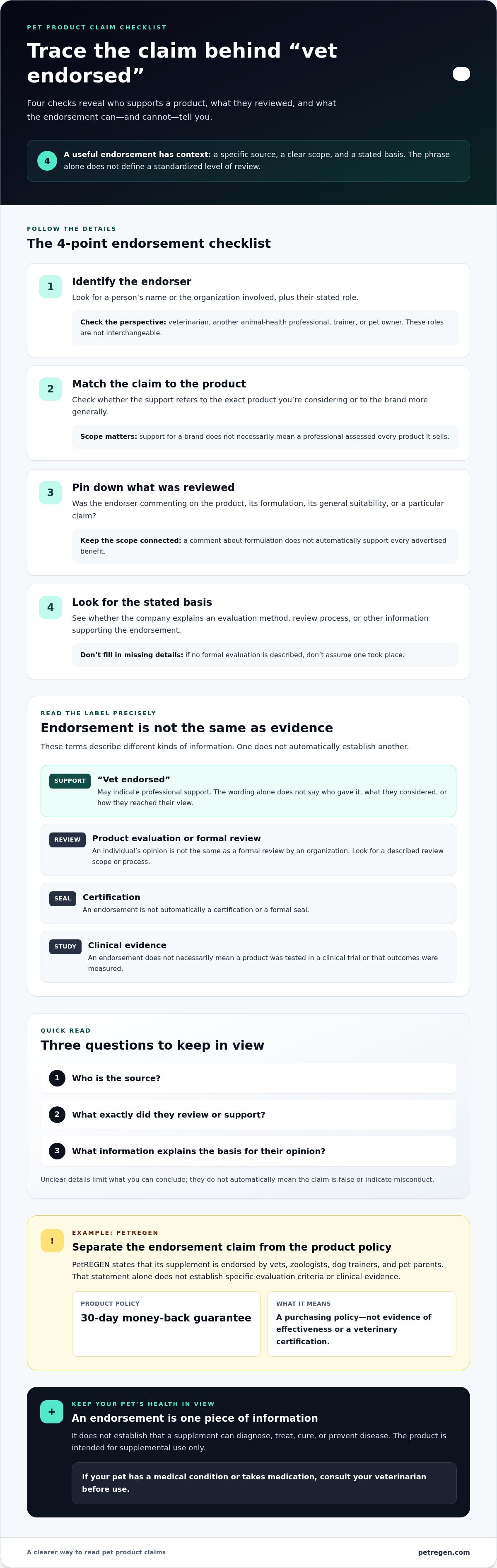
Once you see an endorsement claim, follow the details behind it rather than relying on the wording alone. This simple sequence can help you understand what the claim does, and doesn’t, establish:
- Identify the endorser. Look for a person’s name or the organization involved, along with their stated role.
- Match the claim to the product. Check whether the support refers to the exact product you’re considering or to the brand more generally.
- Pin down what was reviewed. Was the endorser commenting on the product, its formulation, its general suitability, or a particular claim?
- Look for the stated basis. See whether the company describes an evaluation method, review process, or other information supporting the endorsement.
A clear endorsement identifies who supports which product and on what stated basis. A named review process can add useful context, but endorsements don’t all follow the same process. Don’t assume there was a formal evaluation if the product page doesn’t describe one.
Who is the endorser, and what is their role?
Check whether the endorser is identified as a veterinarian, another animal-health professional, a trainer, or a pet owner. These roles can offer different perspectives, so don’t treat them as interchangeable. If a claim doesn’t name an individual or explain their relevant role, avoid inferring their qualifications, experience, or level of involvement. The missing detail limits what you can conclude, but isn’t by itself proof of misconduct.
Was the product, ingredient, or brand actually reviewed?
Scope matters. Support for a brand generally doesn’t necessarily mean that a professional assessed every product it sells. Likewise, a comment about formulation doesn’t automatically support every advertised benefit. Look for wording that connects the endorser to the exact product and clarifies the subject of their opinion. One reviewed feature or claim can’t establish the basis for unrelated claims.
Be careful not to apply guidance beyond its stated context. For example, AAFCO guidelines on 'vet recommended' claims address claims on pet food labels and discuss substantiation through surveys. That resource can help explain why the basis for a recommendation matters, but its specific guidance shouldn’t be treated as a universal review process for every pet product or supplement.
For a concrete example, PetREGEN states that its supplement is endorsed by vets, zoologists, dog trainers, and pet parents. That describes the company’s stated endorsement; it doesn’t identify individual endorsers or establish a particular review method. PetREGEN also offers a 30-day money-back guarantee, which is separate from endorsement details and doesn’t explain how an endorsement was reached. You can consider these points alongside the product information at PetREGEN’s supplement details, then bring health questions to your veterinarian.
Vet Endorsement vs. Certification, Product Review, and Clinical Evidence
These terms can sound similar on a product page, but they describe different kinds of support. If you’re asking what does “vet endorsed” really mean beside claims about a supplement, the key is to identify what was assessed and what the result can actually show. A professional’s opinion, a program’s seal, and a study each have different scopes.
| Category | Who is involved? | What is assessed? | What can it establish? |
|---|---|---|---|
| Informal endorsement | A veterinarian or other professional expressing support | Whatever the endorser says they considered; it may not be described | That the person has stated support, not necessarily that the product was tested or shown effective |
| Formal product review or seal | An organization or panel operating a defined program | Products against that program’s stated criteria and scope | That the product met the program’s criteria, not that every claim or use is validated |
| Clinical evidence | Researchers assessing a specific product or ingredient | A defined intervention, population, methods, and measured outcomes | Evidence related to the conditions and outcomes actually studied, not an automatic guarantee for every pet |
How is a professional endorsement different from a seal?
An endorsement communicates stated support. A seal generally signals that a product has gone through a particular program with defined criteria, so the program’s name and scope matter. VetEndorsed describes the VOHC Seal as applying to oral-care products and plaque or tartar reduction. It also describes VPRC review as involving product quality checks followed by a veterinarian panel. These are examples with specific scopes, not evidence that either organization reviews all supplements or has assessed PetREGEN.
Does vet endorsement prove a supplement works?
No. An endorsement alone doesn’t demonstrate clinical effectiveness or promise a particular result. Ingredient research, testing of the finished product, and a professional’s opinion are distinct forms of information. Research on an ingredient doesn’t automatically establish that a particular product has the same effect, while a professional’s support doesn’t by itself show that outcomes were measured.
Check whether evidence concerns the exact product, the relevant animal, and the specific outcome being claimed. A study of one ingredient or one population may not answer questions about a different formulation or pet. If those details aren’t provided, treat the claim as limited rather than filling in the gaps.
PetREGEN offers a 30-day money-back guarantee. That is a purchasing policy, not a certification or clinical evidence. For any supplement, use professional endorsements as one part of your decision and discuss your pet’s health needs with your veterinarian. This product is intended for supplemental use only. It is not intended to diagnose, treat, cure, or prevent any disease. If your pet has a medical condition or is on medication, consult your veterinarian before use.
A Practical Checklist for Evaluating “Vet Endorsed” Claims
A quick check can help you judge what an endorsement does and doesn’t tell you without assuming the claim is misleading. Use the questions below to spot useful detail, identify gaps, and decide what to ask your veterinarian.
- Can you identify the endorser? Look for a name or organization and a clear description of the person’s role. Don’t infer veterinary qualifications from a general title such as “expert.”
- Does the claim name the exact product? A statement about a brand may not explain whether the specific supplement you’re considering was reviewed.
- What does the endorsement cover? Check whether the support relates to formulation, general suitability, a particular product feature, or a specific health-related claim.
- Is the basis described? Look for an explanation of the review, evaluation, or information behind the opinion. A process may not be provided, so avoid assuming one took place.
- Is relevant context disclosed? Note any stated commercial relationship, limitations, or other information that could help you understand the endorsement.
- Do the product details align? Compare the claim with the product’s stated purpose, directions, and disclaimers. Clear product information matters in its own right.
Questions to ask when a claim is vague
Ask who is endorsing the product, whether the support applies to that exact product and claim, and what evaluation or evidence the company describes. Also look for relevant limitations or relationship disclosures. If the answer isn’t available in the claim itself, treat the endorsement as incomplete information, not as proof of effectiveness or evidence of misconduct.
Red flags that call for a closer reading
Pause if endorsement language sits beside guaranteed health outcomes or claims that a supplement treats a disease. Check the issuing organization and scope when a seal or credential is mentioned without explanation. Broad phrases may still reflect someone’s genuine opinion, but they don’t show you what was assessed. Endorsement language should never replace clear product information or veterinary advice.
For health concerns, focus on your pet’s individual situation, not a marketing phrase. A veterinarian can help you consider whether a supplement is appropriate alongside your pet’s care, particularly if your pet has a medical condition or takes medication. PetREGEN describes its supplement as endorsed by vets, zoologists, dog trainers, and pet parents; explore the PetREGEN supplement information with the checklist above, and keep the 30-day money-back guarantee separate from questions about evidence.
This product is intended for supplemental use only. If your pet has a medical condition or is on medication, consult your veterinarian before use.
PetREGEN's Vet Endorsement: What to Do Next
PetREGEN describes its supplement as endorsed by vets, zoologists, dog trainers, and pet parents. That is the company’s stated endorsement. It should be understood on those terms, not as a formal seal, a claim that a named veterinarian has assessed the product, or proof of clinical effectiveness. The different groups may bring different perspectives, but the statement alone doesn’t specify individual endorsers or the process behind their support.
So, what does "vet endorsed" really mean in this case? It tells you how PetREGEN describes the support for its supplement. It doesn’t tell you that an organization has certified the product or that a particular health outcome is guaranteed. Keep the endorsement in context, alongside the product’s own details and your veterinarian’s guidance for your pet.
What PetREGEN’s endorsement statement should, and should not, signal
PetREGEN’s daily powder supplement is intended for dogs, cats, birds, and horses, for pets of all ages and sizes. The company describes it as supporting healthy joints, mobility, comfort, recovery, and whole-body wellness. These are supplemental support areas, not a promise of results for an individual animal and not veterinary treatment.
Use the endorsement as one input in your decision, not a substitute for your own assessment. Read the product information to understand its stated purpose and serving directions for your pet. If you’re considering support for mobility or comfort, or have questions about recovery or wellness, your veterinarian can help you weigh those considerations in light of your companion’s health and care.
Make an informed next step for your companion
Before deciding, compare the endorsement statement with the product information: Does the stated purpose fit what you’re looking for? Are the directions clear for your pet? Do the disclaimers set appropriate boundaries? Taking a moment to review these details can help you make a considered choice rather than relying on a reassuring phrase alone.
PetREGEN offers a 30-day money-back guarantee. That policy may be relevant to your purchasing decision, but it doesn’t establish clinical evidence or change the role of the supplement. Continue to involve your veterinarian in health questions, especially if your pet has a medical condition or takes medication.
This product is intended for supplemental use only. If your pet has a medical condition or is on medication, consult your veterinarian before use.
If you’d like to review the product information and serving directions, explore PetREGEN’s supplement and decide whether it’s worth discussing with your veterinarian.
Make Your Next Choice With Confidence
The question “what does "vet endorsed" really mean” is ultimately about how much confidence a claim deserves. Let it guide you toward better questions, not make the decision for you. Consider what’s stated about the product, how it fits your companion’s needs, and whether your veterinarian’s advice supports your next step. That thoughtful approach helps keep your pet’s wellbeing at the center, whether evaluating wellness supplements or exploring specialized grooming options for curly-coated breeds via royaloodle.com.au.
PetREGEN states that its supplement is endorsed by vets, zoologists, dog trainers, and pet parents. Treat that as the company’s endorsement statement, not as a clinical result or guarantee of a health outcome. The product also comes with a 30-day money-back guarantee, a separate purchasing policy. If you’re curious, review the details at your own pace and bring any health questions to your veterinarian.
Explore PetREGEN’s supplement and take the next step that feels right for you and your companion. Informed choices, made with care, can help you feel more confident about supporting your pet.
Frequently Asked Questions
What does “vet endorsed” mean for a pet supplement?
For a pet supplement, “vet endorsed” generally signals that one or more veterinary professionals have expressed support. It doesn’t tell you whether they assessed the finished product, a particular ingredient, or a broader idea. To understand what does “vet endorsed” really mean for a specific label, look for the endorser’s identity, the exact product and claim involved, and the stated basis. That support can inform a choice, but can’t guarantee results or replace your veterinarian’s advice.
Is “vet endorsed” the same as vet approved?
No, the phrases shouldn’t automatically be treated as interchangeable or as a universal certification. “Vet endorsed” may describe a professional’s stated support. A formal approval or seal should identify the organization behind it and explain its assessment process. Before relying on either phrase, check who is making the claim and what product or claim it covers. Endorsement wording alone doesn’t establish regulatory approval.
Does a veterinarian’s endorsement prove a pet supplement works?
No. An endorsement phrase by itself can’t prove that a supplement will produce a particular result for your pet. A veterinarian’s opinion, a review of the finished product, and product-specific clinical evidence are different kinds of information. For example, a positive customer story describes one experience, not necessarily what other pets can expect. Check what supports the specific claim, and discuss health concerns with your veterinarian rather than treating endorsement as proof of disease treatment.
How can I check whether a pet product is genuinely vet endorsed?
Look for the endorser’s name or organization, their relevant role, the exact product reviewed, and the stated reason or process behind the support. Check whether the endorsement refers to the whole brand or the particular product and claim you’re considering. If those details aren’t provided, treat the phrase as incomplete information, not proof. Then compare it with the product directions and disclosures, and raise questions with your pet’s veterinarian.
Are vet-endorsed supplements safe for every pet?
No endorsement establishes that a supplement is suitable for every individual animal. A pet’s health and medications matter, so consult a veterinarian before use if your pet has a medical condition or takes medication. For PetREGEN, a daily powder for dogs, cats, birds, and horses, pets of all ages and sizes, the guidance is: “This product is intended for supplemental use only. If your pet has a medical condition or is on medication, consult your veterinarian before use.”
Can a vet-endorsed supplement replace a veterinarian’s care?
No. An endorsement can’t diagnose a problem or create a care plan. Discuss symptoms, medical conditions, and medication changes with your veterinarian; a supplement is intended only for supplemental use. For PetREGEN, which is for dogs, cats, birds, and horses, pets of all ages and sizes, the product guidance states: “This product is intended for supplemental use only. If your pet has a medical condition or is on medication, consult your veterinarian before use.”
What is the difference between a vet endorsement and a product certification?
An endorsement generally communicates a professional’s stated support. A certification or seal should identify an issuing organization and its assessment process, including what the process covers. VetEndorsed describes the VOHC Seal as relating to oral-care products and plaque or tartar reduction; it describes VPRC review as involving product quality checks and a veterinarian panel. These examples have specific scopes, not universal supplement coverage or an endorsement of PetREGEN.


