

What if a scientific-sounding claim tells you less than a clear ingredient label? If you’re deciding what belongs in your pet’s care routine, learning how to research pet supplement companies can help you look past polished marketing and focus on the details that matter. Endorsements and positive reviews may be reassuring, but they don’t show on their own whether a finished product has been studied or whether its label makes clear what’s inside.
This guide gives you a repeatable way to compare companies, product information, quality disclosures, and a supplement’s fit for your companion. You’ll learn how to distinguish research on an ingredient from evidence about a finished product, what to look for in ingredient amounts and intended use, and how to evaluate claims without treating marketing as proof.
PetREGEN’s Stem Cell Activator Supplement provides a practical example of how to separate a company’s product information from independent research and clinical conclusions. You’ll also see how to prepare useful questions for your pet’s veterinarian, so supplement decisions can be considered alongside the care your pet already receives.
Key Takeaways
- Use a repeatable checklist to compare a company’s claims, product label, sourcing details, and quality practices.
- When learning how to research pet supplement companies, check whether evidence relates to an ingredient or the finished product, and note what each study can and can’t show.
- Compare ingredient identity and amounts, intended species, and claim support side by side to identify gaps that need closer attention.
- Start with your pet’s needs, record the sources you review, and bring unresolved questions about supplement fit to your veterinarian.
- Use PetREGEN’s stated formula and product positioning as an example, while keeping company-provided details distinct from independent evidence.
Why research a pet supplement company before choosing a product?
A persuasive label, confident scientific language, and heartfelt testimonials can make a supplement seem like an easy choice. But those signals don’t answer the questions that matter for your pet: What does this exact product contain? What evidence supports its claims? Is it intended for your pet’s species and situation? Researching the company adds context, so you can assess the information behind the product instead of relying on its presentation.
Keep four things distinct. A company makes and markets products; a product is a particular formula; an ingredient is one component of that formula; and a veterinary treatment is care guided by a veterinary professional. A company’s experience or expert endorsements may provide context, but they don’t establish that every product works. Research on an ingredient also doesn’t automatically show that a finished formula has been tested or produces the same results.
Evidence-based supplement research means checking whether reliable evidence supports the specific claims made for the specific product, and understanding what that evidence cannot tell you. This distinction helps you ask focused questions without dismissing promising ideas or mistaking marketing for proof.
What does researching a pet supplement company involve?
Examine the company’s claims, the product’s ingredient list and amounts, any quality or manufacturing disclosures, and the stated intended use. Then trace science-related statements to the research they refer to. Laboratory findings, studies in animals, research on an individual ingredient, and studies of a finished product are different kinds of evidence. They shouldn’t be treated as interchangeable. A professional title or testimonial may be relevant background, but it isn’t a substitute for evidence supporting the formula itself.
Which claims deserve a closer look?
Pay particular attention to language that says a supplement treats a disease or promises a guaranteed result. Such claims deserve careful scrutiny and shouldn’t replace an examination or guidance from your veterinarian. Broad phrases such as “natural” and “science-backed” also need specifics: Which ingredients are meant? What research is cited? Does it match the product, species, and claimed benefit? Copy the exact wording and note where you found it, such as a product label, company webpage, or advertisement. That makes it easier to compare claims with their supporting evidence.
Look for a clear line from claim to support. If a company points to ingredient research, note that it may explain why an ingredient is being considered, but doesn’t establish that the company’s particular blend has been studied. If the material cites a finished-product study, check which product and outcome it describes before drawing conclusions. Record missing details rather than filling gaps with assumptions.
Researching a company is one part of a thoughtful decision, not a diagnosis or replacement for veterinary care. Your pet’s age, health concerns, current diet, and other care can all affect whether a supplement is a reasonable fit. Bring the exact claim and your questions to your veterinarian, especially if your pet has a health condition or is already receiving treatment.
How to assess the science behind pet supplement company claims
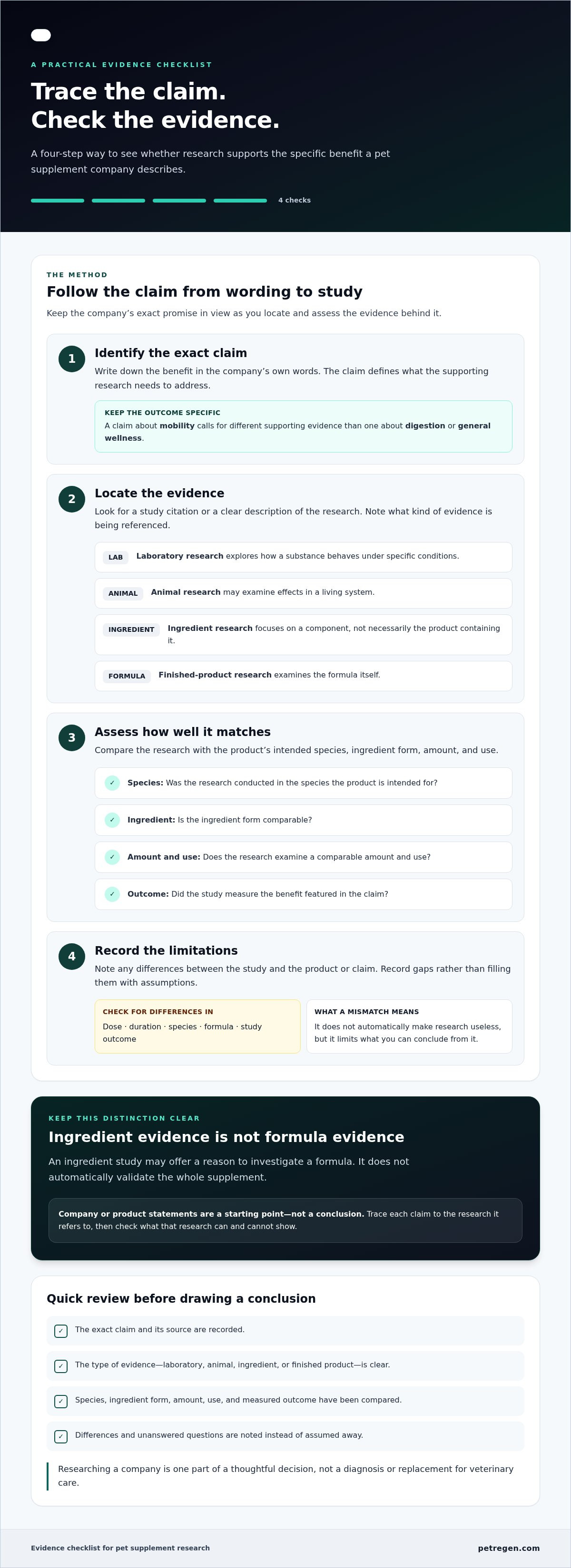
A useful part of how to research pet supplement companies is tracing a specific claim back to the evidence offered for it. “Supported by research” is a starting point, not a conclusion. Find out what was studied, in which animals, at what dose, and whether the measured outcome matches the benefit the company describes.
Use this four-step method:
- Identify the exact claim. Write down the benefit in the company’s own words. A claim about mobility, for example, calls for different supporting evidence than one about digestion or general wellness.
- Locate the evidence. Look for a study citation or a clear description of the research. Note whether it comes from laboratory work, research in animals, a study of an ingredient, or a study of the finished product.
- Assess relevance. Compare the research with the product’s intended species, ingredient form, amount, and use. Check whether the study measured the outcome featured in the claim.
- Record limitations. Note differences in dose, duration, species, formula, or study outcome. A mismatch doesn’t automatically make research useless, but it limits what you can conclude from it.
Laboratory research can explore how a substance behaves under specific conditions, while animal research may examine effects in a living system. Ingredient research focuses on a component, not necessarily the product containing it. Finished-product research examines the formula itself. An ingredient study may offer a reason to investigate a formula, but it doesn’t automatically validate the whole supplement.
How can you tell whether research supports the exact claim?
Compare the study with the label and claim instead of stopping at a familiar ingredient name. Was the research conducted in the same species the product is intended for? Does it examine the same ingredient form and a comparable amount? Did researchers measure the outcome the company highlights, or a different marker? Check how long the study ran and the conditions participants were in. These details show how closely the findings apply to the product and claim.
How should you interpret expert endorsements and testimonials?
Endorsements can provide context about who has reviewed or recommended a product, while testimonials describe individual experiences. Neither is the same as controlled, product-specific research or a clinical conclusion. Ask what the endorsement actually supports, and whether a testimonial explains relevant details such as species, use, or other care. Treat personal stories as individual accounts, not forecasts, and don’t take them as evidence of typical or guaranteed results.
For a concrete example of evaluating company-provided information, compare the stated product positioning and formula for the PetREGEN Stem Cell Activator Supplement with the evidence cited for any specific claim. Keep the company’s descriptions separate from independent findings, and bring questions about relevance or suitability to your veterinarian.
How to compare pet supplement companies and their product transparency
A side-by-side comparison makes information gaps easier to spot than browsing one polished product page at a time. For each product, record what the label and company materials actually say. Use “not stated” for details you can’t find. That’s a prompt for more research, not proof that a product is defective or unsafe.
Use this comparison grid as a starting point for how to research pet supplement companies. Add a column for each product you’re evaluating, and keep your notes factual rather than scoring a brand by its marketing tone.
| What to compare | Company A | Company B |
|---|---|---|
| Ingredient identity and amount | Named ingredients and quantities, where provided | Named ingredients and quantities, where provided |
| Intended species and use | Species, directions, and stated purpose | Species, directions, and stated purpose |
| Claim support | Evidence cited for the specific claim | Evidence cited for the specific claim |
| Sourcing and manufacturing | Disclosed sourcing and quality practices | Disclosed sourcing and quality practices |
| Testing and quality signals | Testing details or named quality program | Testing details or named quality program |
| Unanswered questions | Record missing details and where you looked | Record missing details and where you looked |
What should a transparent pet supplement label show?
Look for ingredient names and quantities where applicable, the species the product is intended for, directions, cautions, and storage guidance. A proprietary blend may explain why every amount isn’t shown, but note what that leaves unclear. Compare the physical label with the company’s online explanation. If they describe different ingredients, uses, or claims, record the discrepancy rather than assuming which version is current.
Which quality and certification signals are worth checking?
Look for specific explanations of ingredient sourcing, manufacturing standards, and quality testing, not just broad assurances. If a company names a certification or program, check what it assesses and whether it applies to the company, facility, or product. The NASC Quality Seal indicates participation in a program that includes a third-party manufacturing audit, quality-control system, labeling guidelines, and adverse-event reporting. It isn’t proof that a product is effective or right for every pet.
Similarly, laboratory accreditation relates to a lab’s competence within its accredited scope; it doesn’t automatically certify a supplement or validate health claims. Look for the named lab, what was tested, and what the reported result covers. A missing disclosure is an unanswered question, not evidence of a confirmed product fault. Keep that distinction clear, then weigh the available details alongside product-specific evidence and your veterinarian’s guidance.
A step-by-step process for researching a pet supplement company
A simple record can make a confusing search more manageable. Start with your pet’s needs, then assess each product against the same questions. This keeps persuasive design, testimonials, and brand familiarity from carrying more weight than information you can actually verify.
Use this checklist for each company and product you’re considering:
- Define your pet’s situation. Note species, age, relevant health concerns, current medications, and what you hope a supplement might support. Avoid treating a symptom as a diagnosis.
- Capture the exact claim. Copy the wording from the label, product page, or advertisement. Record where it appears and the date you reviewed it.
- Review the label. Note ingredient names and amounts where provided, intended species, directions, cautions, and storage guidance. Save a photo or copy so you can refer to the same version.
- Follow the evidence trail. Record each cited study or source, what was examined, and whether it concerns an ingredient or the finished product. Compare its species, dose, duration, and measured outcome with the company’s claim.
- Log quality disclosures. Write down what the company explains about sourcing, manufacturing practices, testing, and any named quality program. Separate specific documentation from broad assurances.
- Mark the strength of each finding. Use “documented,” “unclear,” or “unsupported by the material reviewed.” These labels describe your research, not a definitive verdict on product quality.
- List questions and discuss fit. Note what remains unanswered, then consider whether the available information and your pet’s needs warrant a conversation with your veterinarian.
How do you organize findings across companies?
Use the same headings for every product: claim, label details, intended species, evidence, quality disclosures, source and review date, and open questions. Save exact wording and dates because webpages, labels, and formulas can change. Marking each item as documented, unclear, or unsupported by the material reviewed makes gaps visible without mistaking absent information for proof of a defect.
Keep notes factual. For example, write “the product page names an ingredient, but I couldn’t find its amount,” rather than concluding that the company is hiding information. Consistent records make comparisons fairer and help you revisit a decision if the company updates its materials.
When should your veterinarian be part of the decision?
Include your veterinarian if your pet has a health condition, takes medication, or has a care plan that a new supplement could affect. Bring the product label and a short evidence summary to a routine care discussion. A supplement shouldn’t replace diagnosis or prescribed care. Your veterinarian can help put the product’s intended use in the context of your pet’s health.
To apply the same checklist to PetREGEN’s product information, review the PetREGEN supplement details and compare the stated ingredients and positioning with the evidence relevant to your pet’s needs.
Applying the research checklist to PetREGEN
A worked example shows how to separate a company’s product description from conclusions supported by independent evidence. The details below are company-stated information about PetREGEN’s Stem Cell Activator Supplement. They’re useful starting points for your notes, not proof of a particular outcome for an individual pet.
What can readers evaluate from PetREGEN’s stated product information?
PetREGEN’s Stem Cell Activator Supplement is formulated for dogs, cats, and horses and positioned as a natural superfood supplement. PetREGEN describes its approach as supporting the body’s natural regenerative function by enhancing immune function, and its product information names USA-made, human-grade ingredients, including collagen, real liver, and phytonutrients. Record these as company-stated details, then compare them with the current label and product information. The “Stem Cell Activator” name is product positioning, not veterinary stem cell therapy.
To apply the checklist, separate each kind of information in your notes:
- Product details: Record the stated species, named formula components, and how the company frames the product’s intended use.
- Evidence: Note which specific product claims have research cited, and whether that research concerns an ingredient or the finished formula.
- Company statements: Keep descriptions such as “science-based” or “natural superfood,” along with reported expert endorsements, in a separate category from independent research findings.
- Questions: Mark anything you still need to understand, such as how a cited study relates to a particular claim or your pet’s circumstances.
This distinction matters. Ingredients described as human-grade or USA-made tell you what the company says about ingredient quality and sourcing; those descriptions alone don’t establish that the finished supplement has demonstrated a health outcome. Likewise, endorsements from veterinarians, zoologists, dog trainers, or pet parents are company-reported social proof. They aren’t the same as controlled, product-specific evidence.
How can readers take a clear next step?
Review the current product information using the same questions you’d use for any supplement: What is stated about ingredients, intended species, and use? What evidence supports each particular claim? What remains unclear? PetREGEN also states that it offers a full money-back guarantee. Treat that as a company-stated purchase policy, distinct from scientific evidence or a promise of results.
A checklist doesn’t require you to dismiss a product or accept every claim. It helps you make a more informed comparison and identify the questions that matter for your companion. If your pet has a health condition or takes medication, include your veterinarian in the discussion before changing their care routine.
For the company’s current product information, review PetREGEN’s supplement details and compare its stated product information with your evidence and product-fit checklist.
Make your next supplement decision with care
The value of learning how to research pet supplement companies isn’t finding a perfect promise. It’s having a clear way to decide what you understand, what still needs evidence, and which questions belong in a conversation with your veterinarian. Keep your notes and revisit them if product information changes or your pet’s needs shift.
When considering PetREGEN, read its product information with the same thoughtful eye you’d bring to any supplement. PetREGEN’s Stem Cell Activator Supplement is formulated for dogs, cats, and horses and uses ingredients such as collagen, real liver, and phytonutrients. Consider how the company’s stated product use fits your companion’s care routine, and discuss suitability with your veterinarian if you’re unsure.
Explore PetREGEN’s Stem Cell Activator Supplement and review the product information as you make a careful, informed choice for your companion.
Frequently Asked Questions
How can I tell if a pet supplement company is reputable?
Look for consistent, specific information you can trace, rather than relying on a polished website or confident claims. Check whether the company identifies the product’s intended species, explains its claims, and provides a way to raise product-quality or safety concerns. You can also look for independent quality-program details and see whether company statements match the label. Treat missing information as a question to investigate, not automatic proof of a problem.
Are pet supplements FDA-approved?
Not through a dedicated animal “dietary supplement” approval pathway like the one people may associate with human supplements. In the United States, animal products are generally regulated as animal food or animal drugs, depending on their intended use and claims. A product promoted to treat, cure, or prevent disease may be considered an animal drug. Don’t interpret a supplement’s availability for sale as FDA approval of its safety or effectiveness.
What should I look for on a pet supplement label?
Check that the label identifies the intended species and gives clear directions for use, cautions, and storage information. Look closely at the serving instructions: a container’s total ingredient amount may not tell you how much is provided per serving. Compare the label with the company’s current online product details, and save a photo if you’re discussing the product with your veterinarian. Clear, consistent information makes it easier to assess fit and use.
Does scientific research on an ingredient prove a supplement works?
No. Evidence about one ingredient doesn’t establish that a finished product has the same effect. The formula may combine ingredients in different forms or amounts, and the research may involve another species or measure a different outcome. For example, a study of one form of an ingredient at a particular dose can’t automatically confirm a claim about a blend containing that ingredient. Look for evidence that matches the actual product and claim.
Are customer reviews enough to judge a pet supplement company?
No. Reviews can offer practical clues about things like a pet accepting a product or an owner finding the directions easy to follow, but personal accounts can’t establish that a supplement caused a health change. Experiences may differ, and reviews don’t usually document other care or conditions that could affect an outcome. Use them as one perspective, then assess product documentation and evidence separately rather than treating a high rating as proof.
Should I ask my veterinarian before giving my pet a supplement?
Yes, especially if your pet has a health condition or takes medication. Your veterinarian can help assess whether the product fits your pet’s care plan and whether a symptom needs diagnosis rather than self-management. Bring the label, directions, and your questions to the discussion. Don’t stop or change prescribed care to try a supplement without veterinary guidance. A thoughtful conversation can help you make a decision with your pet’s individual needs in view.


