

What if a nutrient-focused supplement could support an animal’s natural processes without being a treatment? That distinction sits at the heart of the science of regenerative nutrition for animals, a phrase that can sound precise even though it’s used in different ways.
If it’s hard to separate established biology from ambitious marketing, caution makes sense. Nutrition supplies the building blocks and energy animals need for everyday functions, including tissue maintenance and immune activity. But that doesn’t mean a supplement can heal an injury or reverse disease. It’s also important to distinguish evidence about an ingredient from proof that a finished formula delivers the same effect.
This article explains the biological ideas behind regenerative nutrition, what evidence can and can’t establish, and how to assess ingredient and product claims. It also considers where nutritional support, including PetREGEN Stem Cell Activator Supplement, can fit alongside balanced feeding and veterinary care, not in place of them.
Key Takeaways
- The science of regenerative nutrition for animals draws on normal biological maintenance and repair, but “regenerative” isn’t a standardized diagnosis or treatment.
- Proteins, fats, and micronutrients contribute to balanced nutrition, but no single nutrient is a standalone repair solution.
- Assess evidence in layers, from biological rationale and ingredient research to studies in animals and evidence for a finished product.
- Use a responsible sequence: review the whole diet, define a nutrition goal, consider the evidence, and monitor your animal’s response.
- Dogs, cats, and horses have different nutritional needs, so don’t assume a supplement or dose is suitable across species.
What Does Regenerative Nutrition Mean for Animals?
“Regenerative nutrition” isn’t the name of a standardized veterinary diagnosis or treatment. It’s a broad way to describe how nourishment supports ordinary biological functions, including maintenance and repair. The science of regenerative nutrition for animals is easiest to understand when that general idea is separated from claims that a specific food or supplement can produce a particular healing outcome.
A concise definition: Regenerative nutrition is an approach to feeding that aims to provide nutrients animals use for normal body maintenance and repair, without promising to regenerate tissue on demand.
The distinction matters. An animal’s diet supplies energy and essential nutrients that the body uses in many ways. As an overview of Animal nutrition explains, these include macronutrients and micronutrients, each with roles in a balanced diet. Calling a product “regenerative” doesn’t establish that it has a unique biological effect or prove a particular health outcome.
How Is Regenerative Nutrition Different from Regenerative Agriculture?
Regenerative agriculture describes farming systems and their effects on soil, crops, and food production. Animal nutrition concerns what an animal consumes and how its body uses those nutrients. The concepts can connect when agricultural practices shape the ingredients available for feed or food, but they aren’t interchangeable. A farming method doesn’t automatically prove that a food improves animal health.
It helps to distinguish three ideas that are often blended together: farming practices described as regenerative, feeding practices designed to provide appropriate nourishment, and biological processes inside an animal. A food’s origin may be relevant to how it was produced, while its nutritional suitability depends on the animal and its overall diet. Neither label alone shows that it can treat an illness or repair a specific injury.
What Does “Supporting the Body’s Repair System” Mean?
An animal’s body is continually maintaining itself. Cells perform routine tasks, immune activity helps the body respond to challenges, and tissues undergo turnover as older cells are replaced. These processes need energy and nutrients, but they’re complex and vary with species, life stage, and health. “Built-in repair system” is a plain-language metaphor for normal biology, not a guarantee that a supplement will activate healing or restore damaged tissue.
Nutrition can help meet the body’s ordinary needs, especially when the diet is appropriate and balanced. It can’t identify why an animal is limping, losing weight, or recovering slowly, and it shouldn’t delay assessment of concerning changes. Injury, illness, persistent symptoms, and age-related changes may require veterinary evaluation and care. Consider supplements as possible nutritional support within that broader picture, not as substitutes for diagnosis or treatment.
For pet owners, the practical starting point is to treat “regenerative” as a description of an approach and examine the specific meaning behind each claim. Ask what nutrient or biological process is being discussed, what evidence supports the claim, and whether it applies to the animal and product in question. Good nutrition supports normal biology, while outcomes depend on more than a label.
How Nutrition Connects to Animals’ Natural Maintenance and Repair
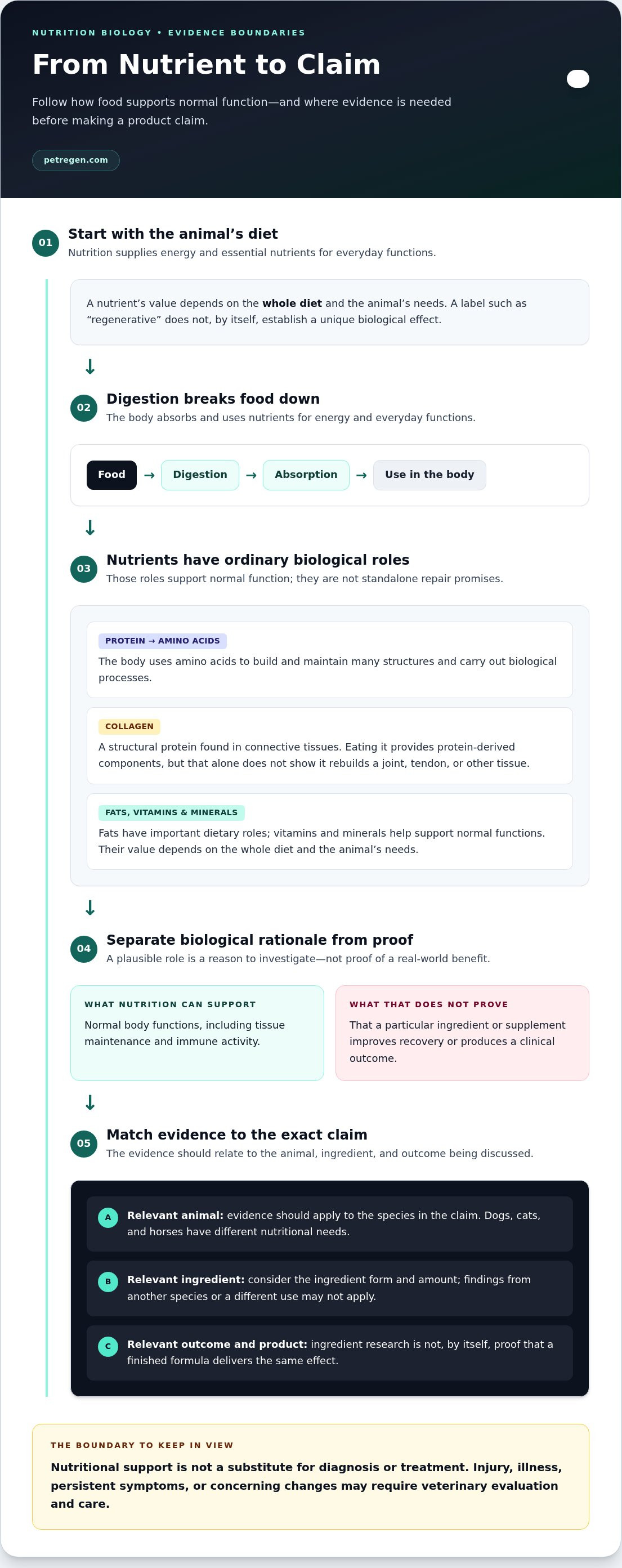
To understand the biology, follow what happens after an animal eats. Digestion breaks food down, and the body absorbs and uses nutrients for energy and everyday functions. Adequate, appropriate nutrition supports normal physiological function, but that general role doesn’t demonstrate that a particular ingredient or supplement improves recovery or produces a clinical outcome.
That distinction is central to the science of regenerative nutrition for animals: a plausible biological role is a reason to investigate, not proof of a real-world benefit. Evidence needs to show what happens in the relevant animal, using the specific ingredient or finished product in the claim.
What Roles Can Amino Acids, Collagen, and Fats Play?
Proteins are made of amino acids, which the body uses to build and maintain many structures and carry out biological processes. Dietary protein is digested into amino acids; a named protein ingredient doesn’t automatically travel intact to a particular tissue or produce a specific recovery effect.
Collagen is a structural protein found in connective tissues. Eating collagen provides protein-derived components, but that fact alone doesn’t show that ingested collagen rebuilds a joint, tendon, or other tissue. Fats also have important dietary roles, while vitamins and minerals help support normal functions. Their value depends on the whole diet and the animal’s needs, not on treating any one nutrient as a standalone regenerative solution.
Omega 7 may appear in supplement formulations, but its presence isn’t evidence of a particular benefit in dogs, cats, or horses. A meaningful assessment needs research relevant to the species, ingredient form, amount, and claimed outcome. Don’t assume findings from another species or a different use apply to your animal.
How Do Immune Function and Oxidative Stress Fit In?
Immune function is a coordinated set of cells and processes, not a switch that a single supplement can simply turn on. Nutrients support normal body functions, including immune activity, but that broad biological connection doesn’t establish that adding an ingredient will strengthen immunity or change an animal’s health outcome.
Oxidative stress describes an imbalance between reactive molecules and the body’s ability to manage them. It’s one part of complex biology, not the sole cause of aging or illness. An ingredient’s antioxidant activity in a laboratory may provide a mechanism worth studying, but it doesn’t prove that the ingredient improves health in a dog, cat, or horse. Species-specific studies and clear outcomes matter.
- Mechanism: Does the nutrient have a plausible role in normal biology?
- Evidence: Has the effect been tested in the relevant species, rather than inferred from laboratory findings or another animal?
- Claim: Does the evidence support the specific promised outcome, or only a more general nutritional role?
This framework helps you assess formulas combining ingredients such as amino acids, collagen, and omega 7 without treating the ingredient list as proof of an outcome. You can review the PetREGEN supplement as a nutritional product while distinguishing its biological rationale from evidence of demonstrated benefits.
What the Science Can, and Cannot, Show About Regenerative Nutrition
Nutrition claims can move quickly from a credible biological idea to a confident promise. A nutrient may play a role in normal biology without being shown to improve a specific health outcome. To assess the science of regenerative nutrition for animals, ask what was studied, in which animals, and what the results actually measured.
Scientific plausibility suggests a possible explanation; demonstrated benefit requires evidence of a meaningful outcome in the animals the claim concerns. The evidence ladder below helps clarify what a study does and doesn’t establish.
| Evidence level | What it can show | What it can’t establish by itself |
|---|---|---|
| Biological rationale | A nutrient or pathway has a plausible role in normal physiology. | That adding a product improves health or repairs tissue. |
| Ingredient research | A specific ingredient has been examined, possibly in a lab or in another species. | That the same effect occurs in a companion animal or a finished formula. |
| Animal studies | An ingredient or intervention has been tested in animals under defined conditions. | That results apply to every species, age, health status, or use. |
| Finished-product evidence | The exact formula has been studied in the relevant animals, with defined outcomes. | More than the population, duration, and endpoints the study supports. |
Evidence doesn’t automatically transfer between humans, laboratory models, dogs, cats, and horses. Species differ, and studies can vary in ingredient form, amount, delivery, and duration. A result observed in cells in a dish, for example, doesn’t show that an animal eating an ingredient will experience the same effect. Research in one animal species may not support an identical claim for another.
Match each claim to the study details: species and population, dose, duration, and measured endpoint. If a study tracks a laboratory marker, it doesn’t necessarily demonstrate improved mobility, comfort, or recovery. Those outcomes matter to owners, but they need to be measured directly before a product claim can reasonably rely on them.
How Can Pet Owners Judge the Strength of a Nutrition Claim?
Start with peer-reviewed research in the species named by the claim, and check which animals were included. Confirm whether researchers tested an individual ingredient or the exact finished formula. Look for a comparison group, relevant measured outcomes, study limitations, and disclosures about funding or conflicts. A testimonial or ingredient study can raise a question, but it can’t substitute for product-specific evidence.
Why Is a Supplement Not the Same as Stem Cell Therapy?
A nutritional supplement and a veterinary procedure are different categories. PetREGEN sells a supplement, not veterinary stem cell therapy. The phrase “stem cell activator” shouldn’t be read as proof that a product is a stem cell treatment or produces a clinically established stem-cell effect. Assess any such claim against evidence for the exact product and outcome, and keep supplements separate from veterinary diagnosis and care.
PetREGEN Stem Cell Activator Supplement is a nutritional product presented around whole-body support. Reading about the PetREGEN supplement alongside the evidence framework helps distinguish product descriptions from what research has demonstrated.
How to Apply Regenerative Nutrition Ideas Responsibly Across Species
Turn a broad nutrition idea into a practical plan by starting with your animal, not a trend or ingredient list. The science of regenerative nutrition for animals is most useful when it prompts thoughtful questions about diet, evidence, and monitoring, while keeping species-appropriate feeding and veterinary care at the center.
- Assess the whole diet. Consider species, life stage, current food, feeding pattern, and health context. A supplement shouldn’t distract from whether the overall diet is suitable and complete for that animal.
- Define the goal. Be specific about what you hope to support, such as maintaining a consistent feeding routine or addressing a nutrition gap identified with professional guidance. A supplement isn’t a substitute for investigating a symptom.
- Review the evidence and label. Check the intended species, ingredient list, feeding directions, and whether evidence relates to the ingredient or the finished product. Don’t assume the same dose or safety profile applies to another species.
- Monitor responsibly. Make changes thoughtfully and track one or two meaningful observations, such as appetite or activity. A change noticed after starting a supplement is worth recording, but timing alone doesn’t prove the supplement caused it.
What Should Owners Consider Before Adding a Supplement?
Start with the animal’s species, life stage, regular diet, and health history. Read the full product label rather than relying on a headline claim: confirm which species it’s intended for, review the ingredients, and follow the stated feeding directions. If the goal involves a health concern, or the animal already takes medication, discuss the plan with a veterinarian before making a change.
Keep a simple record of what you introduce and what you observe. Avoid adding several new products at once, since that makes it harder to interpret a change. Notes can help focus a conversation with your veterinarian, but they’re observations, not proof of cause and effect.
Why Must Nutrition Plans Differ for Dogs, Cats, and Horses?
Dogs, cats, and horses differ in digestive biology, dietary needs, and feeding patterns. Don’t transfer a product or amount intended for one species to another by guesswork. Even animals of the same species can have different needs based on life stage, diet, and health. Follow species-specific directions and guidance rather than assuming that a shared ingredient means a shared dose.
Keep a suitable, complete, and balanced diet as the foundation. Supplements don’t replace the nutrients and overall feeding plan an animal needs, and adding more isn’t automatically better. For horses, consider any supplement in the context of the horse’s existing feeding routine and overall management, not as a stand-alone nutrition plan.
Veterinary input is especially important if your animal is ill, takes medication, is pregnant, has persistent symptoms, or may need a significant diet change. These situations can affect which nutritional choices are appropriate and may call for assessment rather than experimentation. If you’re considering nutritional support for a dog, cat, or horse, explore PetREGEN’s supplement for animals as one option within a broader, species-specific plan.
How PetREGEN Connects Regenerative Nutrition With Whole-Body Support
With the role of nutrition and the limits of evidence in mind, PetREGEN offers a product example of a whole-body approach. PetREGEN Stem Cell Activator Supplement is formulated for dogs, cats, and horses. It’s a science-based natural superfood supplement designed to support immune function and the body’s natural regenerative processes, supporting mobility, recovery, and healthy aging. It is nutritional support, not a treatment for disease or veterinary stem cell therapy.
What Is PetREGEN’s Nutritional Approach?
The formula uses USA-made, human-grade ingredients, including collagen, real liver, amino acids, omega 7, and phytonutrients. These ingredients reflect the formula’s nutritional focus, but their names alone don’t prove a particular health outcome. Ingredient forms, amounts, and current label wording matter when assessing a product, so use the product label for details rather than inferring specifics from a general description.
“Whole-body support” signals a broad approach rather than a claim focused on one symptom. That framing helps explain the product’s intent, but it shouldn’t be mistaken for evidence that every ingredient benefits every animal in the same way. Research on an individual ingredient may not establish what the combined formula does. To assess a claim responsibly, distinguish the product’s stated purpose from findings demonstrated in the relevant species and product.
How Can Owners Explore the Product With Realistic Expectations?
Start by confirming that the product is intended for your animal’s species, then read the ingredient list and feeding directions. Consider your pet’s usual diet, life stage, and health context as part of the decision. Dogs, cats, and horses have different nutritional needs, so don’t assume that suitability or directions for one species apply to another.
A supplement belongs alongside appropriate nutrition and veterinary care, not in place of either. If your animal has an illness, takes medication, is pregnant, or has persistent symptoms, discuss nutrition changes with a veterinarian. This is especially helpful when you’re hoping to address a specific concern: a supplement’s general nutritional purpose doesn’t diagnose the cause or establish that it will change that concern.
Keep expectations grounded. Review the product’s stated purpose, examine its label, and consider available evidence without assuming that “stem cell activator” means proven stem cell treatment. The phrase describes the product’s positioning; it isn’t, on its own, proof of a clinical effect. PetREGEN offers a full money-back guarantee.
If you’re considering nutritional support for your companion, explore PetREGEN Stem Cell Activator Supplement and review how its ingredients and intended use fit your animal’s overall nutrition plan.
Make Your Next Nutrition Choice With Confidence
Your animal’s wellbeing is personal, and nutrition decisions deserve more than a persuasive label or a hopeful promise. Use the science of regenerative nutrition for animals as a reminder to pause, clarify what you want to support, and choose an approach that fits your companion’s needs. If you’re weighing a supplement, write down the question you want it to answer and what evidence would help you feel confident. That simple step can make product information easier to assess and conversations about your animal’s care more focused.
PetREGEN’s full money-back guarantee is part of its offer as you consider the supplement. Whatever you choose, keep expectations grounded and your animal’s overall wellbeing at the center.
Explore PetREGEN Stem Cell Activator Supplement and consider whether its nutritional approach fits your next step.
Frequently Asked Questions
Can regenerative nutrition replace a complete and balanced diet?
No. A supplement should not replace a complete and balanced diet or veterinary care. It may add nutritional support, but it isn’t designed to provide every nutrient an animal needs. For example, adding a powder to a cat’s meals won’t make an otherwise unsuitable diet complete. Keep species-appropriate food as the foundation, follow the product label, and discuss major diet changes with a veterinarian, especially if your animal has a health condition or takes medication.
Can dogs, cats, and horses take the same regenerative nutrition supplement?
Some products, including PetREGEN, are formulated for dogs, cats, and horses, but that doesn’t mean each animal should receive the same amount. Species, body size, health, diet, and label directions all matter. Use only the directions intended for your animal, and don’t estimate a dose based on another species or a larger companion. If your animal has a medical condition or takes medication, discuss the product’s suitability with a veterinarian.
Is the term regenerative nutrition a veterinary treatment category?
No. The science of regenerative nutrition for animals concerns a broad nutritional approach, not a veterinary diagnosis or defined procedure. A product’s use of “regenerative” describes its positioning; it doesn’t establish that the product treats a condition. Read claims carefully and distinguish nutritional support from veterinary stem cell therapy or prescription medicine. If your animal develops symptoms, focus on finding out what’s causing them rather than relying on a label to explain or resolve the problem.
Can a supplement activate an animal’s stem cells?
The phrase “stem cell activator” alone doesn’t prove that a supplement produces a specific clinical result. To assess the claim, look for evidence that directly examines the claimed effect in the relevant species, rather than relying only on a proposed mechanism or a study of an individual ingredient. Also consider what researchers measured: a change in a laboratory marker doesn’t automatically mean an animal feels or functions differently. Don’t confuse supplement language with veterinary stem cell treatment.
How long does it take to notice a change after starting an animal supplement?
There’s no universal timeline that applies to every animal or product. If you decide to use a supplement, note your animal’s usual appetite, activity, and other relevant patterns before starting, then track observations consistently. Avoid introducing several new products or diet changes at once, since that makes changes harder to interpret. A sudden, worsening, or persistent symptom needs veterinary advice rather than a wait-and-see period for a supplement to take effect.
Should I tell my veterinarian that my pet is taking a supplement?
Yes. Share the product name and ingredient label so your veterinarian can consider it alongside your animal’s diet, health conditions, and medications. This is particularly helpful before surgery, during care for a chronic condition, or if symptoms change. Keep the label or a clear photo of it with your pet’s health records. Sharing this information supports coordinated care, but it doesn’t mean the supplement has been shown to work for a particular condition.


