

What if your horse’s best day isn’t proof that a supplement is working, and a stiff morning isn’t proof that it isn’t? If you’ve wondered how to tell if my horse's supplement is working, you’re not alone. Changes in mobility, energy, comfort, or recovery can be subtle, and one good or difficult day rarely tells the whole story.
It’s hard to compare week to week when workload, weather, turnout, and routine keep changing. The clearest clues often come from consistent trends, not isolated ups and downs. Some changes may take weeks or months to notice, so pair patience with careful observation.
This guide will help you choose practical signs to monitor, record them in a simple, repeatable way, and make fair comparisons over time. You’ll also learn how to share observations and concerns with your veterinarian, so you can discuss whether to keep monitoring, reconsider expectations, or look into another cause. A supplement can be part of a thoughtful wellness routine, but it isn’t a substitute for veterinary assessment.
Key Takeaways
- To learn how to tell if my horse's supplement is working, look for sustained changes in relevant signs rather than relying on one unusually good or difficult day.
- Build a useful baseline by noting your horse’s usual comfort, mobility, energy, and routine before judging progress.
- Compare similar days and keep brief, consistent notes so changes in workload, footing, weather, or care don’t muddy the picture.
- Follow the product label and discuss your observations or concerns with your veterinarian, especially if your horse’s condition changes.
- Consider PetREGEN as a wellness-support supplement, not a substitute for veterinary assessment or treatment.
How to Tell If Your Horse’s Supplement Is Working Starts With a Clear Baseline
Before judging whether a supplement may be supporting your horse, define what you hope to observe. A supplement may be considered helpful when a relevant change in your horse’s everyday wellbeing is sustained over time, not when one observation appears better. This is a practical way to assess a trend, not proof that a supplement treated an injury or disease.
Start with a “before” picture. Note what’s normal for your horse before introducing a supplement, including their usual workload, turnout, footing, feeding routine, and behavior. A horse that is naturally slower to warm up, for example, shouldn’t be compared with one that moves freely from the first step. Understanding general horse nutrition can also put feeding and activity into context, while a veterinarian can help assess your individual horse’s diet and health.
What changes might an owner reasonably monitor?
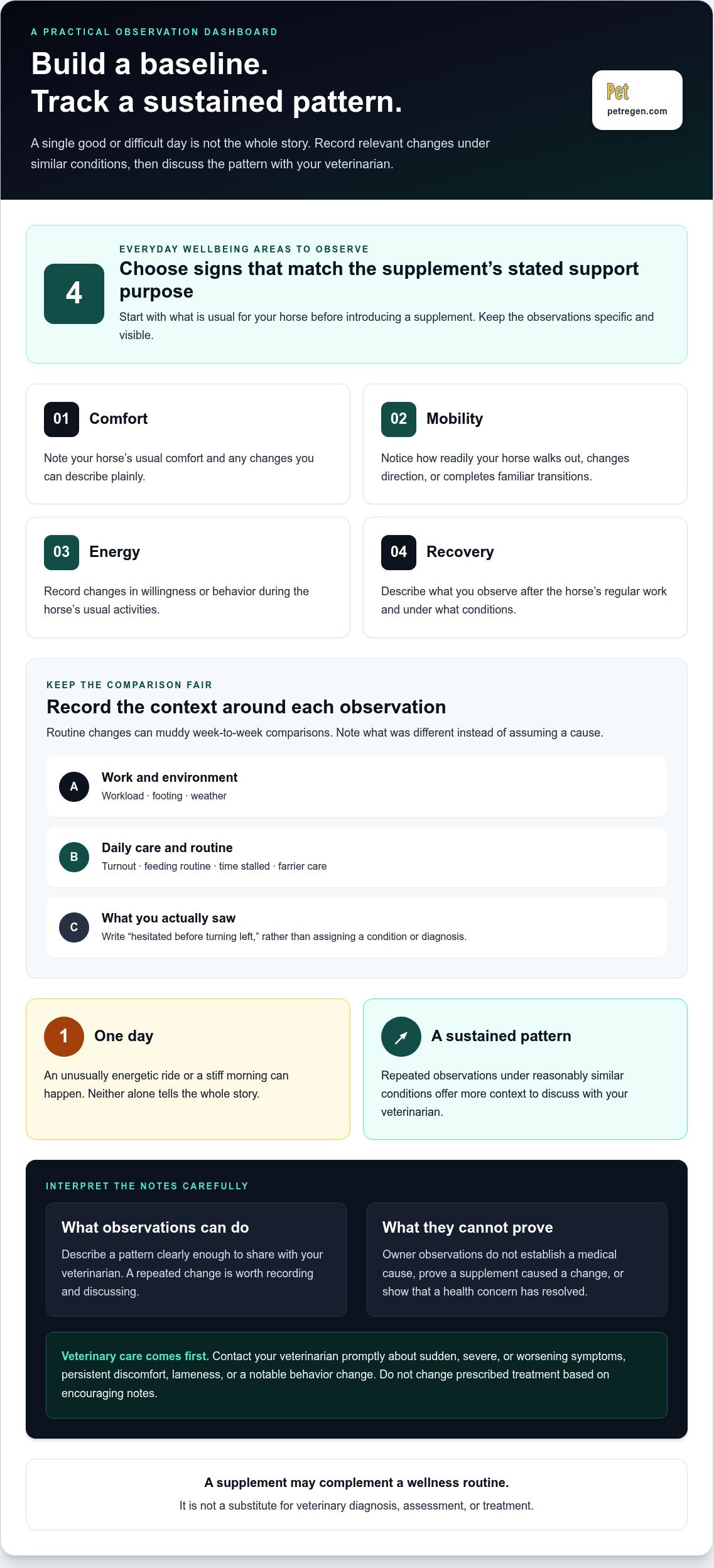
Choose a few visible observations that match the supplement’s stated support purpose. If you’re focused on mobility or recovery, notice how readily your horse walks out, changes direction, or settles after their usual work. Describe what you see: “hesitated before turning left” is more useful than labeling the horse with a condition. Record the circumstances too, such as whether the horse had just been stalled or worked on different footing.
Keep expectations grounded. A change in willingness or movement can have more than one explanation, so observations don’t diagnose the cause. The goal is to describe a pattern clearly enough to discuss it with your veterinarian, not to determine on your own whether an injury or disease is present.
Why one unusually good or difficult day proves little
Horses don’t perform or behave identically every day. Workload, footing, weather, routine, and ordinary variation can all affect what you notice. One energetic ride might feel encouraging, while a stiff morning might raise concern, but neither tells the whole story. A series of observations under reasonably similar conditions gives you more context than a single impression.
For a useful comparison, note whether the horse had a typical day or an unusual one. Record changes in exercise, turnout, farrier care, feeding, or routine alongside your observation. If several factors shift at once, it becomes harder to connect a change to any one cause. That uncertainty is a reason to keep the record factual and avoid jumping to conclusions.
So, how to tell if my horse's supplement is working? Look for a sustained change in the specific signs you chose to observe, while remembering that intended support doesn’t guarantee an individual response. Supplements aren’t substitutes for veterinary diagnosis or care. If a new or worsening concern appears, or you’re unsure how to interpret a change, contact your veterinarian rather than waiting for a supplement to resolve it.
What a Horse Supplement Can Support, and What It Cannot Prove
A supplement’s stated purpose describes the kind of support it is intended to provide. It doesn’t establish that the product will change a particular horse’s comfort, mobility, energy, or recovery, and an owner’s observations can’t diagnose the reason for a change.
Nutritional support may complement a horse’s wellness routine, but it isn’t veterinary diagnosis or treatment. That distinction matters if you’re weighing how to tell if my horse's supplement is working. A noticeable difference is worth recording, but it doesn’t prove the supplement caused it or that an underlying health concern has resolved.
Evidence also needs to be interpreted carefully. Research on an individual ingredient doesn’t automatically demonstrate that every product containing it has the same effects, or that every horse will respond. The formula, amount provided, the horse’s diet and health, and the outcome measured all matter. For a broader foundation, the Merck Veterinary Manual explains the nutritional requirements of horses, including how dietary needs relate to the whole feeding plan. Your veterinarian can help assess whether a supplement makes sense for your horse.
How to interpret mobility, energy, and recovery observations
Think of your notes as owner observations, not clinical measurements. Instead of writing “mobility improved,” record something you could see: your horse stepped into a familiar walk more readily, completed the usual transitions without hesitation, or seemed willing to finish a routine activity. For recovery, describe what you observed after the horse’s regular work and under what conditions.
These details make a conversation with your veterinarian more useful, but they don’t establish a medical cause. Workload, footing, routine, and other health factors may contribute. Even a repeated improvement is a pattern to discuss, not proof of treatment or a reason to dismiss new discomfort.
When supplement tracking should not delay veterinary care
Don’t wait for a tracking period to end if your horse has sudden, severe, or worsening symptoms. Contact your veterinarian promptly. Persistent discomfort, lameness, or a notable behavior change also deserves veterinary attention, especially if it affects normal movement, eating, or daily activities.
Keep prescribed care separate from supplement observations. Don’t stop, reduce, or change a veterinary-prescribed treatment because your notes seem encouraging, and don’t use a supplement in place of an assessment. Share what you’ve recorded, when the change began, and any relevant routine changes with your veterinarian. That gives them useful context to decide what the observation may mean and what to do next.
If you’re considering a supplement as one part of a broader wellness routine, learn about the PetREGEN horse supplement and its intended support role, while keeping your veterinarian involved in decisions about your horse’s health.
How to Separate Supplement Progress From Normal Equine Variation
A horse can seem freer after an easy day and less willing after a demanding ride, even if nothing about the supplement has changed. To judge whether an observation might be part of a trend, compare like with like: similar activity, footing, turnout, and time in the routine. Note what differed on unusual days instead of treating every change as evidence for or against the supplement.
Think of the record as a way to spot patterns and ask better questions, not as a test that proves cause. If your horse appears more comfortable after the workload drops, for example, the lighter work is relevant context. A pattern can help guide a veterinary conversation, but it can’t establish on its own what caused the change.
Which routine changes can affect what you observe?
Alongside each observation, note factors that may shape how your horse moves, behaves, or recovers. These can include exercise intensity, training, turnout, travel, footing, weather, farrier care, feeding, and other supplements. You don’t need a long diary. A few factual words, such as “hilly ride,” “new arena surface,” or “travel day,” can make a comparison more meaningful.
Avoid changing several parts of the routine at once just to test a supplement. If a major diet or care change is being considered, discuss it with your veterinarian or another appropriate equine professional.
The table below shows how to keep observations separate from possible explanations:
| What you notice | What stayed the same or changed | Possible context to record |
|---|---|---|
| Moves more freely during a familiar warm-up | Same exercise and footing as usual | Note the observation again on comparable days; don’t assume what caused it |
| Seems less willing to complete a usual activity | Workload was heavier than usual | Record the harder session and how the horse behaves afterward |
| No clear difference in familiar transitions | Routine remained largely unchanged | Mark the observation as unchanged; it still helps show the full picture |
How to interpret mixed or inconsistent results
Mixed results are still useful. Your horse might seem more willing to walk out but show no noticeable change in recovery after familiar work. Record both. Don’t choose only the best days as evidence of progress, and don’t let one difficult day erase a longer pattern. Review the full set of observations, including the days that don’t fit your expectation.
If you’re asking how to tell if my horse's supplement is working, look for a repeated change under reasonably comparable conditions while considering what else changed. If the record is inconsistent or hard to interpret, share it with your veterinarian. They can consider the observations alongside your horse’s health, care, and routine, and help decide whether further assessment is needed.
A Simple Horse Supplement Tracking Plan You Can Use at Home
A useful log doesn’t need to take long. Its job is to help you compare observations consistently, remember how the supplement was used, and bring clear information to your veterinarian. Keep the process manageable so it fits into your usual care routine.
Record a baseline, follow the label, observe consistently, and review the full trend. This checklist keeps tracking organized without promising a particular result.
- Choose a few relevant observations. Select the signs you want to follow, such as willingness to move through familiar transitions, comfort during a usual activity, or behavior after routine work. Use the same plain-language descriptions each time.
- Note the normal routine. Write down typical activity and care details so later entries have context. Record the supplement’s start date and follow its label directions.
- Make brief, regular entries. Note what you observed, whether the supplement was given as directed, and anything unusual about that day. Include missed servings or changes in use without trying to compensate unless the label or your veterinarian advises you to.
- Review rather than react. Look across the record for recurring patterns, unchanged signs, and entries that may have been affected by a different routine. Discuss questions or health concerns with your veterinarian.
What to include in a horse supplement log
Keep the same fields each time. For example, an entry might read: “Tuesday, usual turnout and light ride, same arena; walked into familiar transitions willingly; supplement given as directed; no other notable changes.” If you take photos or videos, use comparable conditions, such as similar lighting, location, activity, and camera angle. These records document what you see; they don’t diagnose a cause.
- Date and routine: Note turnout, exercise, travel, or anything outside the usual pattern.
- Movement or behavior: Describe a visible action rather than assigning a medical label.
- Supplement use: Record whether it was given according to the label and note missed servings or changes.
- Other notable changes: Include relevant differences in care, feeding, activity, or the horse’s behavior.
A notebook, spreadsheet, or notes app can all work. Choose the format you’ll actually use, and keep each entry factual and short.
When and how to review the record
Review entries periodically instead of judging the supplement by each individual day. There’s no universal deadline for seeing a change; follow product directions and ask your veterinarian what expectations make sense for your horse. Some changes may take weeks or months to become noticeable. Bring the log and any questions to appointments, particularly if you’re tracking a change in comfort, movement, or behavior.
If you’re considering a supplement as part of your horse’s wellness routine, explore PetREGEN’s horse supplement and follow its label directions while continuing to monitor your horse thoughtfully.
Considering PetREGEN for Your Horse? Set Realistic Expectations and Next Steps
PetREGEN is a horse supplement designed to support the body’s natural regenerative function by enhancing immune function, and to support mobility, recovery, and healthy aging. Its multi-system formula cleans, nourishes, and supports pets, with ingredients including collagen, real liver, and phytonutrients. The ingredients are USA-made and human-grade. These details describe the formulation and intended support role, but they can’t predict how an individual horse will respond.
Keep the distinction clear: a supplement may be part of a thoughtful wellness routine, but it isn’t veterinary stem cell therapy, a prescription medicine, or a substitute for examination and treatment. If your horse has a health concern, talk with your veterinarian about assessment and care before relying on a supplement. An observed change during use is useful information to record, not proof that the product caused it.
How PetREGEN fits into a measured wellness routine
Start by considering whether its stated support areas match what you want to monitor, such as everyday mobility, comfort, or recovery after familiar activity. Use PetREGEN according to its label directions. Record use consistently, including missed servings or other relevant changes, and keep observations factual. The goal is to notice patterns without assuming a particular result.
When you’re deciding how to tell if my horse's supplement is working, the product’s intended purpose can help you choose what to observe, but it shouldn’t dictate what you conclude. A change may have several possible explanations, and a lack of visible change is also worth noting. Bring questions or concerns to your veterinarian, especially if your horse’s condition changes or they receive other care.
A confident next step for owners
Before adding a supplement, consider your horse’s current diet, health, and routine with your veterinarian. This is especially helpful if your horse takes prescribed medication, already receives other supplements, or has ongoing discomfort. Don’t stop or alter prescribed care based on supplement observations. Follow PetREGEN’s label directions and discuss its use alongside your horse’s existing care with your veterinarian.
Then give your plan enough consistency to make your notes useful, while avoiding a fixed results deadline that doesn’t account for the individual horse or the product’s directions. Review the full record, not just the most encouraging days, and share it with your veterinarian if the pattern is unclear. Your horse’s comfort and appropriate care remain the priority.
If PetREGEN’s stated support role aligns with your goals, explore PetREGEN Stem Cell Activator for horses and consider it as part of a veterinarian-informed wellness routine. Keep expectations measured, track observations honestly, and let your horse’s health needs guide the next step.
Make Your Next Step About Your Horse
The most useful outcome of tracking isn’t a verdict you have to reach alone. It’s a clearer starting point for deciding what to watch next with your veterinarian. Before your next conversation, choose the observation that matters most to your horse’s daily comfort, then ask what would count as a meaningful change and what signs should prompt a fresh assessment.
That shared plan can make the next few weeks feel less like guesswork. Keep your notes honest, stay open to explanations beyond the supplement, and let your horse’s needs guide any adjustments. If you’re considering a supplement, explore PetREGEN for horses and review the product information with your horse’s wellbeing in mind.
Knowing how to tell if my horse's supplement is working takes patience, thoughtful observation, and good veterinary communication. You’re already taking a caring step by paying attention. Keep asking questions, and keep your horse at the center of the plan.
Frequently Asked Questions
How long should I monitor my horse before judging whether a supplement is helping?
There isn’t one waiting period that fits every supplement or goal. Follow the product label and ask your veterinarian what timeframe is reasonable for your horse. Some changes may take weeks or months to become noticeable. Hoof quality can take about 9 to 12 months to grow out, so a short-term check won’t show the full picture. Seek veterinary advice sooner if your horse’s health or comfort worsens.
Can a horse supplement cause side effects or changes in appetite?
Yes, a horse may have an unwanted reaction or a change in appetite after a supplement is introduced, though the cause may not be clear. Note when the change began, how much was given, and any other recent diet or care changes. Contact your veterinarian for advice, especially if your horse stops eating, seems unwell, or develops sudden or severe symptoms. Don’t assume a new sign is harmless or caused by the supplement alone.
Should I tell my veterinarian that my horse is taking a supplement?
Yes. Share the product name, ingredient label, amount given, when you started it, and why you chose it. This gives your veterinarian useful context when reviewing your horse’s diet, health, and care plan. Bring details for other supplements and medications too, rather than relying on memory. If you have the packaging or a clear photo of the label, keep it available for your appointment.
Can I give my horse more than one supplement at the same time?
Sometimes, but check with your veterinarian before combining products. Different labels may list overlapping ingredients or nutrients, and the total amount from several products can be hard to assess by sight. Provide the full labels and explain what each supplement is intended to support. If your veterinarian approves a change, introducing one new product at a time can make it easier to notice changes or concerns.
What should I do if my horse refuses a supplement?
Don’t force it or change the serving amount to make it easier to give. Check the label for directions on how it can be offered, and ask your veterinarian whether mixing it with a small portion of familiar feed is appropriate. Avoid putting it into a full ration if your horse may leave some behind. If refusal continues or appetite changes, contact your veterinarian to discuss what may be going on.
Can a horse supplement interact with medication?
It can be difficult to know whether a supplement is suitable alongside a medication without reviewing both products. Tell your veterinarian the medication name, dose, and schedule, and provide the supplement’s complete ingredient label before adding it. This also applies to non-prescription products and anything already mixed into feed. Don’t stop, reduce, or alter prescribed medication based on supplement use or your observations without veterinary guidance.
Is a natural horse supplement automatically safe for every horse?
No. “Natural” doesn’t mean a product is right for every horse or appropriate at any amount. A horse’s health, diet, other supplements, and medications can all matter when considering a new product. Read the label, use only the stated directions, and discuss individual concerns with your veterinarian. If your horse is unwell or has a known dietary or health issue, get veterinary guidance before introducing something new.


