

What if the clearest clue to a change in your pet’s movement is already happening during an ordinary walk across the room? Subtle shifts can be hard to describe from memory, and one video may capture an unusual moment rather than your companion’s usual gait. A video diary to track pet mobility gives you a simple way to compare short clips over time and bring specific observations to your veterinarian.
Learn what to film, how to keep conditions consistent, and what details to note so each clip is easier to understand later. You’ll also find guidance on organizing recordings and sharing them with your veterinarian. A few thoughtful clips and brief notes can create a useful record without asking you to diagnose the cause of a change yourself.
Key Takeaways
- A video diary to track pet mobility pairs dated clips with brief, factual notes, helping you compare everyday movement over time without trying to diagnose the cause.
- Film in a familiar, safe space with steady, well-lit footage that shows your pet’s whole body moving.
- Log the date, activity, surface, visible observations, and relevant context so your veterinarian has clearer details to discuss.
- Choose a manageable filming routine with veterinary guidance, and let your pet move naturally rather than repeating actions for the camera.
- Compare clips from similar settings, and seek veterinary advice when you notice a concerning change in your pet’s movement.
Why Keep a Video Diary to Track Pet Mobility?
It can be difficult to describe a small movement change after the moment has passed. Was your dog slower getting up today, or did it just feel that way? A video diary to track pet mobility gives you a dated record: short clips of ordinary movement paired with factual notes. Instead of relying on memory alone, you can compare what your pet did in similar situations.
The goal isn’t to monitor every step or interpret movement like a clinician. It’s to collect useful observations over time. A clip may show your cat pausing before jumping down, or your dog taking a few moments to rise after resting. Repeated recordings can help you notice whether something happens again. A single unusual moment may simply reflect that day’s activity or surroundings, and it doesn’t establish a lasting change.
Recordings can make a veterinary appointment more specific. Rather than saying, “I think walking looks different,” you can share a clip and explain when it was filmed, what your pet was doing, and whether you’ve noticed the same thing elsewhere. Video supports the conversation; it doesn’t replace your veterinarian’s questions, examination, or judgment.
What can a mobility video diary help you notice?
Focus on visible actions, not what you think they mean. Note whether your pet rises in one smooth movement or pauses, walks across a room, turns around, or settles into a resting position. These are observations, not conclusions about pain or its cause. Gait analysis examines how movement is assessed, but a home video remains an informal record, not a clinical assessment.
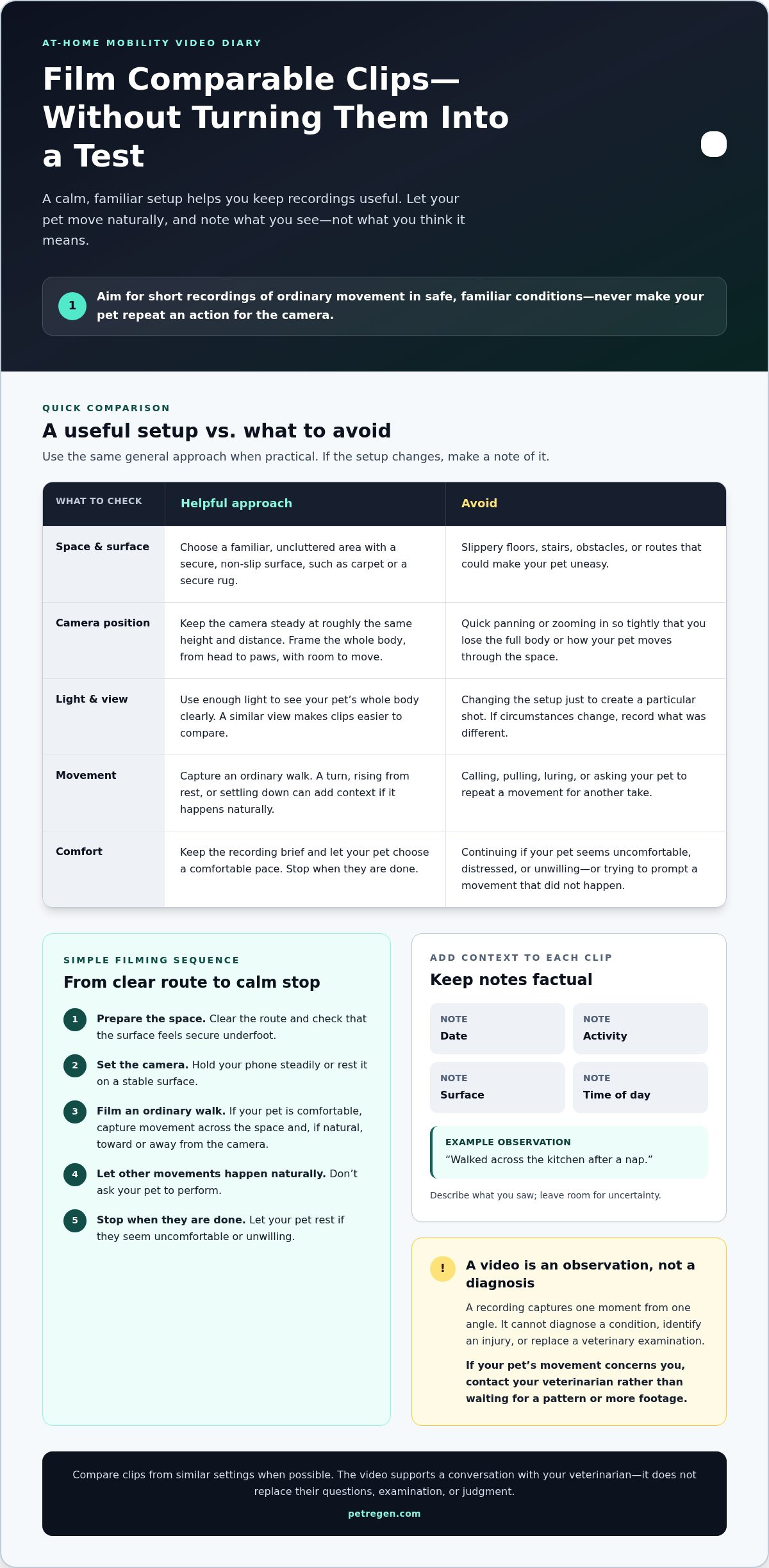
Add a short note with the context: date, activity, surface, and time of day. “Walked across the kitchen after a nap” is more useful than “seemed stiff.” Record only what you saw, and leave room for uncertainty.
What a video diary cannot tell you
A recording can’t diagnose a condition, identify an injury, or replace an examination. Similar-looking movements can have different explanations, and a camera captures only one moment from one angle. Don’t treat a limp or change in pace as proof of a specific disease. If your pet’s movement concerns you, contact your veterinarian for guidance rather than waiting for a pattern to become obvious.
Keep the diary supportive, not stressful. Don’t make your pet repeat a movement just to capture it, and don’t delay seeking advice because you want more footage. If a clip seems unusual, note the circumstances and, if it happens naturally again, record another ordinary moment. Several dated observations can help your veterinarian understand what you’ve seen, while leaving diagnosis and next steps to the professional.
How to Film Consistent Pet Mobility Videos at Home
A useful mobility clip doesn’t need special equipment or a staged performance. A phone camera and a calm moment in your pet’s regular routine are enough. Consistency means filming under comparable conditions so clips are easier to review side by side. Use the same safe, familiar space whenever practical, and let your pet choose a comfortable pace.
Choose a simple setup and repeatable route
Pick an uncluttered area with a non-slip surface, such as a clear section of carpet or a room with a secure rug. Avoid slippery floors, stairs, obstacles, and routes that could make your pet uneasy. Keep the camera at roughly the same height and distance each time, with enough light to see your pet’s whole body.
- Prepare the space. Clear the route and check that the surface feels secure underfoot. Don’t move furniture or introduce a new setting just to make filming easier.
- Set your camera position. Hold your phone steadily or rest it on a stable surface. Frame your pet from head to paws, leaving room for natural movement through the shot.
- Capture an ordinary walk. If your pet is comfortable, film them walking across the space and, if it happens naturally, toward or away from the camera. Don’t call, pull, or lure them into repeated passes.
- Include another movement only if it happens naturally. A turn, rising from rest, or settling down can add context. Wait for an everyday moment rather than asking your pet to perform.
- Stop when your pet is done. Keep the recording brief. If your pet seems uncomfortable, distressed, or unwilling, stop filming and let them rest.
Capture movement without creating a test
One calm pass can be more useful than several prompted attempts. Keep the camera still rather than panning quickly, and avoid zooming in so tightly that you lose your pet’s body or the way they move through the space. If another person is available, they can hold the camera while you stay nearby as usual. Don’t change your pet’s routine to get a particular shot.
Use a similar view for future clips, but don’t worry if home circumstances sometimes require a different setup. Note what changed, such as a different room or surface, so you can distinguish the setting from what the footage shows. If your pet doesn’t walk, turn, or rise during a recording, don’t try to make them repeat the action. A missing clip is better than a forced movement.
Filming is one way to observe movement; it doesn’t provide a diagnosis or replace veterinary guidance. For a separate wellness option, learn about the PetREGEN Stem Cell Activator Supplement, a daily powder supplement for dogs, cats, birds, and horses, pets of all ages and sizes. It supports healthy joints, mobility, comfort, and recovery. “This product is intended for supplemental use only. It is not intended to diagnose, treat, cure, or prevent any disease. If your pet has a medical condition or is on medication, consult your veterinarian before use.”
How to Compare Mobility Clips and Share Them With Your Vet
A video diary to track pet mobility is easier to use when each clip has context. Before comparing recordings, check whether they show a similar activity in a similar setting. A walk on carpet may look different from one across a hard floor, and a side view won’t show the same details as a view from behind. Differences don’t make a clip useless, but they can make a direct comparison less reliable.
Use a timeline without overreading normal variation
Review dated clips in order and look for observations that recur, rather than treating one moment as proof of a pattern. Consider whether the activity, surface, camera angle, or surroundings changed. Pets may move differently in different circumstances, so note those differences instead of assigning a score or condition label unless your veterinarian recommends a specific tracking method.
Keep a simple log beside the recordings. Use neutral wording that separates what the camera shows from what you suspect: “The video shows a pause before standing; it doesn’t establish why the pause happened.” This keeps your notes clear and gives your veterinarian room to interpret the footage.
| Date | Activity | Surface | Visible observation | Relevant context |
|---|---|---|---|---|
| Record filming date | Describe the ordinary movement | Note the floor or ground | Write only what you saw | Add routine or setting details |
| Record filming date | Describe the ordinary movement | Note the floor or ground | Write only what you saw | Add routine or setting details |
For instance, “walked across the rug, paused before turning” is more useful than “seemed sore.” Include context you’ve observed, such as a change in routine or when the movement occurred. Don’t interpret a visible gait pattern as proof of a particular disease or injury.
Prepare clips for a veterinary conversation
Choose a few representative recordings that clearly show the movement you’re concerned about, ideally with dates and short notes. A small, organized selection is easier to review than a long, unlabeled archive. Ask your veterinary practice how it prefers to receive videos and notes, since sharing methods may differ.
Before the appointment, write down what prompted you to start recording and whether you’ve noticed the same movement in other situations. You might say, “I noticed this during ordinary walks, and I have clips from these dates.” Keep the description factual, then let the veterinarian guide the discussion. If a change worries you, contact your veterinarian for advice rather than waiting to gather more footage. The diary supports a clearer conversation; it can’t determine whether a medical problem is present.
Build a Practical Pet Mobility Video Diary Routine
A diary works best when it fits naturally into your life and your pet’s routine. There’s no single filming schedule that suits every animal. Choose a manageable cadence based on what you’re noticing and your veterinarian’s guidance, rather than feeling you need to record every day. The aim is to collect useful observations without turning ordinary movement into a test.
Make recording easy to maintain
Keep clips together in one clearly named album or diary, then use filenames that make each recording easy to find. Include the date and activity, but avoid diagnostic labels that suggest a cause. For example, “2026-10-19-walk” is neutral and searchable. Pair it with a short note about the setting or anything relevant you observed.
- Choose a realistic rhythm. Decide when recording feels manageable, such as during an ordinary activity you already observe. Adjust the cadence with your veterinarian if they recommend monitoring more or less often.
- Keep clips brief and routine. Capture an everyday moment, then put the phone away. Don’t ask your pet to repeat a movement or keep filming just to fill a diary.
- Review without overanalyzing. Periodically look through the notes and clips for repeated observations. Bring relevant material to a scheduled veterinary appointment, especially if you’ve noticed a change worth discussing.
A simple system matters more than a large archive. If you miss a planned recording, continue when it’s convenient; there’s no need to recreate the moment or catch up. Keep notes factual, and let your veterinarian advise whether the frequency or type of observation should change.
Know when observation should give way to care
If you notice a movement change that concerns you, contact your veterinarian for guidance. If the change is worsening, don’t wait for another clip or a complete timeline before reaching out. A diary can help you explain what you’ve seen, but it can’t determine the cause or tell you what care your pet needs.
Let your pet set the limits. Stop filming if they seem distressed, uncomfortable, or unwilling to continue, and prioritize their comfort over getting a complete recording. Don’t try to diagnose from a video or use the diary as a reason to postpone professional advice.
For a separate part of a whole-body wellness routine, explore PetREGEN’s daily supplement for dogs, cats, birds, and horses, pets of all ages and sizes. The powder is sprinkled onto food once or twice daily, and the product supports healthy joints, mobility, comfort, and recovery. PetREGEN offers a 30-day money-back guarantee. “This product is intended for supplemental use only. It is not intended to diagnose, treat, cure, or prevent any disease. If your pet has a medical condition or is on medication, consult your veterinarian before use.”
Pair Mobility Tracking With Whole-Body Wellness Support
A video diary and a supplement serve different purposes. The diary helps you record what your pet does during everyday movement; it doesn’t provide treatment or explain what’s causing a change. PetREGEN is a daily powder supplement that supports healthy joints, mobility, comfort, and recovery. Keeping those roles distinct lets you use your observations to guide veterinary conversations while considering wellness support separately.
Where a supplement fits, and where it does not
PetREGEN supports natural regenerative processes and whole-body wellness for dogs, cats, birds, and horses, pets of all ages and sizes. It’s a daily powder sprinkled onto food once or twice daily. The formula includes AFA algae, reishi mushrooms, and other botanicals. Its listed attributes are: No artificial colors or flavors; No preservatives; No added sugar; No fillers or unnecessary additives; Gluten-free; GMO-free.
Keep the diary focused on observation. A clip may help you explain what you’ve seen, while a supplement is a separate wellness choice. Neither should be used to interpret or manage a concerning movement change without veterinary guidance. If your pet has a medical condition or is on medication, consult your veterinarian before use.”
A careful next step for concerned pet owners
If you’re considering PetREGEN as part of your pet’s wellness routine, review the product information and serving directions. The supplement’s serving directions are based on your pet’s weight:
- Up to 25 lb pet: ¼ scoop, 1-2 times per day
- 25-60 lb pet: ½ scoop, 1-2 times per day
- 60-90 lb pet: ¾ scoop, 1-2 times per day
- 90 lb + pet: 1 scoop, 1 time per day
Each jar contains 30 full scoops. The product comes with a 30-day money-back guarantee. It is a supplement option, not a substitute for professional advice or care.
This product is intended for supplemental use only. If your pet has a medical condition or is on medication, consult your veterinarian before use.
Continue filming only as a way to keep observations organized, and seek veterinary advice if movement changes concern you. To learn more about PetREGEN’s supplement for dogs, cats, birds, and horses, pets of all ages and sizes, visit the product website.
Make Your Next Step a Thoughtful One
Your pet’s movement can vary from one moment to the next, so observe without rushing to conclusions. Let a video diary to track pet mobility be a calm record that helps you ask clearer questions, not a test your companion has to pass. If a change worries you, your veterinarian is the right person to help you decide what to do next. Don’t wait to build a complete diary before seeking guidance.
As you pay attention to your pet’s comfort and everyday wellbeing, you can also consider supportive options separately from recording and veterinary care. PetREGEN’s daily powder supplement supports healthy joints, mobility, comfort, and recovery for dogs, cats, birds, and horses, pets of all ages and sizes.
Explore PetREGEN for whole-body wellness. For questions, email info@petregen.com. We typically respond within 24 hours Monday to Friday.
Frequently Asked Questions
Can a video diary help me track my pet’s mobility over time?
Yes, a video diary to track pet mobility can help you see whether a movement you’ve noticed appears again in everyday situations. For example, dated clips might help you compare how your pet moves after resting on different days. Treat what you record as observations, not proof of a problem or its cause. If a change concerns you, share your observations with your veterinarian rather than relying on the diary to assess your pet’s health.
How often should I record videos of my pet moving?
There’s no universal recording schedule; choose a pace that feels manageable and follow any guidance from your veterinarian. You might film occasionally during a familiar routine, then adjust if your vet asks for more observations. A diary doesn’t need a new entry every day to be useful. If you’ve noticed a concerning or worsening change, contact your veterinarian instead of waiting for the next planned recording.
What movements should I include in a pet mobility video?
Include ordinary movement that relates to what you’ve noticed, such as walking through a familiar room or moving between resting and standing, if it happens comfortably on its own. If your concern occurs during a specific everyday transition, a natural recording of that moment may provide helpful context. Don’t set up a challenge, use stairs to test your pet, or ask them to repeat an action for the camera.
Can my veterinarian review videos of my pet walking?
Yes, videos can give your veterinarian a view of movement at home that may not happen during an appointment. Before sending anything, ask the clinic how it prefers to receive recordings and whether it can review them before or during your visit. Choose footage that relates to your concern and include its date. Your veterinarian can explain what the video contributes and whether an examination or other assessment is needed.
Should I keep the original video files or edit them first?
Keep the original files so the full recording and its context remain available. If you want to make a shorter copy for easier sharing, retain the original and avoid edits that could change how movement appears, such as speed adjustments or filters. Give the shared copy a clear date and activity label. If the clip seems unclear, mention that rather than presenting an edited version as a complete record.
Is a pet mobility video diary a substitute for a veterinary exam?
No. A diary can help you explain what you’ve observed, but it can’t provide a hands-on examination or determine the cause of a movement change. Even a clear recording shows only what happened in that moment. If your pet’s mobility concerns you, contact your veterinarian for advice. Don’t postpone an appointment or recommended care while trying to build a longer video history.
What should I do if my pet seems uncomfortable while I am filming?
Stop recording and let your pet rest. Don’t coax them to continue, reposition them, or repeat the movement to get a clearer shot. Make a brief note of what you observed and the circumstances, then contact your veterinarian if the discomfort or movement change concerns you. Your pet’s comfort comes first; footage is optional and should never take priority over seeking professional guidance.


