

One unusually easy jump doesn’t prove a mobility supplement is working. A more useful clue may be quieter: your cat returning to a familiar routine with less hesitation. Because cats can hide discomfort, it’s understandable to wonder whether the subtle signs a cat mobility supplement is effective are real or simply reflect a good day.
Look for patterns, not a single impressive moment. This guide explains how to notice small changes in everyday movement, record them consistently, and avoid assuming a supplement caused them or will deliver a guaranteed result. Focus on familiar routines, from getting up after a nap to climbing into a favorite spot, and note when a change deserves a conversation with your veterinarian.
PetREGEN is a daily powder supplement intended to support healthy joints, mobility, comfort, and recovery as part of whole-body wellness. It is not a substitute for veterinary assessment or care. Before use, keep this distinction in mind: This product is intended for supplemental use only. It is not intended to diagnose, treat, cure, or prevent any disease. If your pet has a medical condition or is on medication, consult your veterinarian before use.
Key Takeaways
- Watch familiar routines such as jumping, climbing stairs, getting up, playing, grooming, and using the litter box for subtle changes.
- The subtle signs a cat mobility supplement is effective are best treated as repeatable changes in function, not proof of a cure or a specific cause.
- Use a simple diary to note the date, activity, observed change, and relevant routine context, then look for patterns over time.
- Contact your veterinarian about mobility changes that are new, worsening, persistent, or concerning. Tracking should never delay care.
- PetREGEN is intended to support healthy joints, mobility, comfort, and recovery as supplemental support, without promising a particular outcome.
What Subtle Changes in a Cat’s Mobility Are Worth Noticing?
A cat may adjust a routine without developing an obvious limp. Your companion might take a different route to a favorite perch, pause before climbing, or settle in a lower spot. These details can be easy to miss. A cat’s flexible spine and retractable claws are part of cat anatomy and mobility, but familiar day-to-day habits offer a more practical point of comparison than general expectations.
Look for what’s different from your cat’s usual behavior, not what you think a cat “should” be able to do. One hesitation is an observation, not proof of pain, a health condition, or a supplement’s effect.
Everyday movement changes owners can observe
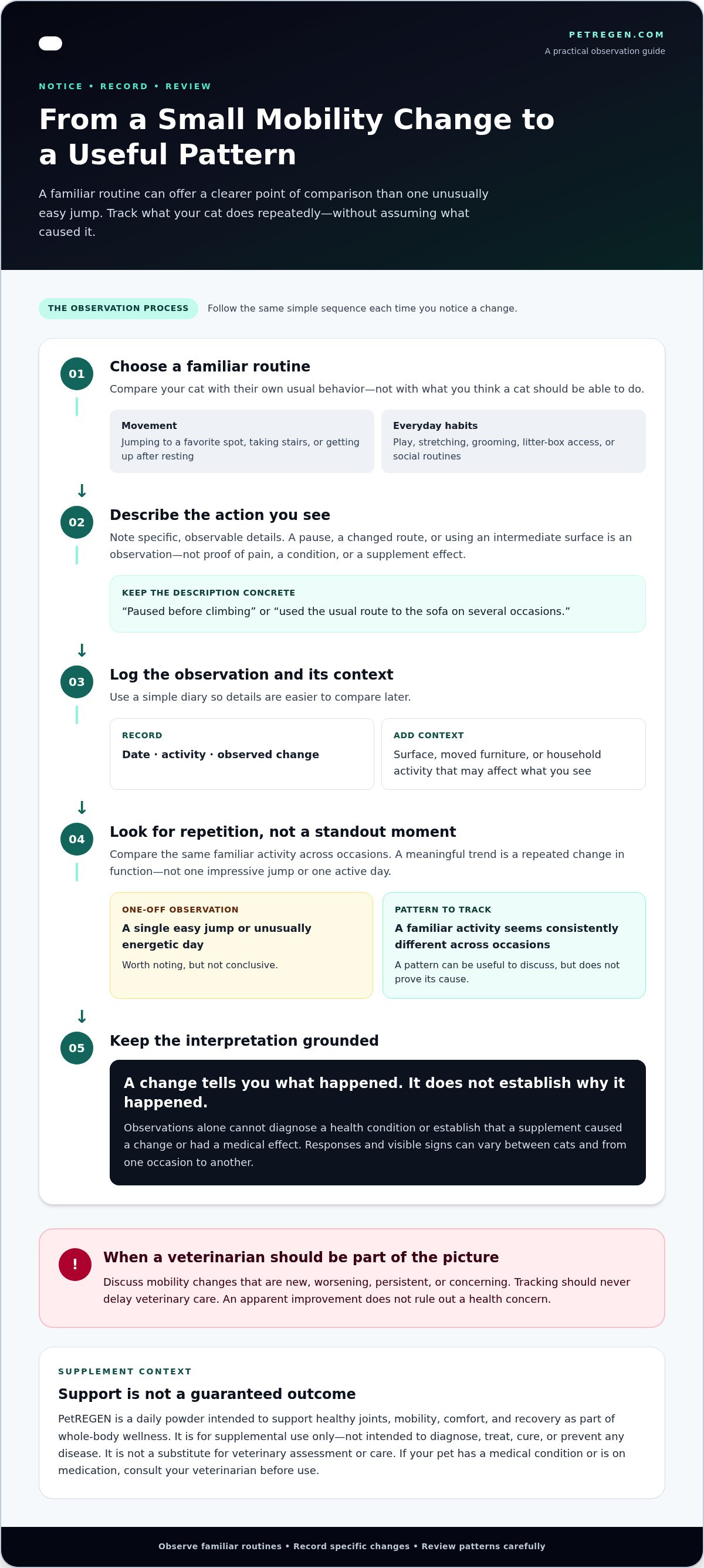
Choose familiar activities your cat does often and notice how they approach them. Is the usual jump still one smooth movement, or does your cat pause, use an intermediate surface, or skip it? On stairs, note whether your cat takes the same route and moves at a similar pace. After resting, observe how easily they rise and whether they stretch before moving on.
- Jumping and routes: Notice hesitation, a changed takeoff point, or choosing lower resting places.
- Stairs and getting up: Observe pauses, altered pacing, or a different sequence of movements.
- Play and stretching: Look for changes in how often your cat initiates play, follows a toy, or stretches during familiar routines.
Keep the setting in mind. A different surface, moved furniture, or a change in household activity may affect what you observe. Describe what happened without assigning a cause.
Routine and behavior changes that may accompany mobility shifts
Movement can also show up in everyday care and comfort routines. A cat who reaches less easily may groom certain areas differently, while a change in litter-box entry or exit may be noticeable even if walking around the home looks much the same. Note the exact behavior and when it occurs. Irritability or spending more time alone is also worth recording as a change, not interpreting as a diagnosis.
- Grooming: Has your cat’s usual grooming routine or reach changed?
- Litter-box access: Does your cat approach, enter, turn around, or exit differently than before?
- Social habits: Are there observable shifts in play, interaction, or time spent resting alone?
A meaningful mobility trend is a repeated change in familiar activities, observed across occasions, rather than one unusual moment. That distinction matters when you’re considering the subtle signs a cat mobility supplement is effective. Your observations can help you recognize patterns, but they don’t prove what caused a change or confirm a medical result. Record specific actions in plain language and look for consistency over time.
What Could These Signs Say About a Cat Mobility Supplement?
A change in how your cat moves can be encouraging to notice, especially when it appears in a familiar activity and happens repeatedly. But observation and explanation are different things. If your cat starts using a favorite step to reach a perch instead of jumping directly, that detail may be worth tracking. It doesn’t show by itself why the routine changed or whether a supplement played a part.
Possible supportive changes versus proof of an effect
An encouraging observation is a repeatable functional change, not evidence of a cure. A supplement may be intended to support healthy joints and mobility, but that intended role doesn’t establish the cause of a change you see. Observations alone can’t diagnose a health condition or establish that a supplement has had a medical effect.
Noticing a change tells you what happened; it doesn’t establish why it happened. That distinction helps keep expectations grounded while still making room for hope. If you’re watching for subtle signs a cat mobility supplement is effective, describe the behavior plainly, such as “used the usual route to the sofa on several occasions,” rather than writing “the supplement fixed jumping.” The first records an observable pattern. The second assumes a cause and outcome.
A single active day, one easy jump, or a short-lived shift isn’t conclusive. Your cat may move differently from one occasion to another for reasons unrelated to a supplement. A more useful question is whether a familiar activity seems consistently different across multiple observations, while remembering that even a repeated pattern doesn’t prove what produced it.
- Worth tracking: A repeated change in a routine your cat already knows well.
- Not proof: One unusually energetic day or a single successful movement.
- Not a diagnosis: A behavior observation without veterinary assessment.
Why a cat’s response and visible signs may vary
Daily routines aren’t identical. Your cat may be more active after a quiet day, less interested in play when the household is busy, or choose a different resting place because the environment has changed. These details can affect what you see, so note relevant context alongside the movement rather than treating every variation as a supplement response.
There’s no single visible pattern or guaranteed response that applies to every cat. Some changes may be difficult to spot, and an apparent improvement doesn’t rule out a health concern. Likewise, an unchanged routine doesn’t establish that a supplement is ineffective. Keep expectations measured and focus on clear, repeated observations.
If mobility changes are worsening, persistent, or concerning, contact your veterinarian rather than relying on supplement tracking to explain them. PetREGEN is a daily powder supplement intended to support healthy joints, mobility, comfort, and recovery as part of whole-body wellness. If you’re considering PetREGEN supplemental mobility support, discuss its suitability with your veterinarian, particularly if your cat has a medical condition or takes medication.
This product is intended for supplemental use only. It is not intended to diagnose, treat, cure, or prevent any disease. If your pet has a medical condition or is on medication, consult your veterinarian before use.
How to Tell a Real Mobility Trend from a Good Day
A simple record can help separate a repeatable change from an unusually energetic afternoon. Compare your cat with their own usual behavior, not with another cat or an imagined standard. The goal isn’t to prove a supplement caused a difference. It’s to keep clear, balanced notes that help you spot patterns and explain what you’ve noticed.
Create a useful baseline before judging change
Before assessing a new pattern, jot down how your cat handles familiar daily activities. Use observable descriptions rather than labels like “stiff” or “better.” For example, note whether your cat completes a usual route without pausing or takes a different path. If your cat is already using a supplement, record its start date and serving routine to provide context for the timeline.
Then use this short process:
- Establish a baseline. Note your cat’s usual approach to a few regular activities, including what they do and any pauses or route changes you observe.
- Observe familiar routines. Pay attention during ordinary moments rather than creating tests or encouraging a movement your cat avoids.
- Record specific changes. Write down what happened, including when an activity looked unchanged or was difficult to observe.
- Review the pattern. Compare entries across time and activities, keeping in mind that a pattern is an observation, not proof of cause.
Review patterns without overinterpreting them
A useful diary should be quick enough to maintain. For each entry, note the date, activity, observed change, and relevant routine context. Context might include a change in the room layout, an unusually busy day, or less opportunity for play. Keep the wording neutral so your notes capture what you saw rather than what you hope it means.
- Date: When did you observe the activity?
- Activity: What familiar routine were you watching?
- Observed change: What did your cat do, or not do?
- Routine context: Was anything different about the setting or that day?
Look for repeated changes across familiar activities, not one standout event. Include ordinary or difficult days too. Leaving out observations that don’t fit your hopes can make the record less balanced and harder to interpret. There’s no need to set a fixed response window. Keep notes at a manageable pace and review them for consistency rather than rushing toward a conclusion.
If you’re wondering whether the subtle signs a cat mobility supplement is effective, your diary can help you describe what changed and when. It can’t establish that the supplement caused the change or diagnose a health issue. Share the notes with your veterinarian when asking for guidance, especially if mobility changes are new, worsening, persistent, or concerning. If your cat has a medical condition or takes medication, consult your veterinarian before supplement use.
When Should You Discuss Your Cat’s Mobility with a Veterinarian?
Tracking supplement support should never delay veterinary care. A diary can help you describe what you’ve noticed, but it can’t determine what’s causing a mobility change or whether a supplement is appropriate. Contact your veterinarian about changes that are new, worsening, persistent, or concerning, even if you’re also watching for patterns over time.
Changes that should prompt a veterinary conversation
Consider the change in context: is movement different from your cat’s usual routine, and does it interfere with familiar daily activities? A sudden shift, a change that continues or worsens, or difficulty getting around the home merits veterinary guidance. If your cat seems unwell or their everyday activities change substantially, reach out promptly rather than waiting to complete a tracking period.
A checklist or diary can help organize your observations, but it can’t diagnose arthritis or another condition. Don’t use a day that looks better to dismiss a concern, and don’t assume a mobility change is simply part of aging.
What to share during the appointment
Bring dated notes that describe what you observed and when. Include movement as well as related routines, such as grooming, play, and litter-box access. Specific details can make the conversation clearer than a general description like “seems worse.” Tell the veterinarian what supplement your cat takes, the serving amount, and when you began giving it.
- Movement notes: Describe the activity and what changed, including days when it looked unchanged.
- Routine context: Note relevant changes at home or in your cat’s usual activity.
- Supplement details: Bring the name, serving amount, and start date.
- Your question: Ask whether continued use suits your cat’s individual circumstances.
This information can support a more informed discussion, but your veterinarian is the right person to assess your cat’s health and advise on next steps. If you’re considering PetREGEN as supplemental support, discuss it with your veterinarian, especially if your cat has a medical condition or takes medication. PetREGEN is intended to support healthy joints, mobility, comfort, and recovery, not to replace veterinary assessment or care.
For information about PetREGEN supplemental support, review the product details and keep your veterinarian involved in decisions about your cat’s care.
Using PetREGEN as Supplemental Mobility Support for Your Cat
After recording your cat’s everyday movement and considering when to seek veterinary advice, you can think about supplements as one part of a broader wellness routine. It isn’t a treatment, and no particular change in your cat’s movement is guaranteed.
Tracking the subtle signs a cat mobility supplement is effective can help you describe a pattern, but it can’t establish that a supplement caused it. Keep observing familiar activities, and discuss new, worsening, persistent, or concerning changes with your veterinarian. Their guidance can help you consider whether a supplement suits your cat’s individual needs.
What PetREGEN’s stated support and formula include
PetREGEN is a daily powder supplement that supports natural regenerative processes and whole-body wellness. Its superfood ingredients include AFA algae, reishi mushrooms, and other botanicals. It’s intended for dogs, cats, birds, and horses, and for pets of all ages and sizes.
- No artificial colors or flavors
- No preservatives
- No added sugar
- No fillers or unnecessary additives
- Gluten-free
- GMO-free
These details describe the supplement’s stated formula and positioning, not a promise of a specific mobility result. Across the wellness sector, ensuring rigorous formulation and quality standards is central for contract specialists such as Vita Manufacture, who manufacture vitamins, minerals, and dietary supplements. For pet owners, reviewing such ingredient details is valuable, but remember to use your observation notes to distinguish a repeated routine change from an isolated good day, and keep veterinary care central to decisions about your cat’s health.
Serving guidance, precautions, and next steps
Follow the weight-based serving guidance below. Sprinkle the powder onto food. Each jar contains 30 full scoops.
- Up to 25 lb pet: ¼ scoop, 1-2 times per day
- 25-60 lb pet: ½ scoop, 1-2 times per day
- 60-90 lb pet: ¾ scoop, 1-2 times per day
- 90 lb+ pet: 1 scoop, 1 time per day
If you’re considering PetREGEN for your cat, follow the serving guidance and speak with your veterinarian if your cat has a medical condition or takes medication. PetREGEN is designed for dogs, cats, birds, and horses, and for pets of all ages and sizes. You can review the product details and continue observing your cat’s routines while seeking veterinary advice when needed. We typically respond within 24 hours Monday to Friday.
PetREGEN comes with a 30-day money-back guarantee.
Make Your Next Step a Thoughtful One
Your notes can help turn uncertainty into a clearer conversation about your cat’s everyday comfort. Keep observing familiar routines without expecting every day to look the same, and seek veterinary guidance when a change concerns you. The subtle signs a cat mobility supplement is effective are observations to discuss, not proof of a medical result.
If you’re considering a supplement, PetREGEN is a daily powder with a pet-approved taste, and it comes with a 30-day money-back guarantee. Review the product details to decide whether it may fit into your cat’s wellness routine.
Explore PetREGEN’s natural stem cell support, and keep taking small, caring steps toward your cat’s wellbeing.
Frequently Asked Questions
Is it possible to tell whether a cat mobility supplement is effective?
You can notice repeated changes in familiar activities, but those observations can’t prove a supplement caused them or diagnose a condition. The subtle signs a cat mobility supplement is effective might include an easier rise after resting or more interest in play, but record these as observations, not conclusions. Keep the setting consistent where possible, don’t encourage movements your cat avoids, and discuss ongoing concerns with your veterinarian. A supplement doesn’t replace veterinary care.
What subtle signs might suggest my cat’s mobility is changing?
Changes may show up as hesitation before a familiar jump, taking another route, getting up differently, playing less, or grooming in a changed way. For example, note whether your cat now uses a nearby chair to reach a usual resting place. One event may be ordinary variation, so write down what happens during regular routines. If a change persists, worsens, or concerns you, contact your veterinarian instead of relying on a supplement to explain it.
How long does it take to notice a cat mobility supplement working?
There’s no guaranteed timeframe or visible response that applies to every cat. Avoid setting a deadline or judging support from one unusually active day. Follow the product directions, and keep a record that includes routine changes, not just days that seem encouraging. If you’re unsure how to assess your cat’s ongoing mobility concerns, ask your veterinarian what observations would be useful and whether the supplement fits your cat’s situation.
Can a cat mobility supplement treat arthritis?
No. A supplement shouldn’t be described as treating arthritis or another disease, and watching your cat’s movement can’t confirm an arthritis diagnosis. If you notice a change that affects your cat’s normal activities, share what you’ve observed with a veterinarian rather than trying to identify the cause at home. Discuss supplements with them, particularly if your cat has a medical condition or takes medication. Supplemental support isn’t a replacement for veterinary assessment or care.
What should I record when monitoring my cat’s mobility?
Write down the date, activity, what you observed, and anything relevant about the routine that day. For instance, note whether your cat played as usual after a change to their environment, or whether grooming appeared different. Use descriptions such as “paused before climbing” instead of a broad label like “worse.” Include days when nothing changed. These specific notes can give your veterinarian a clearer picture than memory alone.
Should I stop a supplement if I do not notice a difference?
Don’t make a decision about continued use based only on a short stretch of observation or an assumed response timeline. Recheck the product directions and talk with your veterinarian about your cat’s circumstances, especially if your cat has a medical condition or takes medication. If mobility changes persist, worsen, or concern you, seek veterinary guidance rather than waiting for a supplement-related change to appear.
Can I use PetREGEN for my cat if they have a medical condition or take medication?
Consult your veterinarian before use if your cat has a medical condition or takes medication. Share the product name, serving amount, and any other supplements your cat receives so your veterinarian can consider the full picture. PetREGEN is intended for supplemental use only and isn’t a substitute for veterinary care.


