

Could a natural supplement help your horse feel more comfortable, or could it distract from care that needs to come first? If your horse has been diagnosed with kissing spine, it’s understandable to look for safe ways to support comfort and ability to work. Natural support for horses with kissing spine may have a role, but it can’t diagnose or treat the underlying condition. Evaluate supplement claims carefully, especially when they promise to address the spinal changes themselves.
Radiographic changes don’t always explain a horse’s symptoms, so your veterinarian’s assessment is central to understanding what the diagnosis means for your horse. A support plan can consider several factors while keeping comfort, movement, and realistic goals in view.
This article explains what veterinary care may involve, how rehabilitation and other complementary approaches fit in, and how to assess supplement claims without expecting a quick fix. It also explains how PetREGEN’s stem cell activator supplement may be discussed as general wellness support, not as a treatment for kissing spine. The goal is a thoughtful, veterinarian-guided plan tailored to your horse.
Key Takeaways
- Interpret imaging alongside your horse’s signs, comfort, and function. Back sensitivity or behavior changes can have more than one cause.
- Compare natural support for horses with kissing spine by its purpose, evidence, and the veterinary oversight it may require.
- Build a practical plan with your equine veterinarian: agree on goals, review options and ingredients, introduce one change at a time, and monitor your horse.
- PetREGEN may be discussed as general wellness support, but it isn’t veterinary stem cell therapy or a treatment for kissing spine.
What kissing spine means for a horse's back, comfort, and movement
Kissing spine describes dorsal spinous processes, the bony projections along the top of the vertebrae, that sit unusually close together or overlap. These changes may appear on radiographs, but an image alone can’t show whether they’re causing pain or affecting movement. A veterinarian interprets imaging alongside the horse’s history, examination, and clinical signs.
That distinction matters. Some horses have visible changes without obvious discomfort. Back sensitivity, reduced performance, or behavior changes can also result from other issues, including saddle fit, conditioning, lameness, or soft-tissue pain. Learning about horse's back anatomy and health can help put spinal findings in the wider context of how the back works and what can contribute to discomfort. Before looking for natural support for horses with kissing spine, identify what may be affecting your individual horse rather than assuming every symptom has one cause.
What signs might prompt an equine veterinary assessment?
Changes can be subtle or show up during work. Possible signs include sensitivity when the back is touched or groomed, reluctance to work, difficulty moving freely, reduced performance, or changes in behavior under saddle. A horse may also react during saddling or resist familiar requests. These signs can indicate discomfort, but they don’t confirm kissing spine. Several back, limb, tack, or training-related problems can look similar.
Contact an equine veterinarian for advice if your horse appears painful, deteriorates suddenly, or develops a significant behavior change. Don’t try to diagnose the cause from one sign or press on a sore area to test the response.
How do veterinarians assess suspected kissing spine?
Assessment typically combines the horse’s history, a physical examination, and diagnostic imaging such as radiographs. Your veterinarian may ask when the changes began, how they relate to exercise or saddling, and whether performance has shifted. The examination helps assess the back and overall comfort; imaging shows the position and appearance of the spinous processes.
The findings need to fit together. Radiographic changes don’t automatically mean they’re the source of pain, and similar signs may warrant looking for other contributors. Horses with imaging changes don’t all need the same management. A veterinary assessment helps clarify what the findings may mean for your horse and which next steps are appropriate.
How veterinary care addresses kissing spine before natural support
A diagnosis doesn’t automatically determine the next step. Your veterinarian considers examination findings, your horse’s comfort and function, and how the imaging fits the clinical picture. As the UC Davis Center for Equine Health explains, assessment and management should be considered in light of the individual horse, not a radiograph alone.
Veterinary treatment addresses the condition and its clinical effects. Complementary wellness support may contribute to broader care, but it can’t replace diagnosis or change spinal anatomy. Supplements marketed as natural support for horses with kissing spine shouldn’t be treated as a way to correct overlapping bone or substitute for veterinary care.
What kinds of veterinary management may be discussed?
Options depend on the horse and the veterinarian’s assessment. A discussion may include rehabilitation or a structured exercise plan, workload adjustments, and other interventions such as injections or surgery where appropriate. These are possibilities to review with the treating veterinarian, not a universal protocol. Rehabilitation may also be considered alongside other care, with activities tailored to your horse’s comfort and progress.
Ask what each option is intended to address and how your care team will judge whether it’s helping. Useful questions include:
- What are the expected benefits and potential risks for this horse?
- What should I monitor at home or during work?
- When should we reassess, and what would prompt a change in the plan?
Workload changes and exercise should follow veterinary guidance, especially if your horse is painful or has recently declined. Don’t add demanding exercises or therapeutic interventions based on a general recommendation alone.
Why do diagnosis and follow-up matter?
Back discomfort can have more than one source. Saddle fit, lameness, or soft-tissue pain may call for a different evaluation. If the initial explanation doesn’t match what you observe, ask your veterinarian whether other contributors should be considered. A clear diagnosis helps keep the care plan relevant instead of focusing on an image without context.
Keep a simple record of comfort, willingness to move, behavior under saddle, workload, and any changes introduced. Share it at follow-up. If signs persist, worsen, or change, revisit the plan with your veterinarian rather than relying on a supplement or device to resolve the problem. If you’re considering general wellness support, discuss the product and its directions with your equine veterinarian. You can review PetREGEN’s stem cell activator supplement as a possible conversation starter, not as a kissing-spine treatment.
Comparing natural support options for horses with kissing spine
Natural support for horses with kissing spine can mean several things, from reviewing a horse’s diet to checking saddle fit or following a veterinarian-guided rehabilitation plan. These approaches don’t all serve the same purpose. Some support general health or comfort, but they shouldn’t be presented as correcting the position of the vertebrae or treating the underlying spinal condition.
The American College of Veterinary Surgeons describes veterinary care for kissing spine as an individualized process that may include different management approaches. Use that veterinary framework when weighing complementary options. For any product or device, ask what evidence supports the specific claim being made.
| Option | Intended role | Evidence questions | Discuss with your veterinarian |
|---|---|---|---|
| Nutrition and supplements | Support overall health and meet dietary needs | Is there product-specific evidence for the claimed kissing-spine outcome, or only general ingredient information? | Does it suit the full diet and current supplements? |
| Rehabilitation | Build strength, mobility, and function through an appropriate program | Is the plan tailored to this horse and its current comfort and ability? | Which exercises are suitable, and how should progress be monitored? |
| Saddle fit | Check whether tack fits and works appropriately for the horse | What assessment supports a proposed adjustment? | Should fit be reviewed as part of investigating discomfort under saddle? |
| Therapeutic devices or hands-on approaches | May be proposed for comfort or relaxation | Is there independent evidence for the specific device, method, and outcome claimed? | Is the approach compatible with the care plan, and how will response be assessed? |
What can nutrition and supplements realistically contribute?
Good nutrition supports overall health, but a supplement isn’t a structural correction for kissing spine. Before adding anything, review the horse’s complete diet, existing supplements, and the product directions with an equine veterinarian. Ask for evidence specific to the product and the claimed outcome. General wellness language or a proposed benefit of an ingredient doesn’t establish that a supplement improves kissing-spine symptoms.
How should owners assess devices and hands-on approaches?
Ask what a device or hands-on method is intended to do, what independent evidence supports that use, and whether it fits your horse’s veterinary plan. A testimonial describes an individual experience; it isn’t the same as controlled evidence or a veterinary finding. If an approach appears to increase discomfort, stop using it and seek veterinary guidance.
A practical, veterinarian-guided plan for adding natural support
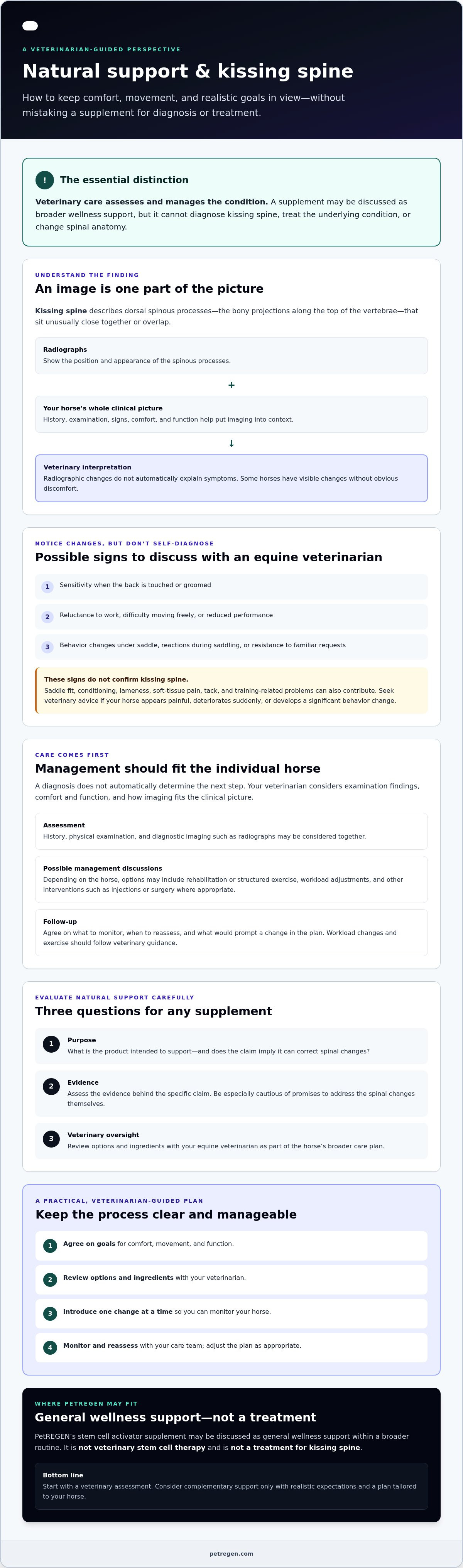
When products and approaches make confident promises, it helps to make decisions in a clear order. Use this checklist to discuss natural support for horses with kissing spine while keeping diagnosis, comfort, and the existing care plan in view.
- Confirm the diagnosis and what it means for your horse. Ask your veterinarian how examination findings and imaging relate to the signs you’re seeing, and whether other causes of discomfort need attention.
- Agree on goals. Be specific. You might want to support comfortable movement, follow a rehabilitation plan, or review general nutrition. Ask how you and your veterinarian will assess progress.
- Review each option before starting it. Bring the full ingredient list, label, and product directions to your equine veterinarian. Ask whether the option fits with current care, what risks or interactions to consider, and what signs mean you should stop or arrange follow-up.
- Introduce one change at a time when practical. Changing several supplements, devices, or routines together can make it harder to tell what may be associated with a change in your horse’s comfort.
- Monitor and reassess. Record relevant observations and keep scheduled veterinary follow-up, even if your horse seems more comfortable.
Questions to ask your equine veterinarian
Before trying a supplement, device, hands-on approach, or exercise change, ask: Is this appropriate alongside my horse’s current care? Are there contraindications or possible interactions? What should I monitor, and when should we reassess? Clarify which changes mean you should stop the approach, contact the veterinarian, or arrange a follow-up examination. If directions are unclear, ask for clarification rather than guessing.
How can owners monitor a support plan responsibly?
Choose simple observations with your veterinarian, such as willingness to move, comfort during routine handling, and response to the agreed workload. Note when a change begins and record other relevant factors, including exercise or tack changes. These notes can guide a conversation, but they don’t prove that a product or approach caused improvement. Keep planned check-ins; apparent comfort doesn’t confirm that the underlying issue has resolved.
Once your veterinarian has reviewed the ingredients and directions, you can Explore PetREGEN’s horse supplement as a possible general wellness option to discuss. It isn’t a treatment for kissing spine, so keep its role distinct from veterinary care.
Where PetREGEN may fit in a horse's broader wellness routine
A supplement may be considered as part of a horse’s overall wellness plan, but it shouldn’t be confused with care for kissing spine itself. PetREGEN Stem Cell Activator Supplement is a nutritional supplement, not veterinary stem cell therapy or prescription medicine. It shouldn’t be presented as treating kissing spine, changing spinal anatomy, or improving condition-specific symptoms.
What PetREGEN says its equine supplement is designed to support
PetREGEN describes its approach as supporting immune function and the body’s natural regenerative processes as part of whole-body wellness. These are the company’s stated aims, not proof of a kissing-spine outcome. A general wellness supplement may be worth discussing if it aligns with your horse’s broader needs, but it shouldn’t replace veterinary assessment, rehabilitation guidance, or other care recommended for the diagnosed condition.
PetREGEN describes the formula as including collagen, real liver, amino acids, omega 7, and phytonutrients, with USA-made, human-grade ingredients. Check the current product label for ingredients and horse-specific serving directions. The presence of an ingredient doesn’t prove that the finished supplement is effective for a particular back condition.
How to decide whether it belongs in your horse's plan
Bring the current ingredient list and product directions to your equine veterinarian. Review the supplement alongside the horse’s full diet, existing supplements, health needs, and current care plan. Ask whether it’s appropriate for your horse, how to introduce it, what to monitor, and when to reassess. If the veterinarian recommends against it or identifies a concern, follow that guidance.
If you and your veterinarian decide to try it, keep expectations grounded: the supplement is intended for general wellness support, not as a kissing-spine treatment. Track relevant observations as part of the agreed plan, while remembering that a change in comfort alone can’t establish what caused it. Continue routine veterinary follow-up, and revisit the plan if signs persist, worsen, or change.
For product details to review with your veterinarian, Explore PetREGEN and discuss your horse's needs.
Build a thoughtful support plan with your veterinarian
Helping a horse with kissing spine starts with interpreting imaging alongside comfort and clinical signs, then choosing care for the individual horse. Natural support for horses with kissing spine may complement a veterinary-guided plan, but supplements and devices shouldn’t replace diagnosis, treatment, or follow-up. Introduce changes carefully and track your horse’s comfort and movement without assuming that a change proves what helped.
PetREGEN describes its supplement as science-based, made with human-grade ingredients, and intended to support general wellness. It is not a treatment for kissing spine. PetREGEN also reports endorsements from veterinarians, zoologists, dog trainers, and pet parents, along with a money-back guarantee. Review the current product details and guarantee terms before making a decision.
Before adding any supplement, review its current ingredients and directions with your equine veterinarian and consider how it fits your horse’s full diet and care plan. Explore PetREGEN's horse supplement and discuss it with your veterinarian. With clear goals and thoughtful follow-up, you can make informed choices centered on your horse’s comfort and quality of life.
Frequently Asked Questions
Can natural support help a horse with kissing spine?
Natural support may complement a veterinarian-guided plan, but it can’t replace diagnosis or treatment. For natural support for horses with kissing spine, consider general wellness, appropriate nutrition, saddle-fit review, and rehabilitation recommended for your horse. The value of a supplement or device depends on its purpose and evidence. Ask your veterinarian whether it fits your horse’s needs and how to assess its contribution.
What is the best natural treatment for kissing spine in horses?
There isn’t one natural treatment that’s best for every horse. The right approach depends on clinical findings, comfort, function, and what your veterinarian identifies as contributing to the problem. Rehabilitation, workload changes, nutrition review, or saddle-fit assessment may be discussed, but each has a different role. Ask about benefits, risks, and monitoring before starting an option, and don’t rely on a product or device to correct spinal changes.
Can supplements cure kissing spine in horses?
No supplement should be considered a cure for kissing spine. A supplement may be discussed for general wellness or nutritional needs, but that doesn’t show it can change the position of the vertebrae or treat the condition. Look for product-specific evidence behind any condition-related claim, and review ingredients and directions with your equine veterinarian. Keep supplements separate from veterinary treatment, rehabilitation, and follow-up care recommended for your horse.
Is kissing spine in horses diagnosed with X-rays?
Radiographs can show the position and appearance of the dorsal spinous processes, but X-rays alone don’t establish that the findings are causing pain. Veterinarians interpret imaging alongside the horse’s history, physical examination, and signs during movement or work. Similar signs may have other causes, so your veterinarian may assess the broader picture. Ask what the images indicate and how those findings relate to your horse’s comfort and function.
What should I ask my veterinarian before giving my horse a supplement?
Bring the current ingredient list and product directions, then ask whether the supplement suits your horse’s full diet, health needs, and existing care. Check for possible contraindications or interactions with current supplements or treatments. Ask what outcome is realistic, what to monitor, and when to reassess. Clarify which reactions or changes mean you should stop giving it and contact your veterinarian. Don’t guess at horse-specific serving directions if the label is unclear.
Can a horse with kissing spine return to work?
Some horses may return to work, but whether and how depends on the individual horse’s comfort, function, assessment, and response to care. Ask your veterinarian what activity is appropriate now and what signs should guide progression. If work resumes, follow the agreed plan rather than increasing demands based only on a good day. Stop and seek veterinary advice if pain, reluctance, or performance worsens or changes.
How can I tell whether my horse's support plan is helping?
Agree with your veterinarian on practical signs to track, such as comfort during handling, willingness to move, behavior under saddle, and response to the planned workload. Keep a consistent record of changes to exercise, tack, diet, or supplements so you can discuss the timeline at follow-up. Improvement in one observation doesn’t prove which change helped or mean the underlying issue has resolved. Continue veterinary reassessment as planned.


