

Natural doesn’t automatically mean safe, and skepticism doesn’t have to mean dismissing every supplement. When marketing promises sound more certain than the research, natural pet supplements skepticism is a sensible place to start, especially when your companion’s health is involved.
It can be difficult to know whether a product’s ingredients are accurately described, whether studies support the specific benefit being advertised, or whether a supplement could interact with care your pet already needs. Wanting clear answers isn’t being difficult. It’s part of looking out for your pet.
This article offers a practical way to assess claims, research, labels, and potential safety concerns. You’ll learn what studies can show, where their limits matter, and which questions to bring to your veterinarian before trying a supplement. The goal isn’t to accept every claim or reject every product. It’s to distinguish evidence about an ingredient from evidence about a finished product, weigh the risks, and make a more informed decision together.
Key Takeaways
- Use natural pet supplements skepticism to evaluate claims and risks, rather than assuming every supplement works or fails.
- Check how strong the evidence is, and whether it studies the ingredient or the finished product you’re considering.
- Review the label for clear ingredients, intended species, directions, and manufacturer information. Ask your veterinarian about suitability, dosage, and possible interactions.
- Identify your pet’s health goal and have symptoms assessed before trying a supplement that could delay needed care.
- Assess PetREGEN by the same standards as any supplement, and distinguish the product from veterinary stem cell therapy or medical treatment.
Why skepticism about natural pet supplements is reasonable
When you want to help a dog, cat, or horse feel better, a persuasive supplement claim can be tempting. But unclear wording, uneven evidence, and questions about ingredients or safety are valid reasons to pause. A careful review isn’t cynicism. It helps you work out what a claim actually supports and whether a product may suit your animal.
Evidence-based skepticism means asking what was tested, in which animals, for what outcome, and what risks may apply, without assuming every supplement works or every supplement is harmful. Risks can depend on the ingredients, amount, species, health conditions, and other products or medicines an animal receives. Dogs, cats, and horses don’t necessarily have the same needs or tolerances, so don’t assume a product suited to one species is right for another.
What does skepticism about pet supplements mean?
A “natural” label describes a product’s marketing or ingredients. By itself, it doesn’t establish effectiveness, purity, accurate labeling, or safety. Those questions require separate evidence. At the same time, concerns about quality don’t prove that all supplements are harmful. A practical middle ground is to check the specific product and intended use, then discuss concerns with a veterinarian who knows your animal.
It also helps to distinguish a supplement from veterinary care. A supplement isn’t a diagnosis, prescription medicine, or veterinary stem cell procedure. In the United States, animal products are regulated as animal food or animal drugs, rather than under a distinct pet-supplement category. The human Dietary Supplement Health and Education Act (DSHEA) does not apply to animal products. Don’t assume that human supplement rules or evidence automatically apply to pets.
Why do supplement claims deserve a closer look?
A marketing statement isn’t the same as a demonstrated health outcome. A study may examine an ingredient in a particular amount or setting, while a product contains that ingredient alongside others, in a different formulation or amount. Evidence about one ingredient doesn’t automatically establish that a finished formula delivers the advertised benefit.
That distinction matters if you’re concerned about wasting time or missing a health problem. A supplement may not address the cause of a symptom, and relying on it instead of seeking veterinary assessment could delay appropriate care. Persistent, worsening, or concerning changes deserve professional attention. Asking questions isn’t rejecting hope. It’s a practical way to protect your companion while assessing what a product can and can’t reasonably promise.
What the science can, and cannot, show about natural pet supplements
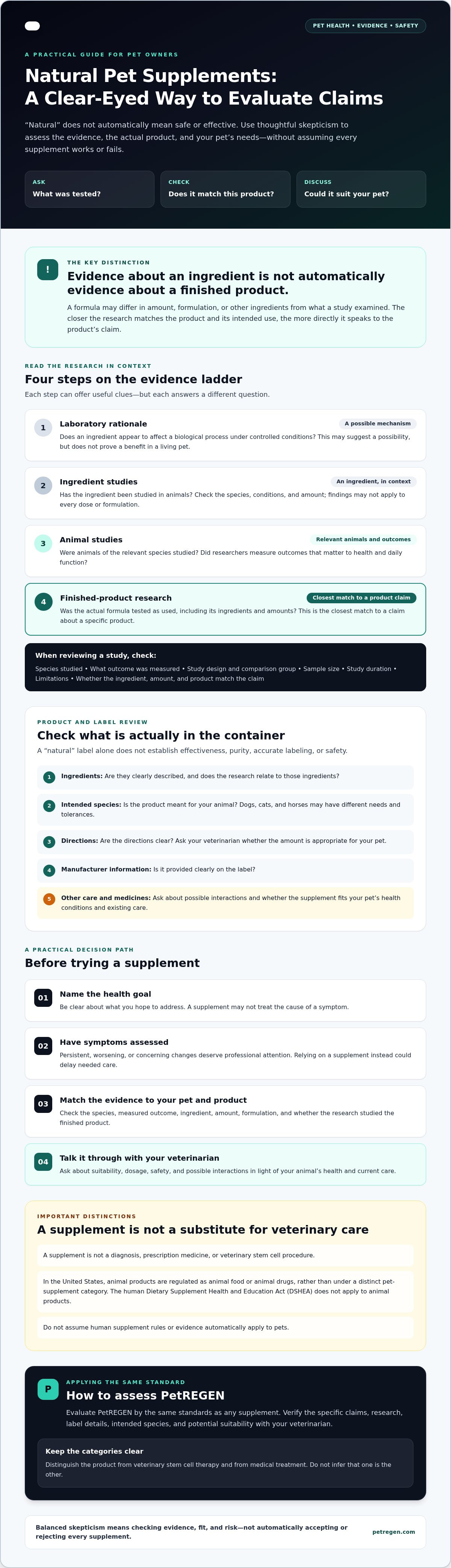
Research is easiest to interpret as an evidence ladder. Each step can offer useful clues, but answers a different question:
- Laboratory rationale: Does an ingredient appear to affect a biological process under controlled conditions? This can suggest a possibility, but it doesn’t prove a benefit in a living pet.
- Ingredient studies: Has that ingredient been studied in animals, and under what conditions? Results may not apply to every amount or formulation.
- Animal studies: Were animals of the relevant species studied, and did researchers measure outcomes that matter to their health and daily function?
- Finished-product research: Was the actual formula tested as used, including its ingredients and amounts? This is the closest match to a claim about a specific product.
Evidence that an ingredient may have an effect is not the same as evidence that a finished supplement delivers that effect. Formulation, amount, other ingredients, and the animals studied all matter. This distinction is central to natural pet supplements skepticism: it helps keep a promising explanation from being mistaken for a proven result.
How should pet owners read supplement research?
Start with the species. Research in one species, or in people, may offer background, but it doesn’t automatically establish a benefit or safe use in dogs, cats, or horses. Then check what the study measured. A change in a biological marker may be interesting, but it isn’t necessarily the same as a noticeable improvement in mobility, comfort, or another meaningful outcome.
Next, consider the study design, sample size, publication date, and limitations. Was there a comparison group? How long did the study run? Did it examine the specific ingredient, amount, and product being discussed? A testimonial can describe one pet’s experience, but it can’t establish what caused the change or predict results for other animals. Tufts veterinary nutrition experts discuss supplements, including why claims and potential risks deserve careful consideration.
What does a research-backed claim actually establish?
A narrowly worded claim might say an ingredient was studied for a particular outcome in a defined group of animals. That still doesn’t prove that every product containing it will produce the same outcome. Broad promises of healing or whole-body transformation require evidence that directly supports those claims, not just a plausible explanation or research on one component.
Before relying on a claim, look for the original study and note what remains untested: the finished formula, a different species, long-term use, or outcomes that matter in everyday life. Research and product information can change, so check current information and ask a veterinarian what applies to your pet. If you’re evaluating PetREGEN, review the PetREGEN Stem Cell Activator Supplement information alongside the evidence for its specific claims, then discuss whether it may suit your animal.
How to assess supplement labels, quality, and safety
A label is a starting point, not proof that a supplement works or is safe for every pet. In the United States, animal products are generally regulated as animal food or animal drugs, depending on their intended use and claims, rather than as a separate supplement category. The FDA regulation of pet supplements page explains this framework. It’s useful to examine what a product contains, who makes it, and what evidence supports its claims.
Which label details should you check first?
Check the intended species, complete ingredient list, serving directions, and manufacturer details before weighing any marketing claim. Look for a clear product identity, directions for use, and a responsible company that can answer questions about ingredients and quality controls. If a blend is described as proprietary but key details aren’t available for your veterinarian to review, ask the manufacturer for clarification.
A front-label phrase such as “natural,” “clinically studied,” or “quality tested” doesn’t, by itself, prove effectiveness or establish that a product is unsafe. Ask what was tested and request documentation for claims that matter to your decision.
How can you reduce preventable supplement risks?
Quality documentation and efficacy evidence answer different questions. Manufacturing information or testing records may help explain how a product is made or whether certain quality checks were performed. They don’t automatically demonstrate a health benefit. If a company cites a certification, quality seal, or independent test, verify who issued it, what it covers, and whether it applies to the specific product. A logo alone doesn’t prove that a supplement will work.
Suitability and amount matter, too. A serving that may be appropriate for one animal might not suit another. Species, body size, health conditions, and medicines can affect what a veterinarian recommends. Before adding a supplement, share the full label with your pet’s veterinarian, especially if your companion is ill or takes medication.
Store products securely, following label directions and keeping containers away from pets. Flavored supplements may tempt an animal to eat more than intended if left accessible. If your pet gets into a container, may have received too much, or shows a possible adverse reaction, contact a veterinarian promptly and keep the packaging handy. This is the practical side of natural pet supplements skepticism: check the details, verify quality claims, and get guidance that accounts for your individual pet.
How to decide whether a natural supplement is appropriate for your pet
Start with a clear purpose, not a product promise. Are you hoping to support a specific aspect of your pet’s wellbeing, or responding to a new symptom? If your dog, cat, or horse has a change in behavior, appetite, movement, or energy, ask a veterinarian whether it needs assessment before considering a supplement. Don’t let a product become a reason to postpone finding out what’s behind a change.
What should you ask your veterinarian before starting?
Bring the product label, the benefit it claims to offer, and a list of your pet’s current medicines and supplements. Share relevant health history, age, and species, too. These details help your veterinarian consider whether the product is suitable and whether ingredients could interact with treatment or be inappropriate for your pet’s condition.
Useful questions include:
- Do these symptoms need diagnosis before I consider a supplement?
- Is this product suitable for my pet’s species, age, and health history?
- What evidence supports this specific claim for an animal like mine?
- What changes should I watch for, and when should we reassess?
Clear answers can turn natural pet supplements skepticism into a practical conversation. If the evidence is limited or doesn’t match your pet’s situation, ask what that uncertainty means before deciding.
How can you tell whether a supplement is helping?
Agree on a realistic goal and a monitoring plan with your veterinarian before starting. Choose an observable change related to why you’re considering the product, such as how easily your pet completes a routine activity. Keep notes consistently rather than relying on a general impression or someone else’s testimonial. Record any unwanted changes, too.
Follow the label and your veterinarian’s guidance. Don’t increase the amount, combine products, or continue indefinitely just because you hope to see a result. If there’s no clear improvement, or your pet seems worse, contact your veterinarian and reassess whether continued use makes sense. A planned follow-up helps distinguish a meaningful pattern from day-to-day variation.
Use the same questions for every brand, including PetREGEN. Review the product information for the PetREGEN Stem Cell Activator Supplement with your veterinarian before deciding whether it fits your pet’s needs. A careful choice starts with your animal, the evidence, and a plan to check how things are going.
Where PetREGEN fits, and what to verify before choosing it
Once you’ve applied the same evidence, label, and safety checks to each option, you can assess PetREGEN as one example. The company describes its Stem Cell Activator Supplement as formulated for dogs, cats, and horses, and says it supports immune function and the body’s natural regenerative processes. These are company-stated benefits, not proof of a treatment effect or a guaranteed result. Despite the product name, this supplement is not veterinary stem cell therapy.
The table separates what the company describes from the documentation to check and questions that can help you assess its claims. It offers a practical way to apply natural pet supplements skepticism, not a conclusion for or against the product.
| Area | Company-stated information | Documentation to check | Questions to ask |
|---|---|---|---|
| Formula | The company describes the supplement as a USA-made, human-grade superfood formula that includes collagen and real liver. | Check the current product label and published ingredient, sourcing, and manufacturing information. | Is the full ingredient list clear, and is the formula appropriate for my pet’s species and health history? |
| Intended benefits | The company says the product supports immune function and natural regenerative processes. | Look for research supporting the exact product claim, species, and outcome. Ingredient research alone may not establish a finished-product benefit. | What evidence supports this specific claim for my animal, and what remains uncertain? |
| Trust signals | The brand reports endorsements from veterinarians, zoologists, dog trainers, and pet parents, and states that a money-back guarantee is available. | Verify current endorsement documentation, permitted wording, and the guarantee’s current terms. | What does the endorsement reflect, and what conditions apply to the guarantee? |
What should readers verify about PetREGEN’s claims?
Product details and terms can change, so compare the current label with the company’s published information rather than relying on an older description. Ask for support tied to the exact claim you’re evaluating, including the species studied and the outcome measured. An endorsement or guarantee may inform your decision, but neither establishes that the supplement will produce a particular health result.
What is a sensible next step for a cautious pet owner?
Share the label, intended benefit, and your pet’s current medications with a veterinarian before starting. A supplement doesn’t replace diagnosis, prescribed treatment, or urgent care. To review the details directly, Review PetREGEN and its product information, then discuss whether it may be appropriate for your companion.
Natural Pet Supplements Skepticism: Make Your Next Decision with Confidence
Good natural pet supplements skepticism isn’t about rejecting every option. It means checking whether research supports the specific claim, reviewing product details, and considering your pet’s individual health needs. Evidence for an ingredient doesn’t automatically prove a finished formula works, and a supplement should never delay diagnosis or needed veterinary care.
Before choosing, share the label, intended benefit, and your pet’s medications with your veterinarian. Ask what evidence applies to your pet’s species and what changes to monitor. PetREGEN describes its formula as USA-made and made with human-grade ingredients, and reports endorsements from veterinary and animal-care professionals. These are company statements, so verify current documentation and approved wording rather than treating them as independent proof.
To review the product details using the same careful approach, review PetREGEN and its product information, then discuss any questions with your veterinarian. Thoughtful questions are a caring way to support your companion, and you can make the next decision one informed step at a time.
Frequently Asked Questions
Are natural supplements safe for pets?
Not automatically. Safety depends on the ingredients, amount, species, your pet’s health, and any medicines or other supplements they take. A natural label doesn’t establish that a product is safe for every dog, cat, or horse. Check the full ingredient list and directions, and ask your veterinarian whether the product is appropriate for your pet. Store it securely, too, since eating more than the intended serving may be harmful.
Do natural pet supplements actually work?
Some claims may have supporting evidence, but effectiveness depends on the specific ingredient or finished product, the species studied, and the outcome measured. Research on an ingredient doesn’t prove that every formula containing it works. Look for studies that match the product’s claim and your pet’s species. Natural pet supplements skepticism means checking what the evidence supports, not assuming all supplements work or dismissing them all.
How can I tell if a pet supplement is high quality?
Start with the intended species, complete ingredient list, serving directions, and identifiable manufacturer information. Look for clear answers about sourcing, manufacturing, and quality testing, and verify any certification or quality seal with the organization that issued it. These details can inform your assessment of product identity and quality, but they don’t prove a health benefit. For that, look for evidence supporting the specific product claim and discuss the label with your veterinarian.
Can pet supplements interact with medications?
Yes, a supplement may interact with a medicine or may not be suitable for an animal’s health condition. The possibility depends on the ingredients and your pet’s circumstances, so don’t assume that a natural product is compatible with current treatment. Give your veterinarian the full label and an up-to-date list of medicines and supplements before starting it. Don’t stop prescribed medicine or combine products without professional guidance.
What should I do if my pet eats too many supplements?
Contact your veterinarian promptly if your pet eats more than the directed amount, gets into a container, or shows a possible adverse reaction. Keep the package available and share the product name, ingredient list, estimated amount eaten, and when it happened. Don’t wait for symptoms to appear before seeking advice, and don’t try to induce vomiting or give a home remedy unless a veterinary professional instructs you to do so.
Are testimonials proof that a pet supplement works?
No. A testimonial can describe one owner’s experience, but it can’t show that the supplement caused the change or that other pets will have the same result. Health changes may have more than one explanation, and individual stories don’t replace research on the specific ingredient or finished product. Treat testimonials as personal accounts, then check the study evidence, product details, and advice from your veterinarian.
Should I ask my veterinarian before giving my pet a natural supplement?
Yes. Your veterinarian can help determine whether symptoms need assessment first and whether a supplement is suitable given your pet’s species, age, health history, and medicines. Bring the product label and explain the benefit you’re considering. You can also ask what evidence supports that specific claim and what changes to monitor. Agreeing on a follow-up plan helps you reassess use rather than relying on anecdotes or increasing the amount on your own.


