

Pinned ears aren’t a diagnosis, but they are a reason to pause and pay attention. If you notice horse pinning ears when saddled, it’s understandable to worry that your horse may be hurting, wonder whether the saddle or girth is to blame, or feel uneasy about getting close. The behavior can signal discomfort or fear, including anticipation of something that has hurt before, but it can’t identify the cause on its own.
Rather than treating the warning as bad behavior, look for clues and take your safety seriously. This article explains how saddle fit, girth discomfort, soreness, and other factors may contribute, and what changes in your horse’s body language to observe without putting yourself at risk. You’ll also learn what details to record and when to involve a veterinarian or qualified saddle fitter. A careful investigation can help you choose sensible next steps without jumping to a diagnosis or escalating a worried horse’s response.
Key Takeaways
- Ear pinning is a signal to investigate, not proof of a particular cause. Consider the full context and your horse’s other body-language cues.
- With horse pinning ears when saddled, check how the saddle, pad, girth, and changes in body condition may affect comfort. Don’t assume tack is the only explanation.
- Pause, keep a safe position, and note when the behavior happens. Don’t punish your horse or repeatedly recreate the reaction to test a theory.
- Seek a veterinarian’s advice for new, persistent, or escalating behavior, and consult a qualified saddle fitter when tack fit may be a concern.
- Follow professional recommendations and track changes across saddling sessions and riding conditions. The cause may take careful assessment to understand.
What does it mean when a horse pins its ears when saddled?
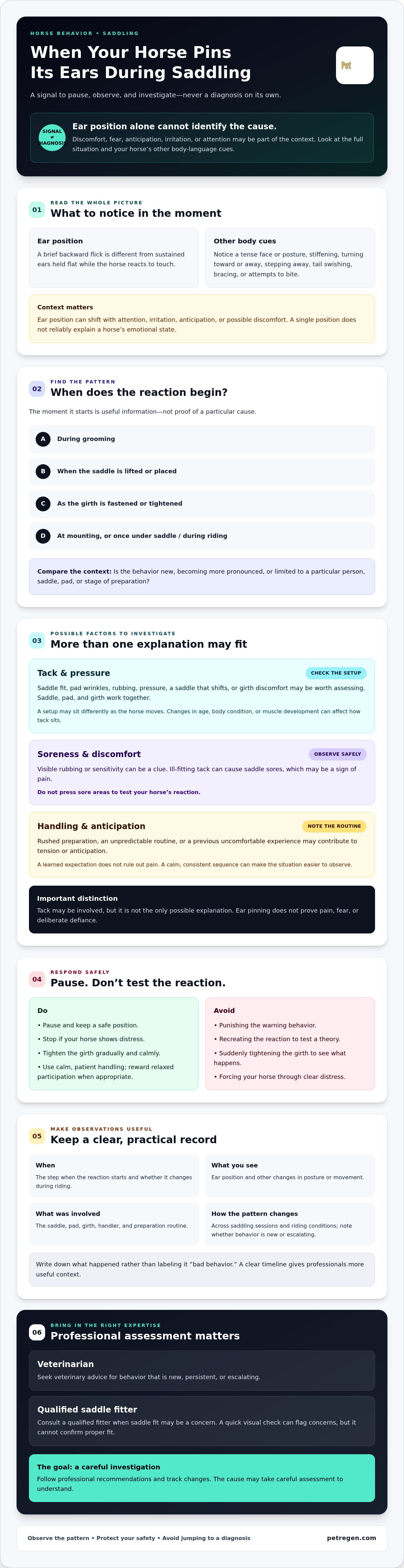
A sudden change in your horse’s behavior during saddling can be unsettling, especially if your horse usually stands quietly. It deserves attention, but it doesn’t reveal the cause by itself. Ear pinning is an observable signal: the ears are held back, sometimes tightly against the head. A brief ear flick is different from sustained pinning accompanied by stepping away, tail swishing, a tense posture, or attempts to bite.
Ear position alone cannot confirm pain, fear, or deliberate defiance. Consider it alongside what’s happening around the horse. With horse pinning ears when saddled, the useful question isn’t just what the ears are doing, but when the behavior starts and what else changes.
What can a horse’s ears communicate?
Horses use body language in context. Ear position may shift with attention, irritation, anticipation, or possible discomfort, but no single position reliably explains a horse’s emotional state. Notice whether the face looks tense, the body stiffens, or the horse turns toward or away from you. A horse may also move its ears to track sounds, so a momentary backward flick doesn’t necessarily mean the same thing as ears held flat while the horse reacts to touch. For a broader introduction to equine communication, see What does it mean when a horse pins its ears.
Why does the saddling context matter?
Pinning ears during grooming points to a different moment than pinning them only when the saddle is lifted, the girth is tightened, or someone mounts. If your horse seems comfortable during saddle placement but reacts during girthing, note that timing. If the behavior begins under saddle or changes during riding, that’s useful context too. These patterns don’t diagnose the problem, but they can help a veterinarian or saddle fitter decide what to assess.
Ask yourself whether the reaction is new, becoming more pronounced, or limited to a particular person, saddle, pad, or stage of preparation. Does your horse also shift away, brace, swish its tail, or move differently? Record what happens and when, rather than repeatedly recreating the situation to check. A clear timeline gives professionals more useful information than the label “bad behavior” and helps keep your horse’s welfare and your safety in view.
How can saddle fit, girthing, and handling contribute to ear pinning?
Pressure, rubbing, or a saddle that shifts with movement may be worth investigating if your horse reacts during tacking up. That doesn’t prove the equipment is the cause. The saddle, pad, and girth work together, and changes in your horse’s age, condition, or muscle development can affect how the setup sits. A saddle that looks fine on a stationary horse may behave differently once the horse moves.
The Merck Veterinary Manual explains that ill-fitting tack can cause saddle sores, which may be a sign of pain. Look for visible rubbing or sensitivity, but don’t press sore areas to see how your horse reacts. A quick visual check can flag concerns, but it can’t confirm proper fit. Equipment observations are useful clues; only a qualified saddle fitter can assess saddle fit.
What should owners observe about the saddle and girth?
Notice what happens at each step: where the saddle rests, whether it slips or appears uneven, whether the pad wrinkles, and whether your horse reacts as the girth is fastened. Tighten the girth gradually and calmly. Don’t suddenly pull it tighter to test a reaction. Stop if your horse shows distress, and prioritize a safe position.
If it’s safe and practical, note whether the response changes with a different pad, saddle, or experienced handler. Don’t swap equipment or repeat a setup that appears painful just to compare. Write down what was used and when the behavior began, so a fitter or veterinarian can consider the pattern alongside an examination.
Can handling or anticipation affect the response?
Yes. Rushed preparation, an unpredictable routine, or a previous uncomfortable experience may coincide with a horse becoming tense before the saddle is even in place. A calm, consistent sequence and patient handling can make the process easier to observe. Reward relaxed participation when appropriate, but don’t force your horse through clear distress.
A learned expectation doesn’t rule out pain. If your horse reacts before contact, discomfort may still be present, or the horse may anticipate it after a past experience. Keep notes on the routine, tack, handler, and timing. That context can help professionals decide what to assess without treating the behavior as proof of a single cause.
Once a veterinarian has assessed any health concerns, you can discuss broader wellness support as a separate consideration. Learn about PetREGEN Stem Cell Activator Supplement, and follow veterinary guidance rather than using a supplement as a substitute for investigating saddle discomfort.
Is ear pinning a behavior problem or a sign of pain?
Ear pinning may be related to discomfort, tack or girth pressure, fear, irritation, or anticipation based on a past experience. The timing and surrounding signs can help guide an investigation, but no single behavior confirms the explanation. A horse may also react differently depending on the setting or handler.
Don’t punish a horse for pinning its ears before considering possible discomfort. Punishment can increase fear and make it harder to understand what the horse is communicating. The goal isn’t to label the horse as difficult or decide from one reaction that it’s in pain. It’s to notice patterns and seek an appropriate assessment.
Use observations as clues, not conclusions:
| What you observe | Possible interpretations | Appropriate next step |
|---|---|---|
| Reaction as a particular saddle or girth is used | Equipment pressure, discomfort, or an association with a previous experience | Record the tack and timing; discuss persistent concerns with a veterinarian and qualified saddle fitter. |
| Reaction before contact, or with a particular handler or routine | Anticipation, fear, or learned response; physical discomfort may still be possible | Keep handling calm and predictable, and note what changes. Don’t force the horse through distress. |
| Ear pinning alongside changes in movement, grooming tolerance, or general demeanor | A broader change in comfort or wellbeing that needs professional consideration | Contact an equine veterinarian and describe the changes you’ve noticed. |
Which accompanying signs make veterinary advice important?
Look beyond the ears. Changes in movement, resistance to grooming or touch, altered appetite, or a noticeable shift in general demeanor are worth documenting. Sensitivity, persistent resistance, or a sudden change in behavior are reasons to contact an equine veterinarian. Don’t try to diagnose the cause yourself; the veterinarian can decide whether an examination or further assessment is appropriate.
When might tack or routine be part of the picture?
If horse pinning ears when saddled occurs with one particular saddle, girth, location, or stage of tacking, that pattern can help focus an assessment. It doesn’t prove that item or step is the cause, and a reaction linked to a routine doesn’t rule out discomfort. If the concern persists, involve an equine veterinarian and a qualified saddle fitter so health and equipment can be considered together.
What should you do when your horse pins its ears during saddling?
If horse pinning ears when saddled makes you uneasy, don’t rush to finish tacking up or decide what the behavior means. Use a simple, safety-first plan. Stop sooner if the reaction intensifies, your horse threatens to bite or kick, or you can’t handle the situation safely.
- 1. Pause. Stop the step that prompted the reaction. Don’t punish, provoke, or repeat it to test a theory.
- 2. Protect your safety. Keep a safe distance and avoid standing where you could be struck or trapped. If you’re concerned about handling, ask an experienced handler for help rather than managing the horse alone.
- 3. Observe without escalating. Note what the horse does next, including changes in posture, movement, facial tension, or willingness to stand. Don’t continue toward mounting or riding if discomfort is suspected.
- 4. Document the pattern. Record when the reaction began, which tack was being used, the handling routine, how long it lasted, and any other changes you noticed. Include whether it happened during grooming, saddle placement, girthing, mounting, or riding.
- 5. Arrange appropriate assessment. Contact an equine veterinarian if the behavior is new, persistent, worsening, or accompanied by other changes. A qualified saddle fitter can assess fit and contact when tack may be involved.
How can you keep the saddling process safer?
Choose a secure, familiar space and have an experienced handler present if you’re concerned about a reaction. Keep movements calm and unhurried, and stop if distress escalates. A quiet moment doesn’t prove the cause has passed, so don’t use it as a reason to push on, mount, or ride through suspected pain. Your safety and the horse’s comfort come first.
Who can help assess the underlying cause?
An equine veterinarian can evaluate health and pain concerns and decide whether further examination is needed. A qualified saddle fitter can assess how the saddle sits and makes contact with the horse. Share a concise behavior log with both professionals. A video may help if it can be captured safely, but don’t recreate the reaction for footage or put yourself at risk.
After veterinary guidance, general wellness support can be considered separately from investigating the behavior. Explore PetREGEN Stem Cell Activator Supplement, but don’t use a supplement as a treatment for ear pinning or a substitute for veterinary or saddle-fit assessment.
How to support your horse after identifying possible causes
Once you’ve discussed possible causes with a veterinarian or saddle fitter, follow their recommendations and allow time for the assessment process. Ear pinning may not disappear after one adjustment, and a calmer saddling session doesn’t prove the issue is resolved. Keep paying attention to your horse’s comfort and behavior, and check back with the professionals involved if the response persists, worsens, or changes.
How can you monitor changes over time?
Use a simple log to spot patterns and share useful details at follow-up. Record what happened before and after any recommended change, without deliberately recreating a distressing reaction. Track observations across saddling sessions and, when advised and safe, different riding conditions.
- Circumstances: date, location, handler, and stage of preparation when the response occurred.
- Equipment: saddle, pad, and girth used, plus any changes made on professional advice.
- Behavior: what you observed, how long it lasted, and whether movement or general demeanor also changed.
- Follow-up: recommendations received and what you noticed afterward.
Improvement after changing one thing can be encouraging, but it doesn’t confirm that change was the original cause. If horse pinning ears when saddled continues or new signs appear, revisit the plan with your veterinarian or saddle fitter rather than relying on the log to diagnose the problem.
Where does general wellness support fit?
General wellness is a separate consideration from identifying or treating saddle-related discomfort. PetREGEN Stem Cell Activator Supplement is formulated for horses and is described by the company as supporting natural regenerative function and immune function. It does not diagnose or treat pain, saddle-fit problems, or ear-pinning behavior, and it isn’t a substitute for veterinary care or a saddle-fit assessment.
Before adding any supplement to your horse’s routine, ask your veterinarian whether it’s appropriate and review the current horse-specific product label and directions with them. If your veterinarian agrees that general wellness support may be suitable, you can learn more about PetREGEN Stem Cell Activator Supplement as one option to discuss. Keep following professional advice about the behavior itself.
Take the Next Step Toward a More Comfortable Saddling Routine
When you notice horse pinning ears when saddled, treat it as a signal to pause and investigate, not a diagnosis or a reason to punish. Ear position alone can’t tell you whether discomfort, fear, anticipation, tack, or another factor is involved. Keep a clear record of when the behavior occurs, prioritize safety, and ask an equine veterinarian or qualified saddle fitter for help if it persists, worsens, or comes with other changes.
Follow professional recommendations and give the process time. A change in behavior after an adjustment may be useful to note, but it doesn’t confirm the cause. Your horse’s comfort deserves careful attention, one step at a time.
For a separate conversation about general wellness support, PetREGEN offers a supplement formulated for horses, with a science-based approach focused on whole-body wellness. It isn’t veterinary care or a treatment for saddle discomfort, so ask your veterinarian before adding any supplement. Learn about PetREGEN Stem Cell Activator Supplement and keep working with qualified professionals to support your horse’s wellbeing.
Frequently Asked Questions
Why does my horse pin its ears when being saddled?
A horse may pin its ears during saddling for several reasons, and the behavior alone can’t identify which one applies. Pressure or rubbing from tack, girth discomfort, soreness, fear, irritation, or anticipation of an unpleasant experience may all be worth considering. Note whether the reaction starts during grooming, saddle placement, girthing, or mounting, and whether other signs appear. A clear pattern can help your veterinarian or saddle fitter assess what to investigate.
Is a horse pinning its ears always a sign of pain?
No. Ear pinning can accompany discomfort, but it may also reflect fear, irritation, attention, or anticipation. Ear position by itself can’t confirm pain or rule it out. Look at the whole picture, including posture, facial tension, movement, and when the response occurs. A brief ear movement is different from sustained pinning paired with resistance or other changes. If you’re concerned, record what you observe and seek professional guidance rather than labeling the behavior.
Can a poorly fitting saddle make a horse pin its ears?
Yes, an ill-fitting saddle may create pressure or rubbing that contributes to discomfort, and the horse may react while being tacked up or ridden. But ear pinning doesn’t prove that saddle fit is the problem. The pad, girth, saddle movement, and changes in the horse’s body condition may also matter. A quick visual check can flag something to discuss, but it can’t replace a fit assessment by a qualified saddle fitter.
What should I do if my horse pins its ears when I tighten the girth?
Pause and keep yourself in a safe position rather than tightening suddenly, pulling harder, or repeating the step to test the response. Note when the reaction starts and whether the horse shifts away, tenses, or shows other signs of distress. Don’t punish the horse or force the process to continue. If the behavior escalates or you feel unsafe, stop and seek help from an experienced handler and appropriate equine professionals.
When should I call a veterinarian about ear pinning during saddling?
Contact an equine veterinarian if the behavior is new, persistent, worsening, or accompanied by other changes. Note any differences in movement, appetite, grooming tolerance, sensitivity, or general demeanor. Share when the ear pinning occurs and what tack or handling routine is involved. These details don’t diagnose the cause, but they can help the veterinarian decide whether an examination or further assessment is appropriate. Don’t wait for a pattern to become severe before asking for advice.
Can I keep riding if my horse pins its ears when saddled?
If the reaction is accompanied by suspected pain, escalating distress, movement changes, or unsafe behavior, don’t mount or continue riding until you’ve sought appropriate advice. Ear pinning alone doesn’t establish the cause, but pushing through a concerning response may put you and your horse at risk. Pause, observe, and contact an equine veterinarian if you’re worried. A qualified saddle fitter can also assess tack concerns, but shouldn’t replace veterinary evaluation of possible health issues.
Will a supplement stop my horse from pinning its ears?
A supplement can’t be relied on to stop ear pinning or resolve saddle discomfort. PetREGEN Stem Cell Activator Supplement is formulated for horses and is described by the company as supporting natural regenerative and immune function for general wellness. It isn’t veterinary care or a treatment for pain, saddle-fit problems, or this behavior. Ask your veterinarian before adding a supplement, and continue investigating persistent ear pinning with qualified professionals.


