

Your horse takes a few short, guarded steps after standing, and it’s tempting to reach straight for a supplement. But stiffness can have different causes, from muscle fatigue or poorly fitting tack to joint problems. The right supplements for stiff horses depend on what may be behind the change, not just what a product label promises.
It’s understandable to want a practical way to support your horse’s comfort and mobility. Persistent or one-sided stiffness warrants veterinary assessment, and a supplement shouldn’t be treated as a diagnosis or cure. This guide explains how to compare supplement approaches, assess ingredient and label claims, and decide what to discuss with your veterinarian before choosing a next step.
We’ll cover common contexts for stiffness, how joint-support ingredients differ from broader wellness formulas, and what to check when weighing product suitability. If your horse competes, check the ingredients against the current rules of your governing organization. The goal is a thoughtful choice based on your horse’s needs, with veterinary guidance when it’s warranted.
Key Takeaways
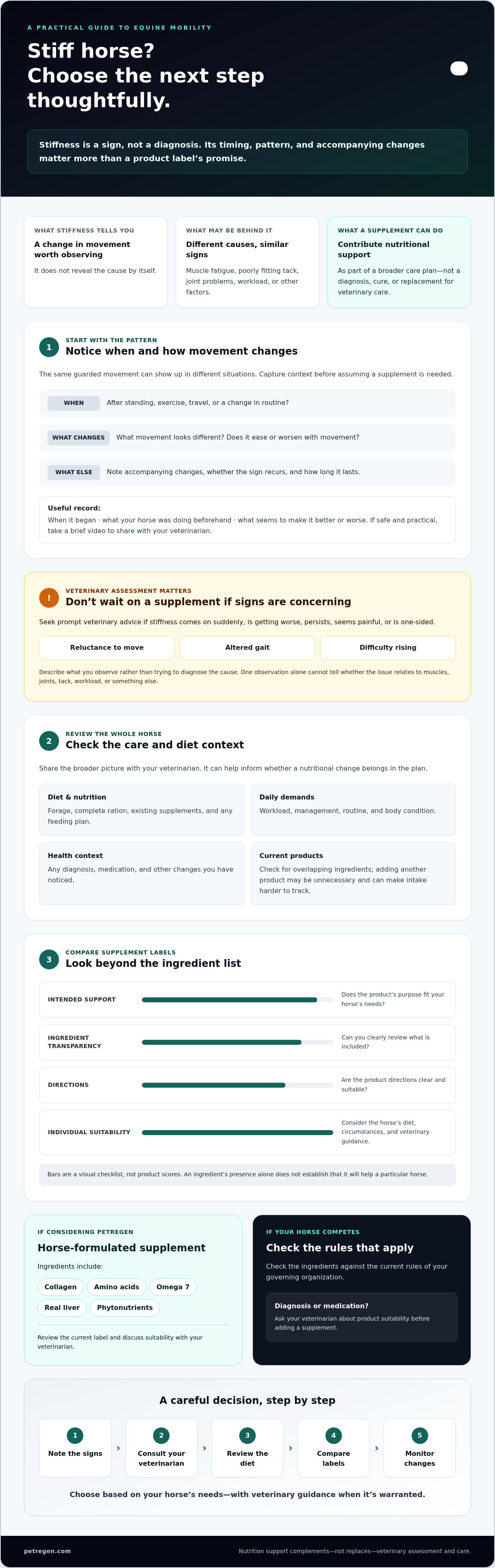
- Stiffness is a sign, not a diagnosis. Its timing, pattern, and accompanying changes can help inform what to discuss with your veterinarian.
- Compare supplements for stiff horses by intended support, ingredient transparency, directions, and suitability, not by ingredient lists alone.
- Use a step-by-step approach: note the signs, consult your veterinarian, review the diet, compare labels, and monitor changes.
- Ask your veterinarian about suitability if your horse has a diagnosis or takes medication, and check competition rules when relevant.
- PetREGEN is a horse-formulated supplement with ingredients including collagen, amino acids, omega 7, real liver, and phytonutrients. Review its current label and discuss suitability with your veterinarian.
Supplements for stiff horses: what stiffness can, and cannot, tell you
Seeing your horse move cautiously, hesitate to take a step, or struggle to get comfortable can be worrying. Stiffness describes an observed change in movement; it doesn’t explain what’s causing it. A horse may look stiff in one situation and move differently later, so one observation can’t tell you whether the issue relates to muscles, joints, tack, workload, or something else.
Look at the full picture: when the change happens, whether it eases or worsens with movement, and whether other signs appear. Similar movement changes can have different explanations. For background, the overview of comprehensive treatment options for lameness illustrates why assessment depends on the individual horse, not a symptom label alone.
When is a stiff horse a reason to call the veterinarian?
Seek prompt veterinary advice if stiffness comes on suddenly, is getting worse, persists, or seems painful. Also note reluctance to move, an altered gait, or difficulty rising. These observations don’t identify a cause, but they can help your veterinarian decide what assessment is needed.
Before you call, note when you first noticed the change, where it appears, what your horse was doing beforehand, and whether anything seems to make it better or worse. Describe what you see rather than trying to diagnose it. If you’re concerned, don’t wait to see whether a supplement changes the signs before contacting your veterinarian.
What can an equine supplement realistically support?
A supplement may contribute nutritional support as part of a broader care plan, but that’s different from treating a diagnosed condition. Products vary in ingredients, intended use, and directions. An ingredient’s presence alone doesn’t establish that it will help a particular horse. Suitability depends on the horse’s overall circumstances, including its existing diet and any veterinary guidance.
“A supplement may support nutrition, but it can’t diagnose the reason for stiffness or replace veterinary assessment and treatment.”
That distinction matters when comparing supplements for stiff horses. Start with your horse’s needs, not a label’s promise. If your horse has a diagnosis, takes medication, or follows a specific feeding plan, ask your veterinarian whether a product is appropriate before adding it. A supplement may complement care when it fits the plan, but it shouldn’t delay assessment of concerning signs.
Why a horse may seem stiff: understand the context before choosing supplements
The same guarded movement can appear in very different circumstances. A horse may seem stiff after standing, following exercise, after travel, or after a change in routine. Age, workload, management, and accompanying signs add useful context, but none identifies a cause on its own. A change in movement is a reason to observe carefully, not to assume a particular supplement is needed.
Share the broader picture with your veterinarian: your horse’s diet and forage, workload, body condition, medications, and current or recent supplements. This history can help inform whether a nutritional change belongs in the plan and what questions to ask next.
What details should you observe and record?
Keep brief notes rather than relying on memory. Record whether stiffness appears after rest, exercise, travel, or a routine change; how long it lasts; whether it recurs; and what movement looks different. Note other changes you observe without trying to label them as a condition.
- Write down when the change began and whether it is becoming more frequent.
- Describe the activity and circumstances around each episode.
- If it’s safe and practical, take a brief video to share with your veterinarian.
Clear observations give your veterinarian a more useful account than the general description “stiff,” especially if movement varies from one day or activity to another.
Why diet and the whole horse matter
Before adding anything, consider the complete ration, including forage, existing supplements, workload, and body condition. Two products may contain overlapping ingredients, so adding another may be unnecessary or make it harder to track what your horse is receiving. Ask your veterinarian or an equine nutrition professional to review the full picture, especially if your horse has a diagnosed condition or takes medication.
Ingredient names alone don’t establish that a product suits your horse. The University of Minnesota Extension explains common ingredients in joint supplements, which can help you prepare questions about a product’s label and intended use.
“A symptom can guide what you observe, but it can’t identify which supplement is right for your horse.” If you’re considering PetREGEN for broader wellness support, review its horse supplement information and discuss suitability with your veterinarian.
Comparing supplements for stiff horses: ingredients, evidence, and fit
Labels can make different supplements sound alike, even when their intended uses, ingredient amounts, and directions differ. Compare supplements for stiff horses using the same practical questions. A familiar ingredient or confident claim doesn’t automatically make a product suitable for your horse.
How to assess supplement ingredients and evidence
Check the complete label, ingredient amounts where provided, serving directions, and manufacturer information. Then ask whether the evidence relates to the specific ingredient, horses, intended use, and claimed benefit. The Mississippi State University Extension Service reviews research on equine joint supplements, including why findings for some ingredients may not provide a simple answer. Evidence about an ingredient generally shouldn’t be treated as proof that every product containing it delivers a particular result.
“An ingredient list tells you what a product contains; it doesn’t prove a specific outcome for your horse.” If amounts or other label details aren’t provided, note what’s missing and ask for clarification rather than guessing about potency, safety, or effectiveness.
Single-purpose formulas versus broader wellness approaches
A focused formula and a broader wellness supplement take different approaches, but neither is automatically a better fit. Compare the product’s stated purpose with your horse’s documented needs and existing ration. Ask your veterinarian about suitability and possible overlap with current supplements.
PetREGEN describes its approach as supporting whole-body wellness and identifies collagen, amino acids, and omega 7 among its ingredients. Those details describe the formula; they don’t prove that it treats stiffness or produces a particular mobility outcome. Review the current horse label and serving directions, then discuss them with your veterinarian before deciding whether the supplement belongs in your horse’s plan.
How to choose and monitor a supplement for a stiff horse
A clear process can help you make a careful choice without letting a product label distract from your horse’s needs. First assess what you’re seeing, then consult your veterinarian, review the full diet, compare labels, and monitor changes. This makes it easier to consider supplements for stiff horses as one possible part of a broader plan, not a substitute for veterinary advice.
A practical checklist before buying
Gather the details your veterinarian needs before choosing a product: your horse’s observed signs and routine, current ration and forage, medications, and every supplement already being fed. Then compare candidate labels for stated purpose, complete ingredients, serving directions, quality information, and available manufacturer support. If amounts or directions are unclear, ask rather than infer.
- Confirm the product is intended for horses and check the current label.
- Ask your veterinarian whether it suits your horse’s health history, diet, and medications.
- Discuss possible ingredient overlap and what signs should prompt reassessment or discontinuation.
A diagnosis or medication makes that conversation especially important. Your veterinarian can help assess suitability and clarify whether a nutritional addition fits alongside your horse’s existing care.
How to monitor a new supplement responsibly
If your veterinarian agrees it’s appropriate, follow the current label directions and professional advice. Avoid starting several new products at once, since doing so makes it harder to understand what changed. Keep brief, consistent notes about routine, movement, and apparent comfort, using the same everyday observations where possible.
Record improvements and setbacks, along with changes in workload or management. A perceived response doesn’t prove that the supplement caused the change or addressed the underlying reason for stiffness. If signs worsen, new symptoms appear, or the result is unclear, contact your veterinarian rather than increasing or changing the serving on your own.
Before settling on a product, make sure you can verify its horse-specific serving instructions and discuss uncertainties with a professional. If you’re considering PetREGEN, review the horse supplement information and check its current label with your veterinarian to see whether it fits your horse’s plan.
Is PetREGEN a fit for a stiff horse? Consider the product and next steps
PetREGEN is a horse-formulated supplement, not veterinary care, prescription medicine, or veterinary stem cell therapy. It may be an option to discuss as part of a broader wellness plan, but it shouldn’t be presented as a treatment for stiffness or a substitute for assessing why your horse’s movement has changed. When comparing supplements for stiff horses, focus on whether a product fits your individual horse, not simply whether its marketing sounds relevant.
What PetREGEN says its horse supplement is designed to support
The company describes PetREGEN as supporting the body’s natural regenerative function and whole-body wellness. Its product information identifies collagen, amino acids, omega 7, real liver, and phytonutrients among the formula’s ingredients. These are product details, not evidence that the supplement resolves stiffness, treats a specific condition, or will produce a particular mobility outcome.
Compare those details with the current product label. Confirm horse-specific serving directions and ingredient information in official product materials, which can guide a discussion with your veterinarian. If a claim or direction is unclear, ask the company for clarification rather than assuming what it means for your horse.
Questions to ask before adding PetREGEN
A veterinarian can help assess whether the formula fits your horse’s care plan, especially if the horse has a diagnosis, takes medication, or already receives other supplements. Bring the current label and ask:
- Does this formula fit my horse’s diet and veterinary plan?
- Could any ingredients overlap with current feed or supplements, or be unsuitable alongside medication?
- What are the current horse-specific directions, and what product details should I verify?
- Are the current guarantee terms stated clearly in official product information?
These questions keep the decision grounded in your horse’s needs. If stiffness is sudden, worsening, persistent, or painful, prioritize veterinary advice rather than waiting to see whether a supplement changes what you observe. A supplement may have a place in a broader plan, but it can’t diagnose the cause or replace care recommended by your veterinarian.
For a practical next step, review PetREGEN for horses, check the current product information, and share the label with your veterinarian before adding it to your horse’s routine.
Choose your horse’s next step with confidence
Stiffness is a sign to pay attention to, not a diagnosis. Its timing, pattern, and accompanying changes can help your veterinarian assess what’s going on. Before choosing supplements for stiff horses, review your horse’s diet and current products, compare labels carefully, and agree on a sensible way to monitor changes.
PetREGEN states that its supplement is formulated for horses, dogs, and cats, and describes its ingredients as USA-made and human-grade. Check current product-label details and serving directions, and discuss whether it suits your horse’s veterinary plan, diet, and medications. The company also reports a money-back guarantee; check the current terms directly before relying on them.
To explore the product, review PetREGEN’s horse supplement and its current product information, then share the label with your veterinarian. A thoughtful choice based on your horse’s needs and veterinary guidance is a positive next step toward supporting overall wellness.
Frequently Asked Questions
Why is my horse stiff after standing or resting?
Stiffness after standing can have several possible explanations, and the timing alone can’t identify the cause. Note whether it eases after movement, recurs, affects one side, or appears with an altered gait or reluctance to move. Share these observations with your veterinarian if stiffness persists, worsens, or seems painful. Don’t assume it’s simply normal aging or choose a supplement based on this one sign.
Can supplements help a stiff horse move more comfortably?
Some supplements may provide nutritional support, but they can’t diagnose the reason for stiffness or guarantee improved comfort or movement. Whether a product is appropriate depends on the horse’s diet, health, and veterinary plan. If your horse’s stiffness is persistent, worsening, or painful, seek veterinary advice rather than waiting to see whether a supplement helps. A suitable supplement should complement care, not replace assessment.
What ingredients should I look for in supplements for stiff horses?
Common joint supplement ingredients include glucosamine, chondroitin sulfate, MSM, and hyaluronic acid. Their presence alone doesn’t show that a product will benefit your horse or address a particular concern. For supplements for stiff horses, check the full label, amounts where provided, directions, and information relevant to horses and the product’s stated purpose. Ask your veterinarian to review the ingredients, especially if your horse has a diagnosis or takes medication.
How do I choose between a joint supplement and a broader horse supplement?
Start with your horse’s documented needs and existing diet, rather than assuming one approach suits every horse. A joint-focused product and a broader wellness supplement have different stated purposes. Compare their labels, ingredients, directions, and possible overlap with current products. Discuss the options with your veterinarian, particularly if your horse has a diagnosis or follows a specific care plan. Match the product’s purpose to professional guidance.
How long should I try a horse supplement before reviewing the results?
There isn’t one review period that suits every supplement or horse. Follow the current label directions and ask your veterinarian when to reassess based on your horse’s situation. Before starting, note the signs and routine you’re tracking, then record observations consistently and avoid introducing multiple new products at once. Don’t extend a trial or wait for a perceived response if stiffness worsens, seems painful, or new signs appear.
Is it safe to give my horse a supplement alongside medication?
Ask your veterinarian before combining a supplement with medication. Share the full product label, serving directions, medication list, and details of any other supplements your horse receives so they can assess suitability and possible overlap. Don’t stop, change, or adjust prescribed medication to make room for a supplement. If you’re unsure about an ingredient or the product’s directions, confirm them with your veterinarian before adding it.
When should I call a veterinarian about my horse’s stiffness?
Contact your veterinarian promptly if stiffness appears suddenly, is worsening or persistent, seems painful, or comes with an altered gait, reluctance to move, or difficulty rising. Note when it began, where you observe it, and what seems to change it; a short video may also help explain what you’re seeing. Don’t use a supplement trial to postpone advice about concerning signs. Your veterinarian can guide the appropriate next step.


