

If you’re wondering, “my dog is 12 is it worth starting supplements now,” it’s understandable to worry that you’ve missed your chance, especially if your dog takes medication or has a health condition. But your dog’s age alone doesn’t decide whether a supplement may be appropriate.
It’s wise to be cautious. Supplements make varied claims, and a new change in mobility, energy, appetite, or comfort may need veterinary attention rather than an over-the-counter product. Your dog’s health, diet, current medications, and the reason you’re considering a supplement matter more than the number of candles on the birthday cake.
This article will help you consider those factors, prepare practical questions for your veterinarian, and assess product claims without expecting a supplement to diagnose or treat disease. You’ll also learn how to track changes if your vet agrees a supplement could fit your dog’s needs. The goal is informed support for your companion’s well-being, not a quick fix.
Key Takeaways
- If you’re asking “my dog is 12 is it worth starting supplements now,” age alone can’t answer the question. Your dog’s individual needs matter.
- Distinguish a general wellness goal from a change that calls for veterinary assessment.
- Use your dog’s health history, diet, medications, and past reactions to guide a conversation with your veterinarian.
- Weigh potential support against uncertain results, product quality, cost, and whether your dog will accept the supplement.
- PetREGEN Stem Cell Activator Supplement is an optional wellness product to discuss with your veterinarian, not a substitute for veterinary care.
My Dog Is 12: Is It Worth Starting Supplements Now?
No, turning 12 doesn’t automatically make supplements pointless or appropriate. A senior dog supplement may be worth discussing if it matches a specific wellness goal, suits your dog’s health and diet, and your veterinarian has considered possible risks or interactions. Supplements are intended to support normal nutrition or body function, not diagnose a problem, treat disease, or prevent illness.
What does being 12 tell you about your dog?
It tells you your dog is older, but not exactly what support they need. Size, breed, health conditions, diet, and life history all help shape an individual dog’s needs. Dogs of the same age can differ in mobility, energy, and independence, so avoid judging your companion’s health by age alone. The aging profile of dogs also varies with breed size, which is one reason a birthday can’t tell the whole story.
Start with what you can observe. Note changes in appetite, energy, movement, sleep, or daily routines, including when they began and whether they’re getting worse. A gradual change may help you clarify a wellness goal. A new or concerning symptom deserves veterinary attention rather than an assumption that a supplement is the answer.
Can supplements still be considered in a senior dog’s routine?
Yes. Starting later isn’t automatically pointless, but no supplement can promise a particular result. A supplement may be considered alongside balanced food and appropriate veterinary care, not as a replacement for either. Its potential fit depends on your dog’s health, medications, diet, and the reason you’re considering it.
Before adding anything, ask your veterinarian whether the product and its ingredients make sense for your dog, especially if they have a diagnosis, take medication, or have reacted to supplements before. Bring the product label and explain your goal, such as supporting general wellness or discussing a change you’ve noticed. Your vet can help determine whether a supplement is reasonable or whether your dog should be examined first.
How Age, Health, and Supplement Goals Shape the Decision
A useful supplement decision starts with a clear question: what are you hoping it will support? General wellness is different from trying to address a new limp, sudden low energy, appetite loss, or another worsening change. Those signs need veterinary assessment, not supplement-only self-management. Describe what you’ve observed, when it began, and how it affects your dog’s usual activities. Avoid assuming the cause before a veterinarian has evaluated it.
Match the supplement to a specific goal
“Better mobility” or “overall wellness” can be a starting point, but make the goal more concrete. For example, note whether your dog hesitates on stairs, takes shorter walks, or seems less eager to play. If you’re asking, “my dog is 12 is it worth starting supplements now,” the answer depends partly on whether the product’s intended support fits that goal and your veterinarian agrees it’s appropriate. A visible change isn’t guaranteed, so decide what you’ll monitor instead of expecting a particular result.
Read product claims carefully, too. The FDA’s information on animal product regulation can help explain why labels and claims matter. A claim on a package doesn’t by itself show that a supplement is effective for your dog or suitable for their health needs. Ask your veterinarian how to assess the product and its ingredients.
Give your veterinarian the full picture
Your veterinarian should review your senior dog’s health picture because diagnoses, diet, medications, and past reactions can affect whether an ingredient is a reasonable choice. Before the conversation, gather:
- Current diagnoses and relevant health history.
- Prescription medicines, over-the-counter products, and any supplements already in use.
- Your dog’s usual food, treats, and table scraps, if applicable.
- Any previous reactions to foods or supplements, including what happened and when.
This information can help your veterinarian consider ingredient concerns, overlapping nutrients, or interactions. Don’t stop or adjust a prescribed treatment to make room for a supplement. Ask the prescribing veterinarian before making any changes.
Keep expectations measured. Dogs may respond differently, and you might not see an obvious change. If your veterinarian approves a product, ask what signs to monitor and when to check back. If you’re exploring optional whole-body wellness support after that discussion, learn about PetREGEN’s supplement approach, then review the product label with your veterinarian before deciding whether it fits your dog.
Is Starting Supplements at 12 Safe, Useful, or Too Late?
Starting a supplement at 12 isn’t inherently too late. The real question is whether a particular product suits your dog’s needs and health history. Age alone can’t predict whether a supplement will be useful or safe for your companion. A supplement may be intended to support normal function, but it shouldn’t be expected to reverse aging, treat an underlying condition, or replace veterinary care.
Potential support also comes with trade-offs. Your dog may not show a noticeable change, may dislike the taste or texture, or may not tolerate an ingredient. Product quality and the evidence behind specific claims can vary, so don’t rely on “natural” or “senior” as proof that a product is right for your dog. VCA’s overview of supplements for older pets offers helpful context for discussing their role with a veterinarian.
What can a supplement reasonably be expected to do?
Think of a supplement as a possible supportive addition, not a cure or a way to turn back the clock. What it may support depends on the product, its ingredients, and your dog’s individual circumstances. Ingredients alone don’t guarantee a result. Before starting, agree with your veterinarian on one or two observable goals, such as noting how easily your dog rises or whether they’re willing to join a familiar walk. Then review what changes, without assuming the supplement caused them.
What safety checks matter for a senior dog?
Have your veterinarian review the complete label before you begin, including the ingredient list, serving directions, and manufacturer information. This is especially important if your dog has a diagnosed condition, takes prescription medicine, or already receives other supplements. “Natural” doesn’t mean suitable for every dog or compatible with every medication. Ask about ingredients of concern, possible overlap with your dog’s diet or other products, and what signs should prompt you to stop.
Consider practical fit, too. Can your dog take it consistently? Is the evidence relevant to the intended use, and are the safety and quality claims clearly supported? If your veterinarian approves a trial, follow the product’s current directions and keep notes on appetite, digestion, comfort, and any other agreed-upon measures. If a concerning reaction or sudden health change occurs, stop the supplement and contact your veterinarian.
For a product-specific discussion, review PetREGEN’s supplement information with your veterinarian. Treat it as one option to assess, not as a substitute for an examination or an individualized care plan.
How to Decide: A Practical Plan for Dog Owners
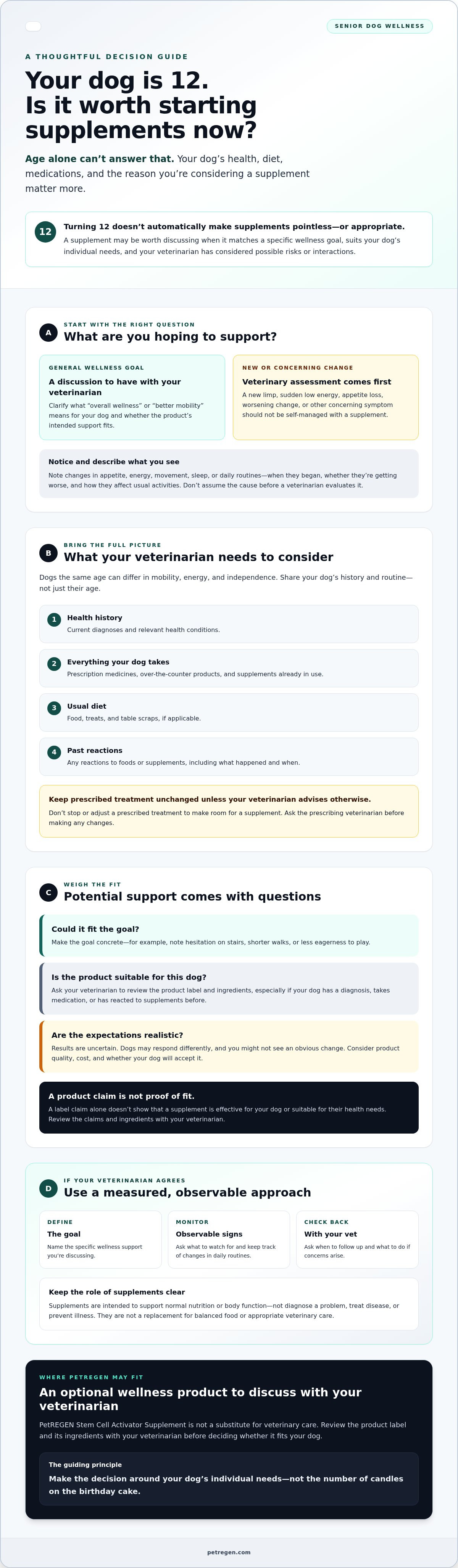
A simple process can turn “my dog is 12 is it worth starting supplements now” from a worried question into a useful discussion with your veterinarian. Start with your reason for considering a supplement, review your dog’s health and routine, get veterinary guidance, then assess the product. If your veterinarian agrees to a trial, introduce only one new supplement at a time so you can better notice changes or possible problems.
Prepare for a useful conversation with your veterinarian
Bring the product’s current label, ingredient list, serving directions, and manufacturer information. Make a complete list of prescriptions, over-the-counter products, other supplements, food, and regular treats. If you’re concerned about a change, note when it started and describe what you see, such as taking longer to rise or leaving food unfinished. Ask whether a checkup or further assessment should come before supplementation.
Use the appointment to set practical expectations. Ask:
- Does this product suit my dog’s diagnoses, diet, and current medications?
- What outcome is reasonable to look for, and what signs should I monitor?
- How should I follow the product’s serving directions, and when should we review progress?
- What reaction or change means I should stop and contact you?
Keep prescribed care unchanged unless your veterinarian advises otherwise. A supplement should not take the place of an examination or a treatment plan.
Monitor changes without mistaking timing for proof
Before starting, record a brief baseline linked to your goal. For mobility, you might note how readily your dog gets up, manages familiar steps, or joins a usual walk. For general wellness, track appetite and energy. Keep observations simple and consistent, such as a short daily note, rather than relying on memory or one unusually good or difficult day.
If your veterinarian approves the product, follow the current label directions as reviewed with them. Avoid changing food, routines, or other supplements at the same time unless advised. Changing one thing at a time makes your notes easier to interpret. Record missed servings and unwanted effects, too. A change after starting a supplement doesn’t prove the supplement caused it, and no particular result is guaranteed. Share your observations at the follow-up your veterinarian recommends.
Checklist: Define the goal, review your dog’s health and current routine, ask your veterinarian about the product, then introduce one approved supplement at a time and track agreed-upon observations without assuming a guaranteed result.
Once your veterinarian has helped you clarify what to look for, review PetREGEN supplement information as one product to assess with them.
Where PetREGEN May Fit in a Senior Dog’s Wellness Routine
After you’ve clarified your goal and discussed supplement safety with your veterinarian, consider whether a specific product fits your dog’s routine. PetREGEN Stem Cell Activator Supplement is one optional product to review, not a treatment or replacement for veterinary care. Its suitability depends on your dog’s health, diet, medications, and your veterinarian’s advice.
What PetREGEN says its dog supplement is designed to support
PetREGEN describes its dog supplement as supporting immune function and the body’s natural regenerative processes, with a whole-body wellness approach. The company reports that it uses ingredients including collagen, real liver, amino acids, omega 7, and phytonutrients, and describes its ingredients as USA-made and human-grade.
Those descriptions can help you decide what to ask about, but they don’t establish that the supplement will produce a particular result for your dog. The name “Stem Cell Activator Supplement” also doesn’t mean the product is veterinary stem cell therapy or prescription medicine. It shouldn’t be used to diagnose, treat, cure, or prevent disease, and it can’t replace an examination or a care plan for a health problem.
How to evaluate the product for your 12-year-old dog
Use the current product label as the basis for a specific conversation with your veterinarian. Check that the ingredients align with your dog’s existing food and supplements, and ask about compatibility with any diagnoses or prescribed medicines. Confirm the latest ingredient amounts and serving directions on the label rather than relying on older descriptions. If you’re considering the product for a particular concern, ask whether that concern needs veterinary assessment first.
Keep the decision practical, too. Consider whether your dog is likely to accept the supplement and whether you can follow the directions consistently. If your veterinarian agrees it may be appropriate, add it as directed and monitor the goal you discussed. Don’t change prescribed treatment unless your veterinarian recommends it.
Review the product information and current label, then discuss whether it fits your dog’s individual needs. Explore PetREGEN and review its supplement information before making a decision with your veterinarian.
Make a Thoughtful Next Step for Your Senior Dog
If you’re still wondering, “my dog is 12 is it worth starting supplements now,” remember that age alone doesn’t decide. Your dog’s health, current routine, and the goal you have in mind matter more. A supplement may be worth discussing if your veterinarian agrees it fits, but results aren’t guaranteed and it can’t replace veterinary care.
Take the next step with a clear purpose: review your dog’s needs with your veterinarian, check the current product label, and track any changes carefully if you decide to proceed. PetREGEN describes its ingredients as USA-made and human-grade, and reports endorsements from veterinarians, zoologists, dog trainers, and pet parents. These details can inform your review, but your veterinarian can help assess whether the product suits your individual dog.
Explore PetREGEN and review its supplement information, then discuss its fit with your veterinarian. With a thoughtful plan and realistic expectations, you can focus on helping your companion get the care and comfort they need at every age.
Frequently Asked Questions
Is 12 too old for a dog to start taking supplements?
No, 12 isn’t automatically too old to start a supplement. Whether it’s worth considering depends on your dog’s health, diet, medicines, symptoms, and the reason you’re considering one. Ask your veterinarian to review the specific product and your dog’s history first. Supplements aren’t a substitute for diagnosing a health problem or following prescribed care.
Can supplements help a 12-year-old dog feel better?
Possibly, if a supplement is appropriate for a specific wellness goal, but results vary and aren’t guaranteed. A change in mobility, appetite, energy, or comfort can have different causes, so don’t assume a supplement is the answer. Describe what you’ve noticed to your veterinarian, including when it began. Together, you can decide whether to investigate an underlying concern and what everyday signs to monitor if a supplement is considered.
Should I ask my veterinarian before giving my senior dog a supplement?
Yes. A veterinary review is especially helpful if your dog has a diagnosis, takes medication, eats a therapeutic diet, or already receives supplements. Share the full ingredient list and serving directions so your veterinarian can assess the product in light of your dog’s needs. Ask even if it’s described as natural or for general wellness, since those descriptions alone don’t establish that it’s suitable for every dog.
How do I know which supplement is right for my 12-year-old dog?
Start with a clear goal and ask your veterinarian whether a supplement makes sense for it. Review the complete, current label, including ingredients, amounts, serving directions, and manufacturer information. Ask how the product fits with your dog’s health conditions, food, and medicines. Don’t choose based on testimonials or broad promises alone. A product’s claims don’t guarantee it will meet your dog’s needs or produce a noticeable change.
Can a senior dog take supplements with prescription medication?
Sometimes a veterinarian may approve a supplement alongside medication, but don’t assume every combination is suitable. Give your veterinarian the names and directions for all prescriptions, over-the-counter products, and supplements your dog takes. Don’t stop, reduce, or replace prescribed medicine on your own. If you notice a concerning reaction after adding anything new, contact your veterinary clinic for advice and share what your dog took and when.
How long should I give a dog supplement before deciding whether it helps?
There isn’t one timeline that applies to every product, dog, or wellness goal. Ask your veterinarian what period is reasonable for the specific supplement and what changes to watch for. Keep simple notes on relevant observations, such as appetite or ease of movement, and ask when to follow up. Don’t increase the serving or continue beyond the label directions based on an assumed schedule. Check with your veterinarian first.
What should I do if my 12-year-old dog has new or worsening symptoms?
Contact your veterinarian rather than trying to manage new or worsening symptoms with a supplement alone. Note when the change began, how it affects daily activities, and whether food, medication, or routine changed around the same time. If your dog seems acutely unwell, seek prompt veterinary guidance. Once immediate concerns and possible causes have been assessed, you can ask whether a supplement belongs in the broader care plan.


