

What if the most helpful first step for a cat with stiff, painful joints is making everyday movements easier? Managing cat joint pain at home can feel uncertain when your companion moves less, hesitates to jump, or struggles to reach familiar places. These changes are worth noticing, even if your cat does not limp or cry out.
You’re right to look for safe, practical ways to support your cat’s comfort and independence. Home adjustments can make daily routines easier, but they do not replace veterinary guidance. A veterinarian can investigate what may be causing the changes and help you choose suitable care.
This guide explains what to observe and share with your vet, how to make key areas of your home easier to navigate, and what to know about laser therapy and supportive options. It also explains where a supplement such as PetREGEN Stem Cell Activator Supplement may fit into a broader wellness plan. The supplement is not a cure for joint disease or a replacement for veterinary treatment. With a clear plan, you can support your cat’s mobility and make informed decisions with your veterinary team.
Key Takeaways
- When managing cat joint pain at home, make everyday necessities easier to reach rather than asking your cat to jump or climb.
- Changes in grooming, movement, or litter-box habits are useful observations to record and share with your veterinarian, not a diagnosis on their own.
- Laser therapy, medication, and supplements have different roles and limitations. Your veterinary team can help determine which options suit your cat.
- A consistent routine for observing daily activities can help you notice mobility changes without handling sore joints.
- PetREGEN Stem Cell Activator Supplement is intended to support natural regenerative function and general wellness, not to treat joint disease or replace veterinary care.
Managing Cat Joint Pain at Home Starts with Recognizing Changes
It can be worrying to see a beloved cat move differently, especially when there is no obvious limp or cry of pain. Cats may show discomfort through small changes in their routines instead: taking longer to stand, choosing a lower resting spot, or skipping a familiar jump. These observations can help you describe what has changed, but they cannot tell you why. Stiffness, altered jumping, grooming changes, and litter-box difficulty are clues to share with a veterinarian, not a diagnosis.
Supportive home care means making daily life more comfortable while working with your veterinary team to assess the problem and plan care. It is not a cure, and observation alone should not replace an exam. For background on osteoarthritis, one possible cause of joint discomfort, see this overview of Osteoarthritis (OA).
What changes in movement or routine should owners notice?
Look for differences from your cat’s usual habits. Your cat might hesitate before jumping onto a favorite chair, use stairs more slowly, rest in a new position, or show less interest in play. You may also notice less grooming, difficulty stepping into the litter box, or a change in how readily your cat seeks company. No single sign proves joint pain, but a pattern is useful information.
Keep dated notes about when a change happens and which activities are affected. Include appetite and any sudden worsening. If it is safe and does not disrupt your cat, a short video of ordinary movement can show your veterinarian what is difficult at home. Do not coax your cat to repeat a movement for the camera.
When does suspected joint pain need veterinary attention?
Arrange a veterinary assessment when mobility changes persist or worsen. A vet can consider joint pain alongside other possible causes and recommend an appropriate next step. Seek prompt veterinary advice if your cat appears to have sudden, severe pain, cannot use a limb, or has a major change in behavior. Do not wait for home observations to explain an abrupt decline.
A veterinarian can assess the cause of your cat’s changes and recommend an appropriate care plan. Your notes and videos can make that conversation clearer by showing what you observe between visits.
How to Make Home Safer and Easier for a Cat with Joint Pain
A few thoughtful changes can reduce the effort it takes for your cat to manage familiar routines. The goal of managing cat joint pain at home is not to make your cat exercise more or redesign every room. It is to make the resources your cat already relies on easier and safer to reach. The American College of Veterinary Surgeons also includes environmental modifications among its treatment options for feline osteoarthritis.
Which home changes can make everyday movement easier?
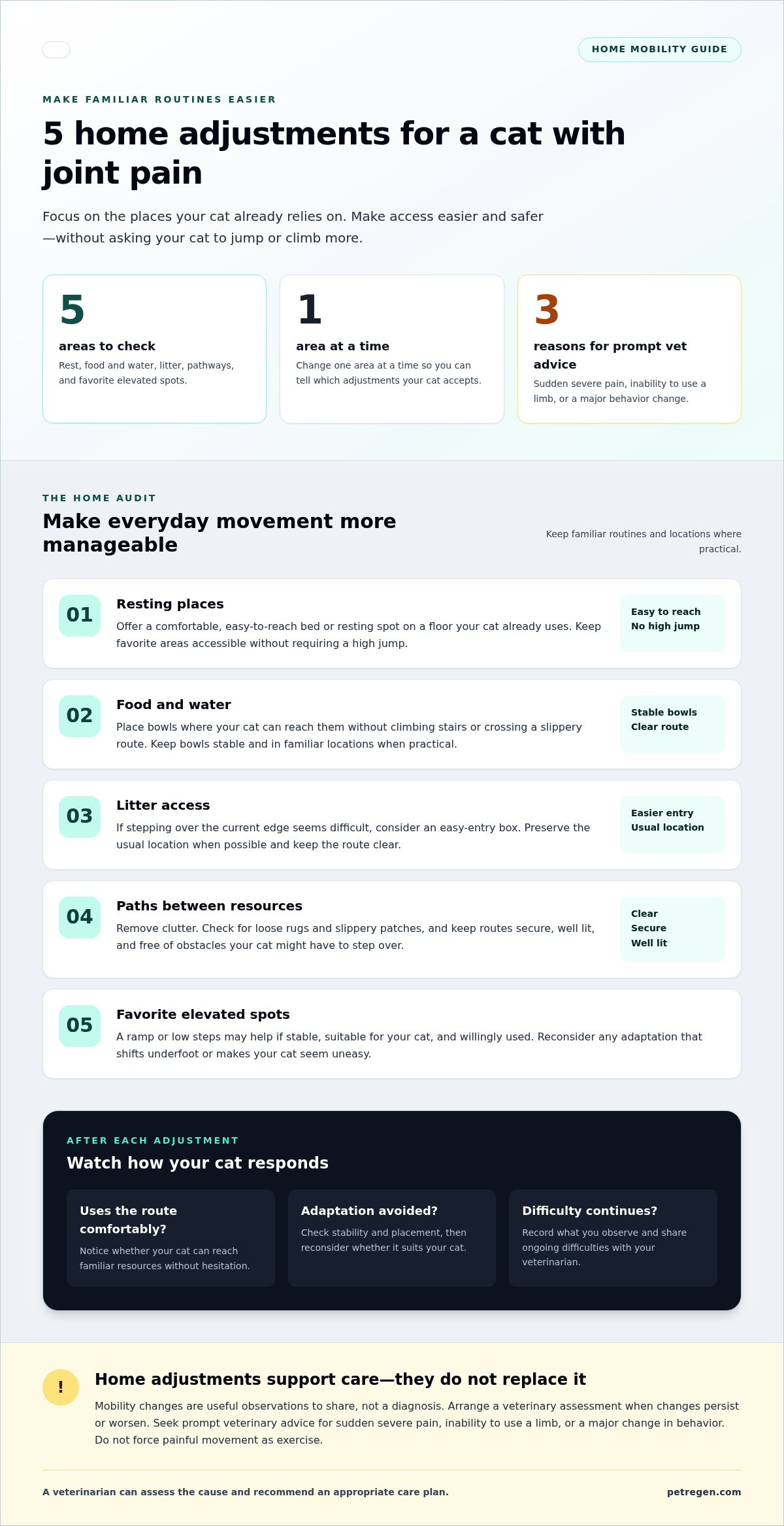
Try this low-risk home audit, changing one area at a time so you can tell which adjustments your cat accepts:
- Resting places: Offer a comfortable, easy-to-reach bed or resting spot on a floor your cat already uses. Keep favorite areas accessible without requiring a high jump.
- Food and water: Place bowls where your cat can reach them without climbing stairs or crossing a slippery route. Keep them stable and in familiar locations when practical.
- Litter: Consider an easy-entry box if stepping over the current edge seems difficult. Preserve the usual location when possible, and keep the route clear.
- Paths between resources: Remove clutter and check for loose rugs or slippery patches. Keep routes secure, well lit, and free of obstacles your cat might have to step over.
- Favorite elevated spots: A ramp or low steps may help if they are stable, suitable for your cat, and willingly used. Do not rely on an adaptation that shifts underfoot or makes your cat seem uneasy.
How can owners support litter-box access and daily routines?
Make essential resources reachable without encouraging repeated jumping or climbing. Keep food, water, resting places, and litter access convenient while preserving familiar routines as much as possible. Avoid moving everything at once. A sudden layout change can be confusing, and a ramp that looks helpful to you may not feel safe to your cat.
Observe how your cat responds to each adjustment. Does your cat use the route comfortably? Can they enter the litter box and reach their resting spot without hesitation? If an adaptation is avoided, check its stability and placement, then reconsider whether it suits your cat. Do not force painful movement as exercise. Record whether access or comfort improves, and share ongoing difficulties with your veterinarian.
Home changes are one part of a broader care plan. For owners also exploring general wellness support, PetREGEN’s approach to whole-body wellness describes a supplement intended to support natural regenerative function, not replace veterinary care or treat joint disease.
Laser Therapy, Medication, and Supplements: What Each Can and Cannot Do
Managing cat joint pain at home may include comfort-focused changes, but treatment choices call for veterinary guidance. Laser therapy and medication are veterinary-directed options. Supplements provide supportive wellness, while environmental adjustments make daily movement easier. These approaches are not interchangeable. Their suitability and potential role depend on the individual cat, so a veterinarian should consider them in light of the diagnosis and overall health. Today's Veterinary Practice provides clinical context on feline degenerative joint disease and pain management.
| Option | Purpose | Who guides it and what owners do | Key limitation |
|---|---|---|---|
| Laser therapy | A light-based modality, also called photobiomodulation, used as part of some veterinary care plans. | A veterinarian decides whether it may suit the cat and directs its use. Owners can track changes and follow the care plan. | It is not a do-it-yourself treatment, and response is not guaranteed or uniform. |
| Medication | Veterinary-directed pain management or treatment of an underlying condition. | The veterinarian selects and monitors medication. Owners follow instructions and report concerns or changes. | Choice and monitoring depend on the cat’s health and diagnosis. Never give human pain medicine unless specifically directed by a veterinarian. |
| Supplements | Potential support for general wellness as an adjunct to a broader plan. | Review the product and its use with the veterinarian, especially if the cat has health conditions or takes medication. | Supplements do not diagnose or treat joint disease, replace prescribed care, or guarantee pain relief. |
| Environmental adjustments | Reduce the effort needed to reach resting places and essential resources. | Owners make gradual, practical home changes and observe whether the cat uses them comfortably. | They can improve access and comfort but do not establish the cause of pain or replace veterinary assessment. |
What should cat owners know about laser therapy for joint pain?
Veterinary laser therapy applies specific light to an area as a treatment modality. Whether it belongs in a cat’s care plan depends on the diagnosis, overall health, and the veterinarian’s judgment. Ask the veterinary team to explain its intended role alongside other care. Do not try to treat your cat with a laser device at home or assume there is a standard number of sessions or a predictable result.
How do supplements fit alongside veterinary care?
PetREGEN Stem Cell Activator Supplement is a natural superfood supplement formulated for cats, dogs, and horses. It is intended to support the body’s natural regenerative function and general wellness, including mobility and healthy aging. It is not veterinary stem cell therapy or a treatment for feline joint pain. Discuss any supplement with your veterinarian, and follow product information appropriate to cats. Keep expectations measured, and do not delay assessment or prescribed pain care in favor of a supplement.
A Practical At-Home Routine for Monitoring Cat Mobility
A simple, consistent record can help you explain what has changed and whether your cat’s routines are becoming easier or harder. When managing cat joint pain at home, focus on what you can observe during ordinary activities. Do not press, bend, or manipulate sore joints, and do not encourage your cat to jump just to test mobility.
What should a cat joint-pain diary include?
Use a notebook or phone note to record brief, factual observations. A daily entry can take less than a minute. If daily notes feel impractical, choose a regular schedule and stick with it.
- Date and context: Note the day and any relevant change, such as a moved bowl, new step, or altered routine.
- Getting around: Record how your cat reaches food, water, favorite resting places, and the litter box. Note hesitation, slower movement, or avoiding a route.
- Everyday behavior: Track grooming, resting positions, social interaction, appetite, and voluntary play.
- Changes over time: Describe what seems different without assigning a pain score or assuming a cause.
Short videos can be useful if you can capture normal movement without stress. Film only when your cat is moving voluntarily. Never stage a jump or repeatedly call your cat to provoke a response. If you have made a home adjustment, note when it began and what you observe afterward. A change that follows an adjustment is worth reporting, but it does not prove the adjustment caused it.
How can owners prepare for a veterinary discussion?
Bring your dated notes and any safe, stress-free videos to the appointment. Make a list of current medications and supplements, including what you give and when, and write down your questions. You might ask what causes are being considered, how to monitor progress, and which changes should prompt follow-up.
Contact your veterinary team if mobility or comfort worsens, remains limited, or changes unexpectedly. Your observations can support their assessment, but they should not delay care when your cat’s condition declines.
If you are considering a supplement as part of broader wellness support, discuss it with your veterinarian and review whether it is suitable for your cat. Explore PetREGEN’s cat supplement as one option to include in that conversation. It is intended to support natural regenerative function and general wellness, not to diagnose or treat joint disease or replace veterinary care.
Building a Supportive Cat Joint-Care Plan with Veterinary Guidance
Helping a cat with mobility changes is a process, not a single home remedy. A thoughtful plan starts with veterinary assessment, then brings together practical changes at home, consistent observations, and a discussion of suitable care options. This partnership matters because similar-looking changes can have different causes, and the right approach depends on your cat’s health and needs.
Managing cat joint pain at home means supporting comfort alongside veterinary care. It does not mean diagnosing the problem yourself or replacing treatments recommended by your veterinarian. Home adjustments may make familiar routines easier, while your notes help the veterinary team understand what your cat experiences day to day.
How can owners evaluate a supportive option responsibly?
Before adding a supplement, consider your cat’s age, health history, current diet, medications, and veterinary recommendations. Share the product label and ingredient information with your veterinarian so they can help assess whether it fits your cat’s overall plan. This is especially useful if your cat has an existing health condition or takes prescribed medication.
PetREGEN Stem Cell Activator Supplement is formulated for cats, dogs, and horses, and is intended to support natural regenerative function and general wellness, including mobility and healthy aging. It is a supplement, not veterinary stem cell therapy or a treatment for joint disease or pain. Keep expectations realistic, follow label directions appropriate to cats, and track observations without assuming a specific result or timeline.
What are sensible next steps for a cat with mobility changes?
Start with the steps that bring useful information and comfort:
- Arrange an assessment for mobility changes that persist or worsen. Bring concise dated notes and any videos of voluntary, everyday movement.
- Make one or two practical adjustments to your cat’s home environment, such as making a favorite resting spot easier to reach.
- Observe without testing whether your cat uses the change comfortably. Share persistent difficulty or unexpected changes with your veterinarian.
- Review care options together, including environmental support, veterinary-directed treatment, and whether a supplement is appropriate.
Small, careful steps can help you support your cat without asking them to push through discomfort. If you are considering a wellness-support option, explore PetREGEN for cats and discuss its fit with your veterinarian as part of your cat’s broader care plan.
Take the Next Step Toward Easier, More Comfortable Days
Managing cat joint pain at home works best as part of a veterinary-guided plan. Notice changes in your cat’s routine, make practical adjustments that ease access to daily necessities, and keep clear notes to share with your veterinarian. Laser therapy, medication, and supplements have different roles, so discuss what fits your cat rather than relying on one approach alone.
PetREGEN Stem Cell Activator Supplement is formulated for cats, dogs, and horses. It is intended to support natural regenerative function and whole-body wellness, not to diagnose or treat joint disease or replace veterinary care. If you are considering a supplement as an adjunct, review it with your veterinarian in light of your cat’s health and care plan.
Explore PetREGEN Stem Cell Activator Supplement for cats as a wellness-support option to discuss with your veterinary team. With attentive observation, thoughtful home care, and professional guidance, you can take steady steps to support your cat’s comfort and independence.
Frequently Asked Questions
Is laser therapy effective for cat joint pain?
Veterinarians may consider laser therapy as one part of an individual care plan for a cat with joint pain. Whether it is suitable, and what benefit to expect, depends on the cat’s diagnosis and circumstances; results are not guaranteed. Ask the veterinarian what goal they are targeting, what alternatives exist, how progress will be monitored, and how laser therapy fits with other recommended care.
Can I use a laser therapy device on my cat at home?
Do not use a laser therapy device on your cat without veterinary direction. The appropriate device, application, and safety precautions depend on your cat’s situation, and a consumer device should not be assumed equivalent to veterinary treatment. Ask your veterinarian whether home use is suitable, what instructions to follow, and which signs mean you should stop and seek advice.
How can I make my home more comfortable for a cat with joint pain?
Make essential resources easier to reach: place food, water, resting spots, and litter access on floors your cat already uses, clear familiar pathways, and reduce avoidable jumping. Introduce changes gradually, then observe whether your cat uses them comfortably. These practical steps can support daily routines, but they do not identify the cause of pain or replace veterinary assessment if mobility changes persist.
What are common signs of joint pain in cats?
Possible signs include hesitation or changes when jumping, slower stair use, less grooming or play, altered resting habits, and difficulty reaching or entering the litter box. Cats may show discomfort subtly, and no single observation confirms arthritis or another diagnosis. Keep dated notes or short videos of ordinary, voluntary movement, and discuss persistent, worsening, or sudden changes with your veterinarian.
Can supplements help a cat with joint pain?
Supplements may be considered for general wellness support, but they do not diagnose or treat joint disease and are not substitutes for veterinary care or pain management. Whether a product is suitable depends on your cat’s health, diet, and other supplements or medications. Review its ingredients and label directions with your veterinarian before use, and avoid assuming it will relieve pain or produce a particular result.
What should I do if my cat suddenly stops using a leg?
Seek prompt veterinary advice if your cat suddenly cannot use a leg or appears to be in marked pain. Do not force your cat to walk, manipulate the affected area, or start a new treatment without guidance. Keep your cat as calm and safe as you can while arranging veterinary help, and describe when the change began and what you observed.
How do I know whether home changes are helping my cat?
Track familiar activities consistently, such as reaching food and water, using the litter box, grooming, resting, and choosing to play. Note dates and any home adjustments, then look for changes in how your cat manages those routines. Do not provoke movement to test your cat. A change in one activity does not prove what caused it, so share your observations with your veterinarian.


