

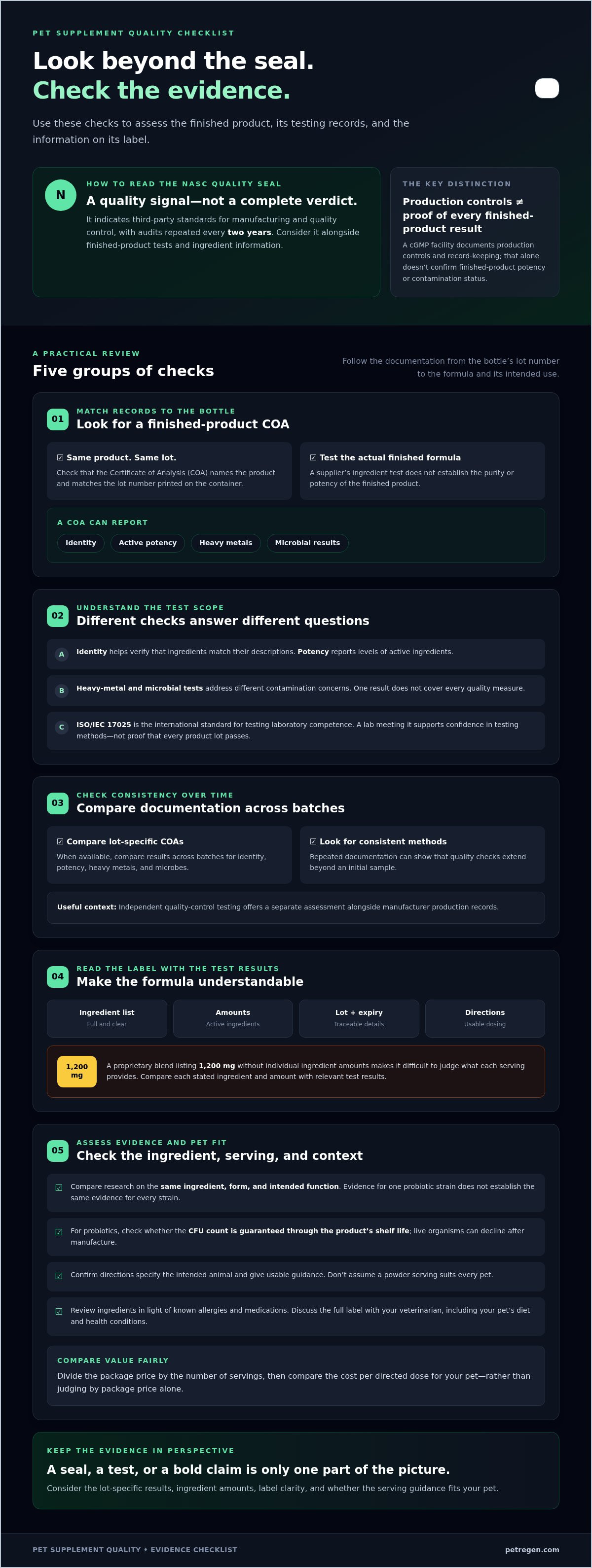
A seal is a quality signal, not a complete verdict. The NASC Quality Seal indicates that a product follows third-party standards for manufacturing and quality control, with audits repeated every two years. To decide how to trust a new pet supplement brand, look beyond the seal and assess the finished product, its ingredients, and the evidence behind its intended use.
It’s reasonable to want clear information before adding something new to your pet’s routine. Strong claims and polished packaging don’t show whether a supplement is carefully made or appropriate for your companion. This guide explains how to read labels, understand what quality standards do and don’t demonstrate, and assess testing and ingredient evidence. You’ll also learn how to interpret the NASC seal without treating it as a promise of results. Use the checklist to make a more informed choice and discuss your pet’s needs with your veterinarian.
Key Takeaways
- Read the NASC Quality Seal as a signal of manufacturing and quality-control standards, then look beyond it for evidence about the finished product.
- Check that labels explain ingredients and amounts clearly, with lot details, expiration information, and usable dosing directions.
- Look for batch-specific testing records and documentation that explain how ingredients and finished products are assessed.
- Judge a formula by the evidence behind its ingredients and its focus on supporting normal health, not by bold promises alone.
Third-party verification and batch-to-batch testing
Independent evidence can help distinguish documented quality controls from marketing claims. Look for testing records for the actual product and lot, not just credentials or test results for an ingredient supplier.
-
Review Third-Party Test Results
Look for a finished-product Certificate of Analysis (COA) tied to the lot number on the bottle. It can report identity, active potency, heavy metals, and microbial results for that tested lot. The International Organization for Standardization identifies ISO/IEC 17025 as the international standard for testing laboratory competence. A laboratory meeting that standard supports confidence in its testing methods, not proof that every product lot passes.
U.S. Congress introduced the Dietary Supplement Health and Education Act in 1994. That human-supplement law shouldn’t replace scrutiny of animal-product testing. Compare the COA’s product name and lot details with the container, and check that results cover the actual finished formula.
-
Check Finished-Product Purity and Potency
Find out whether testing checks the finished supplement for both the ingredients it should contain and potential contaminants. Identity tests help verify that ingredients match their descriptions, while potency tests report levels of active ingredients. Heavy-metal and microbial tests address different contamination concerns, so one result does not cover every quality measure.
Ingredient transparency matters, too. Look for information about ingredient sourcing and testing, while remembering that a supplier’s test does not establish the purity or potency of the finished product. For a nutritional supplement, compare each stated ingredient and amount with relevant test results instead of relying only on broad claims about mobility or digestive support.
-
Compare Quality Across Batches
When available, compare lot-specific Certificates of Analysis (COAs) across batches. Check whether identity, potency, heavy metals, and microbes are assessed using consistent methods. Repeated documentation can show that quality checks apply beyond an initial sample. Independent quality-control testing also provides a separate assessment alongside the manufacturer’s production records.
A cGMP facility documents production controls and record-keeping, but that status alone doesn’t confirm the potency or contamination status of the finished product. The National Animal Supplement Council’s Quality Seal indicates third-party standards for manufacturing and quality control, with audits repeated every two years. Treat the seal as one quality signal, then consider test results and ingredient information together.
How can ingredient labels help you evaluate supplement quality?
Use the label to connect each ingredient’s stated purpose with its amount and serving directions. Clear details make it easier to judge whether the formula fits your pet’s needs.
-
Check Ingredient Explanations and Label Clarity
Read the full ingredient list and look for amounts of active ingredients, expiration dates, lot numbers, and clear dosing instructions. A proprietary blend listing 1,200 mg without individual ingredient amounts makes it difficult to judge what each serving provides. The National Animal Supplement Council has an animal supplement labeling system; treat understandable, specific information as more useful than broad benefit language.
-
Review Ingredient Research and Sourcing
Compare each ingredient with research on the same ingredient, form, and intended function. A study of one probiotic strain, for example, doesn’t establish the same evidence for every strain. For probiotics, check whether the CFU count is guaranteed through the product’s shelf life, since live organisms can decline after manufacture.
Look for sourcing details and explanations of ingredient testing. Manufacturing lead times can be 8 to 12 weeks, so ask how the maker maintains ingredient consistency during production.
-
Check Ingredient Consistency and Serving Guidance
Compare ingredient amounts and serving directions across the label. Confirm that the instructions specify the intended animal and provide usable guidance; don’t assume a powder serving is suitable for every pet. To compare prices, divide the package price by the number of servings, then compare the cost per directed dose for your pet. This accounts for different serving sizes instead of judging value by package price alone.
Before trying a supplement, discuss with your veterinarian whether its ingredients and serving directions fit your pet’s diet, health conditions, and medications. Share the full label so they can consider the formula as a whole.
-
Look for Misleading Labels and Unsafe Ingredients
Be wary of promises to cure disease, vague proprietary blends, or ingredient claims that omit amounts. Review ingredients in light of your pet’s known allergies and medications, and ask your veterinarian about anything unfamiliar. Calling a formula natural or science-based does not, by itself, show that it’s suitable for your pet.
To search for recalls, complaints, or warning letters, look up the product and brand names in FDA recall and warning-letter records. Match any notice to the exact product and manufacturer before drawing conclusions.
For a concrete example of a formula with named ingredients, explore PetREGEN’s ingredient information.
Why do quality standards matter when choosing pet supplements?
Look beyond polished claims to how a manufacturer selects ingredients, controls production, and documents quality. These checks matter when considering any supplement, including one for a senior pet already eating a complete diet.
-
Review Manufacturer Partners and Documentation
Look for a clear explanation of who makes the animal supplement and what records support its quality-control process. Useful documentation can describe ingredient sourcing, manufacturing controls, and how production issues are handled. The U.S. Food and Drug Administration does not review or approve animal supplements for safety or effectiveness in the United States, so availability is not proof of clinical review.
-
Check Sourcing and Manufacturing Requirements
Look for information about where raw materials come from and how suppliers are assessed. Ask whether the manufacturer screens ingredients for heavy metals, pesticides, or harmful fillers, and whether sourcing details apply to the actual formula. Production scale can shape a maker’s choices: manufacturers often set minimum orders of 1,000 to 5,000 units per product line. That threshold can affect which partners a new brand can use.
-
Assess Standards and Contaminant Controls
Check what a stated manufacturing standard actually covers. A cGMP facility indicates documented production controls and record-keeping, but it doesn’t establish the finished product’s potency or contamination status. Those require separate evidence. Look for specific controls for raw materials and manufacturing risks rather than relying on a broad quality claim or a seal without considering its scope.
A veterinarian can help weigh a supplement’s intended use, ingredients, and quality evidence against your pet’s health needs.
-
Consider Manufacturer Influence
Separate evidence from promotion. A paid placement or sponsored review may explain how a product is marketed, but it isn’t independent clinical evidence of effectiveness. Check whether recommendations disclose sponsorship and whether claims connect to research on the relevant ingredient, dose, and intended use. Give more weight to clearly described quality records and relevant evidence than to rankings or endorsements alone.
Science-based formulations
Assess a formula by the evidence for its ingredients, intended purpose, and amounts, not by scientific-sounding language alone. This helps distinguish general wellness claims from a formula supported by relevant research.
- Compare each ingredient with research on that same ingredient, form, and intended use. A study of one ingredient doesn’t validate an entire blend or prove that its combination works. For example, glucosamine may provide modest treatment benefits for osteoarthritis in dogs, but evidence doesn’t support using it to prevent the condition. Check whether the brand explains both the research and its limits.
- Compare the formula’s dosing logic with the animal it’s designed for. Human supplement formulas may be unsuitable for dogs because their dosing is calibrated for a 150-pound human rather than a 20-pound dog. Look for an animal-specific rationale and serving directions that account for the pet’s needs. A familiar ingredient name alone doesn’t show that the amount or combination fits.
- Look for transparency about how experts contribute to a formula. A named advisory board of veterinarians or other professionals may indicate attention to science and product safety, but check whether the brand explains each expert’s role rather than relying on a vague “expert-backed” claim. PetMD’s veterinary panel considered ingredient quality and combinations, research, brand reputation, manufacturing quality, and ease of administration when assessing dog supplements.
- Distinguish support for normal wellness from promises to cure disease. A responsible supplement should explain its intended role without presenting itself as a substitute for veterinary diagnosis or treatment. Check whether evidence supports each advertised benefit and applies to the actual formula, rather than just one studied ingredient. This distinction matters when marketing suggests dramatic results from complex formulas.
Explore a science-based approach to pet wellness with the same careful attention to formulation and purpose.
PetREGEN: PetREGEN Stem Cell Activator Supplement
PetREGEN Stem Cell Activator Supplement is formulated for dogs, cats, and horses, supporting the body’s natural regenerative function through immune support. Its whole-body approach is intended for pet owners exploring support for healthy aging, mobility, and recovery, rather than a supplement aimed at only one symptom.
The formula includes human-grade ingredients such as amino acids, omega 7, collagen, real liver, and phytonutrients. Review the ingredient information and serving directions to see how they fit your pet’s needs, and discuss the product with your veterinarian if your pet has a health condition or takes medication.
If this kind of daily supplement fits what you’re looking for, explore PetREGEN Stem Cell Activator Supplement at petregen.com.
Make Your Next Choice With Confidence
Connect a supplement’s intended purpose with your pet’s everyday needs. Decide what you hope to support, note your companion’s current routine, and discuss those priorities with your veterinarian. This can put a new product in context, especially if your pet has a medical condition or takes medication. Learning how to trust a new pet supplement brand isn’t about finding perfect-sounding promises. It’s about choosing thoughtfully, based on your pet’s needs and the evidence available.
Give yourself room to compare what matters and raise questions before changing your pet’s routine. If you’d like to discuss PetREGEN Stem Cell Activator Supplement or ask about its approach, contact PetREGEN with your questions. Careful decisions are an act of love, and each informed step can help you support your companion with greater confidence.
Frequently Asked Questions
What does the NASC seal mean?
The NASC Quality Seal indicates that a product follows third-party standards for manufacturing and quality control. Treat it as one useful signal, not proof that a supplement suits every pet or will produce a particular result. The seal doesn’t replace reviewing the product’s intended use and ingredients or seeking your veterinarian’s advice for a pet with individual health needs.
How Can You Tell If a Pet Supplement Brand Is Trustworthy?
Look for clear, consistent answers about who makes a product, what it contains, and what evidence supports its intended use. Learning how to trust a new pet supplement brand means weighing documentation and relevant ingredient research together, not relying on testimonials alone. Compare the product’s stated purpose with its ingredients and serving directions, then discuss any questions with your veterinarian.
How do I choose a safe dog supplement brand?
Start with your dog’s specific needs, then assess whether the formula and directions address them without promising a cure. Considering a supplement for an older dog taking medication calls for a different discussion than considering one for a healthy dog. Share the full label with your veterinarian, including inactive ingredients, and ask whether it fits your dog’s health history and existing care plan.
Does the pet supplement brand use third-party testing or provide a certificate of analysis?
Some brands share independent test results or a Certificate of Analysis, while others present quality details in another form. A useful document identifies the product and tested lot, with results that can be compared with the label. When comparing supplements, note whether the evidence applies to the finished product or only to an ingredient before manufacturing.
Is the pet supplement brand registered with the FDA or compliant with FDA rules
The FDA does not review or approve animal supplements for safety or effectiveness in the United States, so a product’s availability is not proof of clinical review.


