

What if a shorter hind-leg stride is more than a small change in your horse’s way of going? Horse short-striding in hind legs can be subtle, so it’s understandable to wonder whether you’re seeing normal variation or a sign of discomfort. A horse may not show an obvious head bob, but a change that is new or persistent still deserves attention.
A shortened stride is an observation, not a diagnosis. The cause may involve the hooves, muscles, joints, soft tissues, or another part of your horse’s health. Only a veterinary assessment can help determine what’s going on. This guide explains possible causes and warning signs, when to contact your veterinarian, and what to record before an examination. It also covers how to support your horse responsibly without taking steps that could worsen the problem. General wellness support may fit into a veterinarian-guided plan, but it can’t replace diagnosis or treatment.
Key Takeaways
- Horse short-striding in hind legs can have several possible causes. The movement change alone can’t identify what’s wrong.
- Contact your veterinarian about a new, persistent, or worsening change. Inability to bear weight, marked distress, or sudden severe symptoms warrant urgent veterinary advice.
- Record when the change began, which hind leg seems affected, and what you observe during ordinary movement.
- Your veterinarian will decide whether an examination or further tests are appropriate based on your horse’s history and findings.
- Coordinate hoof care, workload, nutrition, and recovery with qualified professionals. General wellness support doesn’t replace diagnosis or treatment.
Horse Short-Striding in Hind Legs: What Does the Change Mean?
A shorter hind-leg step can be easy to miss, especially when it develops gradually. Horse short-striding in hind legs describes a horse taking a shorter-than-usual step with one or both hindlimbs. It’s a gait sign to investigate, not a veterinary diagnosis. The observation alone can’t identify a cause or confirm lameness. Equine lameness is a broader category involving an abnormal gait or stance. A veterinarian must assess the horse to determine what a change means.
Your horse’s usual movement is the most useful comparison. A naturally compact stride, a change in footing, or the setting can affect what you see. Compare the horse with its own normal pattern, rather than with another horse or a single brief impression. If possible, note when the stride looks different and whether the change seems to affect one side or both.
What can a shortened hindlimb stride look like?
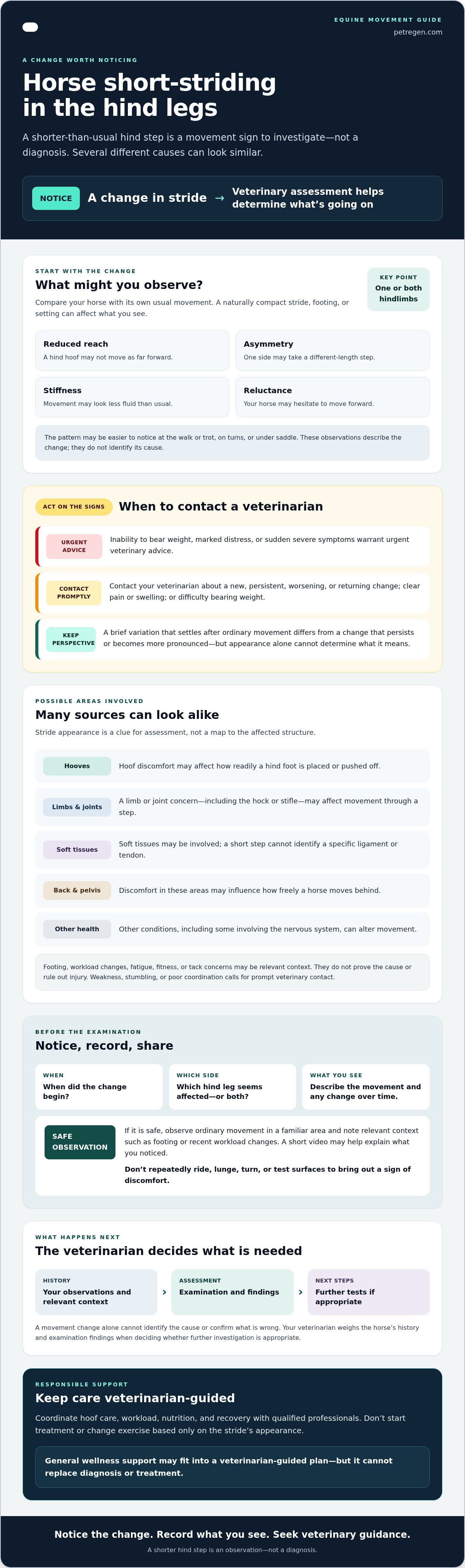
Describe what you notice without assuming that each sign has the same cause. Reduced reach may look like a hind hoof not moving as far forward. Asymmetry may appear as a different-length step on one side. Stiffness can look like less fluid movement, while reluctance may show up as hesitation to move forward. These details help describe the change, but they can’t pinpoint its cause.
The pattern may be easier to notice at the walk or trot, on turns, or under saddle. From a safe position at ground level, observe your horse moving naturally in a familiar area, if it’s safe to do so. Don’t ask the horse to trot, turn, or carry a rider just to bring out a sign of discomfort. A short video of ordinary movement may help you explain what you’ve noticed to your veterinarian.
When is a change in stride more concerning?
A brief variation that settles after ordinary movement is different from a new change that persists, returns, or becomes more pronounced. That difference doesn’t prove a persistent change is serious, but it is a reason not to dismiss it without veterinary guidance. Contact your veterinarian promptly if the movement worsens, your horse shows clear pain or swelling, or the horse has difficulty bearing weight. Sudden severe symptoms or marked distress warrant urgent veterinary advice.
If you’re unsure whether you’re seeing a real change, record what you observe and seek guidance instead of trying to diagnose the problem yourself. Noticing a subtle shift is useful. It gives your veterinarian a starting point for assessment.
Why Might a Horse Short-Stride in the Hind Legs?
A shortened hind stride can have several possible explanations, and different problems may look similar. A horse’s movement alone can’t reliably show where the source is or what is causing it. Stride appearance is a clue for veterinary assessment, not a map to the affected structure.
Possibilities include hoof discomfort, a problem affecting a limb or joint, back or pelvic discomfort, or another condition that alters movement. These are categories to consider, not diagnoses. A veterinarian weighs the horse’s history and examination findings before deciding which possibilities need further investigation.
Could hoof, joint, or soft-tissue discomfort affect the stride?
Yes. Hoof discomfort may change how readily a horse places or pushes off a hind foot. Discomfort involving a joint, such as the hock or stifle, may also affect how the limb moves through a step. Soft tissues may be involved as well. But a short step doesn’t identify a particular hoof, joint, ligament, or tendon as the cause. Don’t start treatment or change exercise based only on the stride’s appearance. Seek veterinary advice about a new or persistent change.
Can back, pelvic, footing, or workload issues also matter?
Back or pelvic discomfort may influence how freely a horse moves behind. Tell your veterinarian about relevant context, including recent workload changes, the footing where you noticed the change, or a tack concern. These details can help guide the assessment, but they don’t prove what caused the gait change. Firmer or uneven footing, fatigue, and fitness may affect movement, yet none can rule out an injury.
Some gait-affecting conditions may involve the nervous system. If your horse seems weak, stumbles, or shows poor coordination, contact a veterinarian promptly rather than continuing exercise to see whether the signs pass. Keep the horse in a safe environment and describe exactly what you observed.
Until your horse has been assessed, don’t try to identify the source by repeatedly riding, lunging, or testing different surfaces. The right next steps depend on the horse and the veterinarian’s findings. After a new or persistent gait change has been evaluated, you can discuss broader wellness support as part of a veterinarian-guided plan. For general information, see whole-body wellness support for horses. A supplement isn’t a diagnosis or treatment for the cause of short-striding.
How Do Veterinarians Assess Hindlimb Short-Striding?
A veterinary assessment turns your observations into a reasoned plan. If you’re concerned about horse short-striding in hind legs, the veterinarian considers the horse’s history and movement together. There isn’t one fixed test for every case, and owners shouldn’t try to reproduce clinical checks or diagnose the source at home.
What information should you share with the veterinarian?
Clear details can help your veterinarian decide what to examine and whether further testing may be useful. Before the appointment, note:
- When you first noticed the change, and whether it’s constant, intermittent, or getting worse.
- Which activities or circumstances seem to make it more noticeable, such as walking, turning, or working.
- Recent changes in workload, footing, tack, or farrier care, along with relevant previous health history.
Don’t put yourself or your horse at risk to gather more evidence. If you already have a video, ask the veterinarian whether it would be helpful and how they’d like it recorded. Avoid provoking the movement change to film it.
What might a lameness examination involve?
The approach depends on the horse and the veterinarian’s findings. It may include these steps:
- History: The veterinarian asks about the change, the horse’s routine, and relevant health or management details.
- Whole-horse examination: The veterinarian assesses the horse physically, which may include palpation, or hands-on examination, as appropriate.
- Movement assessment: The veterinarian may observe the horse at suitable gaits or in selected situations to evaluate how the limbs and body move. Which observations are appropriate is a clinical decision.
- Further diagnostics, if warranted: Depending on the findings, the veterinarian may recommend additional procedures, such as diagnostic imaging. These tests aren’t needed in every case, and no single test is guaranteed to identify every possible cause.
Each stage helps guide the next, but the assessment isn’t a do-it-yourself checklist. Share what you’ve noticed and let the veterinarian choose safe, relevant examination steps. Ask what the findings do and don’t establish, what further testing might clarify, and what to do while the assessment is underway. This keeps decisions grounded in your horse’s situation rather than assumptions based on stride appearance alone.
What Should You Do if Your Horse Is Short-Striding Behind?
A new or persistent change in your horse’s movement deserves veterinary guidance, especially if it’s worsening or appears painful. Don’t push through a ride or strenuous workout to see whether the stride “works itself out.” Until you’ve spoken with your veterinarian, keep activity quiet and avoid giving medication unless they direct you to. Medication can affect what the veterinarian observes and may not be appropriate for your horse.
What can you safely observe while arranging advice?
Useful notes can help you explain what changed without trying to diagnose the cause. Record:
- The date you first noticed the change, and whether it has stayed the same, come and gone, or worsened.
- What your horse was doing, the surface, and the gait when you saw it.
- Whether one or both hindlimbs seem affected, based on ordinary movement.
- Any visible swelling or wounds you notice without handling the affected area.
Observe only if you can do so safely. Don’t force your horse to walk, trot, turn, or stand in a particular way, and don’t manipulate a limb. Keep yourself and others clear if the horse is distressed or unsteady. Stop observing and contact your veterinarian if movement worsens or it doesn’t feel safe to remain nearby.
When should you call a veterinarian promptly?
Contact your veterinarian for a sudden, persistent, worsening, or painful movement change, or if your horse has difficulty bearing weight. Seek urgent veterinary advice for marked distress, inability to stand, or significant coordination problems, such as pronounced stumbling or weakness. If you’re unsure how urgently your horse needs help, call and describe the signs rather than waiting for them to become clearer.
Action summary: Observe only what’s safe, record what you see, and let a veterinarian determine the cause and treatment. Your notes can support an assessment, but they can’t replace one. Don’t wait for rest, a supplement, or an online opinion when the change is new, painful, severe, or getting worse.
After your veterinarian has assessed the gait change, ask whether general wellness support belongs in your horse’s individual plan. PetREGEN Stem Cell Activator Supplement is positioned for whole-body wellness, not as a way to diagnose or treat short-striding. Explore PetREGEN for general wellness support only as an adjunct to veterinarian-guided care.
How Can Long-Term Wellness Support a Horse with Hindlimb Changes?
Once your veterinarian has assessed the gait change, ask how to support your horse’s overall wellbeing within the recommended care plan. If a horse is short-striding in the hind legs, wellness measures may help shape day-to-day management, but they can’t identify or treat the underlying cause. Follow the veterinarian’s diagnosis and treatment recommendations first, and check before changing exercise or adding a supplement.
Long-term care should reflect your individual horse’s needs. Nutrition, workload, hoof care, and recovery planning may all be relevant, but there’s no one-size-fits-all adjustment for hindlimb changes. Discuss feeding with your veterinarian or another qualified equine nutrition professional, and coordinate hoof-care decisions with your farrier and veterinary team. If your horse needs a modified workload or recovery plan, ask the veterinarian what’s appropriate and when to reassess.
Where can supplements fit in a veterinarian-guided plan?
A supplement may be considered for general wellness support, not as a substitute for veterinary care. PetREGEN Stem Cell Activator Supplement is formulated for horses and positioned to support immune function and the body’s natural regenerative processes as part of whole-body wellness. These general support claims don’t establish that it treats a specific cause of an altered gait. Discuss any supplement with your veterinarian, especially if your horse is receiving other care.
What should you ask before choosing a horse supplement?
Review the intended use, complete ingredient information, directions, and suitability for your horse with your veterinarian. Ask whether the product fits the current care plan and whether there’s horse-specific evidence relevant to the claims being made. Don’t assume that a general wellness statement proves a supplement can resolve short-striding, replace veterinary treatment, or improve recovery from a particular condition. Check product details directly, and ask your veterinarian about any uncertainty before use.
Keep the distinction clear: supportive care can sit alongside a veterinary-guided plan, but supplements don’t diagnose or treat lameness. If you’re exploring general wellness options after discussing your horse’s needs with your veterinarian, Explore PetREGEN’s horse supplement as one option to review together.
Take the Next Step Toward Your Horse’s Wellbeing
A shorter hind-leg stride is a sign to observe, not a diagnosis. If you notice horse short-striding in hind legs, record what you see and contact your veterinarian about new, persistent, worsening, or painful changes. A veterinary assessment can help identify the cause and guide appropriate care.
Once your horse’s needs have been assessed, discuss nutrition, workload, hoof care, and any supplement with your veterinary team. PetREGEN offers a supplement formulated for horses and describes its approach as science-based, whole-body wellness support. It isn’t a treatment for lameness or a substitute for veterinary care.
With careful observation and professional guidance, you can make thoughtful decisions about your horse’s wellbeing. Learn about PetREGEN’s supplement for horses and discuss whether it fits your veterinarian-guided wellness plan.
Frequently Asked Questions
What does it mean when a horse is short-striding in the hind legs?
It means the horse is taking a shorter-than-usual step with one or both hindlimbs. You might notice reduced reach, a difference between the two sides, or less fluid movement. This describes an observed change, not its cause. Compare your horse’s movement with its usual way of going, and tell your veterinarian when you noticed the change and in what situations it appears.
Can a horse short-stride behind without being lame?
A short stride alone can’t confirm or rule out lameness. It’s a movement change that may have different explanations, and a horse may not show an obvious head bob. A veterinarian can assess the horse and determine whether lameness or another issue is present. If the change is new, persistent, worsening, or appears painful, contact your veterinarian rather than assuming it’s harmless.
What causes a horse to short-stride in the hind legs?
Possible causes include hoof discomfort, limb or joint problems, soft-tissue issues, back or pelvic discomfort, and other conditions that affect movement. Footing, workload, tack, and fitness may also influence how a horse moves, but they don’t rule out injury. Because different issues can produce similar changes, stride appearance alone can’t identify the cause. A veterinary examination is needed to guide next steps.
When should I call a vet about my horse’s short stride?
Contact your veterinarian about a new, persistent, worsening, or painful change in movement, or if your horse has difficulty bearing weight. Seek urgent veterinary advice for marked distress, inability to stand, or significant coordination problems such as pronounced stumbling or weakness. If you’re unsure how urgent the situation is, describe what you’ve observed to your veterinarian rather than waiting for the signs to progress.
Should I ride a horse that is short-striding behind?
Don’t continue strenuous work or ride to test the stride when your horse has a new or unexplained movement change. Stop exercise and contact your veterinarian for guidance, especially if the change persists, worsens, or seems painful. Keep your horse in a safe, calm environment, and don’t give medication unless your veterinarian directs you to. The appropriate activity level depends on the cause and veterinary advice.
Can a hoof or back problem make a horse short-stride behind?
Yes. Hoof discomfort may alter how a horse places or pushes off a hind foot, while back or pelvic discomfort may affect how freely the horse moves behind. Joint or soft-tissue problems can also change limb movement. These are possibilities, not conclusions based on appearance. Share relevant hoof-care history and any back or tack concerns with your veterinarian, who can assess the horse and decide whether further testing is appropriate.
Can a supplement fix a horse’s short-striding?
No supplement should be relied on to diagnose or treat the cause of a shortened stride. A veterinarian should assess new or persistent gait changes and guide any care plan. PetREGEN Stem Cell Activator Supplement is formulated for horses and positioned for general wellness support, not as a treatment for lameness or short-striding. Discuss any supplement, its intended use, ingredients, and directions with your veterinarian before adding it to your horse’s routine.


