
What if the supplements you've been giving your French Bulldog are only masking the problem, not actually fixing it? If you've spent any time researching supplements for French Bulldog spine health, you already know the fear that comes with owning this breed: the wobbly back legs, the yelp when they jump off the couch, the quiet dread of hearing the letters IVDD from your vet. It's painful to watch, and the thought of expensive spinal surgery feels overwhelming.
Here's what most pet parents don't realize: there's a meaningful difference between supplements that temporarily dull discomfort and those that work at a cellular level to support your Frenchie's body's own built-in repair system. You're right to want more than a band-aid solution.
This guide cuts through the marketing fluff to show you exactly what science-backed regenerative support looks like for your Frenchie's delicate spine. You'll discover which ingredients have real research behind them, why a whole-body wellness approach outperforms symptom-only treatments, and how proactive supplementation could help your fur-baby get back to those happy, full-speed zoomies you love.
Key Takeaways
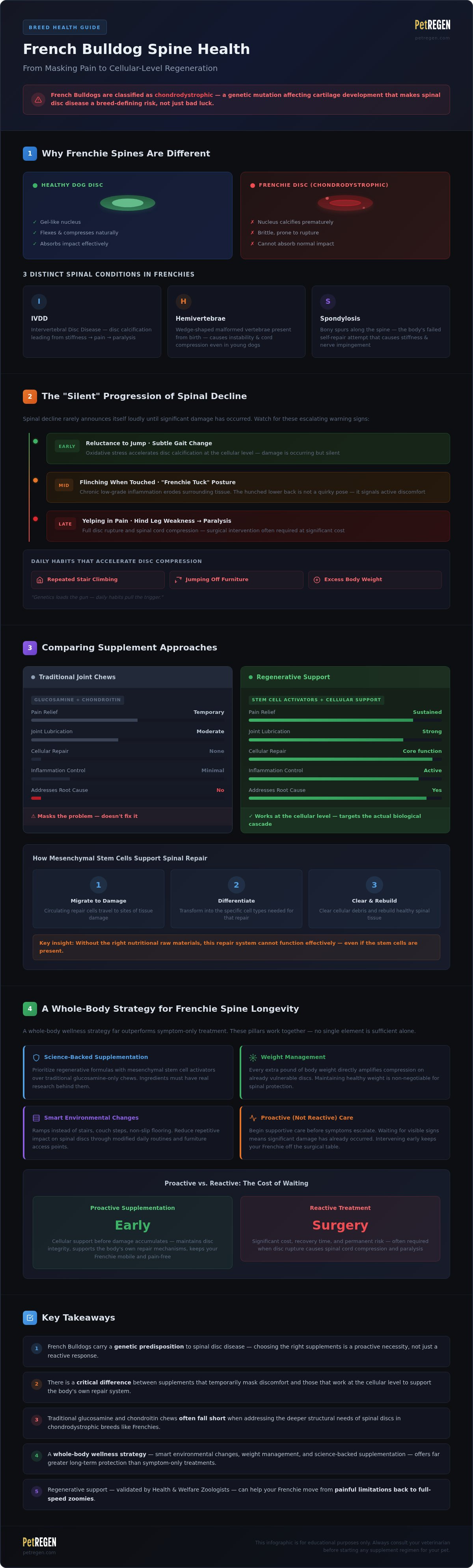
- French Bulldogs carry a genetic predisposition to spinal disc disease that makes choosing the right supplements for French Bulldog spine health a proactive necessity, not just a reactive one.
- There is a critical difference between supplements that temporarily mask discomfort and those that work at a cellular level to support your Frenchie's body's own built-in repair system.
- Traditional glucosamine and chondroitin chews, while popular, often fall short when it comes to addressing the deeper structural needs of spinal discs in chondrodystrophic breeds.
- A whole-body wellness strategy — combining smart environmental changes, weight management, and science-backed supplementation — offers far greater long-term protection than symptom-only treatments.
- Regenerative support, validated by experts like Health & Welfare Zoologists, can help your Frenchie move from painful limitations back to the happy, full-speed zoomies you both love.
Understanding the Unique Spinal Challenges of French Bulldogs
French Bulldogs aren't just small dogs with big personalities. They're a breed whose very charm, that compact, low-slung body and adorably squished face, comes with a serious biological trade-off. To truly understand what's at stake for your Frenchie's back, you need to look past the surface and into their genetics.
Frenchies are classified as chondrodystrophic dogs, meaning they carry a genetic mutation that causes abnormal cartilage development throughout their bodies. This isn't just what gives them those short, bowed legs. It directly affects the composition of their intervertebral discs, the shock-absorbing cushions between each vertebra. In healthy dogs, these discs retain a gel-like nucleus that flexes and compresses naturally. In chondrodystrophic breeds, that nucleus begins calcifying, often prematurely, losing its ability to absorb impact and becoming brittle and prone to rupture.
This is the biological root of Intervertebral Disc Disease (IVDD): a degenerative process that requires a multi-system biological response to slow, manage, and ideally reverse its progression. It's not simply "wear and tear." It's a cascade of cellular breakdown that, left unaddressed, moves from stiffness to pain to paralysis.
Frenchies also face two additional structural conditions that are often confused with IVDD but are distinct problems:
- Hemivertebrae: Malformed, wedge-shaped vertebrae that develop in the womb. These create an inherently unstable spinal column and can cause spinal cord compression even in young dogs.
- Spondylosis: Bony spurs that form along the spine as the body attempts to stabilize degenerating discs. It's essentially your Frenchie's skeleton trying to self-repair, but the process itself can cause stiffness and nerve impingement.
The "Silent" Progression of Spinal Wear
Here's what makes spinal decline so dangerous in this breed: it rarely announces itself loudly until significant damage has already occurred. Before the heartbreaking drag of a hind leg appears, there are quieter warning signs. Watch for reluctance to jump, a subtle change in gait, flinching when touched along the back, or unusual stillness after play. Oxidative stress accelerates disc calcification at the cellular level, and chronic low-grade inflammation quietly erodes the surrounding tissue. Your Frenchie's immune system is actively working to manage that inflammation, which is precisely why choosing the right supplements for French Bulldog spine health matters so much, so early.
Breed-Specific Risks You Need to Know
That classic "Frenchie tuck," where your dog hunches their lower back slightly, isn't always just a quirky pose. It can signal active spinal discomfort. Environmental factors compound the genetic risk significantly: repeated stair climbing, jumping off furniture, and excess body weight all accelerate disc compression in an already vulnerable spine. Genetics loads the gun, but daily habits pull the trigger. Proactive support, not reactive treatment, is the only strategy that keeps your fur-baby off the surgical table. Exploring supplements for French Bulldog spine health before symptoms escalate is one of the most meaningful steps you can take.
The Science of Spinal Regeneration: Beyond Basic Pain Relief
Your Frenchie's body isn't passive. Right now, even as spinal tissue degrades, there's a sophisticated internal repair system actively working to counteract that damage. The real question isn't whether that system exists. It's whether you're giving it the raw materials it needs to actually do its job.
This is the fundamental gap that most supplements for French Bulldog spine health fail to address. Glucosamine chews can temporarily lubricate a joint. A brace can mechanically stabilize a weak back. But neither approach touches the biological cascade happening at the cellular level, where the real battle for your Frenchie's mobility is being fought and, too often, quietly lost.
How Stem Cells Support Spinal Integrity
Your dog's body naturally produces mesenchymal stem cells, a type of circulating repair cell capable of migrating to sites of tissue damage and differentiating into the specific cell types needed for repair. In a healthy, well-nourished body, these cells help clear cellular debris from damaged disc tissue, modulate local inflammation, and lay the groundwork for structural recovery. The challenge is that this system becomes less efficient under chronic oxidative stress, poor nutrition, and the compounding wear of a chondrodystrophic spine. Supporting stem cell activity through targeted nutrition isn't a fringe concept; it's the direction regenerative animal health science is actively moving.
Stem cell activators work very differently from veterinary stem cell injection therapy, which is a clinical procedure requiring extraction, processing, and reinjection of cells. Activators are natural compounds, delivered orally, that nourish and stimulate the body's own circulating stem cell population. No needles. No clinic visits. Just consistent, cellular-level support working from the inside out.
The Multi-System Approach: Clean, Nourish, Support
Genuine regenerative support operates across three interconnected layers, and addressing only one of them is like rebuilding a house while ignoring a leaking roof:
- Clean: Reducing the oxidative load on spinal nerves and surrounding tissue. Phytonutrients, plant-derived antioxidant compounds, help neutralize free radicals that accelerate disc degeneration and nerve inflammation.
- Nourish: Supplying the structural building blocks the body needs to repair connective tissue. Collagen supports spinal ligament integrity, while specific amino acids and Omega-7 fatty acids provide the raw materials for cellular membrane health and tissue synthesis.
- Support: Strengthening the natural regenerative cycle by enhancing immune function so the body can efficiently identify, clear, and replace damaged tissue rather than allowing it to accumulate.
This is exactly the framework behind PetREGEN's whole-body wellness philosophy. Rather than targeting a single symptom, the approach works across all three systems simultaneously, which is why pet parents looking for more than a band-aid solution find it a meaningful shift from conventional joint chews. If you're ready to move from symptom management to genuine regenerative support, explore how PetREGEN's stem cell activator formula works for chondrodystrophic breeds like your Frenchie.
Comparing Traditional Joint Chews with Stem Cell Activators
Walk into any pet store and you'll find an entire wall of joint supplements promising relief for your Frenchie's back. Most of them lead with glucosamine and chondroitin. They're familiar, they're affordable, and they've been around long enough to feel trustworthy. But familiarity isn't the same as effectiveness, especially when you're dealing with a chondrodystrophic spine rather than a standard hip or knee issue.
The Glucosamine Gap
Glucosamine primarily supports cartilage surfaces in load-bearing joints like hips and knees. Spinal discs are a structurally different tissue with different nutritional demands. They're avascular, meaning they don't receive direct blood supply and rely on diffusion to absorb nutrients. Standard joint chews weren't designed with that biology in mind. While glucosamine supports cartilage maintenance, stem cell activators support the actual repair process of spinal tissues, working at the cellular level where disc degeneration originates. That's not a small distinction. It's the entire difference between managing a symptom and addressing its source.
Bioavailability matters enormously here. A supplement with impressive ingredients on the label delivers zero benefit if those compounds can't be absorbed efficiently in your dog's digestive system. Many budget-friendly chews use forms of glucosamine with lower absorption rates, which means your Frenchie may be getting a fraction of the dose the label implies.
Why "Natural" Isn't Always Enough
The word "natural" on a pet supplement label is largely unregulated. It tells you almost nothing about ingredient quality, dosage accuracy, or clinical validation. Cheap pet store supplements frequently use what's known in the industry as "window dressing" dosages, where a studied ingredient appears on the label at a quantity too small to produce any measurable effect. It looks good. It does little.
There's also the question of ingredient grade. Feed-grade ingredients, the standard in many commercial pet supplements, are held to lower purity standards than human-grade equivalents. PetREGEN is formulated with human-grade ingredients, including collagen and phytonutrients, produced in the USA. That's a meaningful quality benchmark, not a marketing phrase.
When evaluating any of the supplements for French Bulldog spine health you're considering, ask these questions before buying:
- Are the active ingredients at clinically studied dosages, or just present in trace amounts?
- Is the formula targeting joint cartilage broadly, or spinal disc tissue specifically?
- Are ingredients human-grade or feed-grade?
- Is there expert validation, such as endorsement from a Health and Welfare Zoologist, behind the formulation?
- Does the approach address the whole body, or just suppress one symptom?
Generic off-the-shelf options rarely pass all five. A proprietary, science-based formula built around a multi-system philosophy, cleaning oxidative load, nourishing tissue repair, and supporting immune function simultaneously, is a fundamentally different product category. That's the framework PetREGEN was built on, and it's why pet parents looking for more than a stopgap solution find it a genuinely different experience from the standard joint chew aisle.
A Holistic Strategy for Frenchie Spine Longevity
No single supplement, no matter how well-formulated, can carry the full weight of your Frenchie's spinal health on its own. The most effective approach layers smart environmental choices, weight management, targeted supplementation, and consistent movement into a strategy that works together, not in isolation. Think of it as building a protective scaffold around your dog's vulnerable spine, one layer at a time.
Step 1: Environmental management. Start with the physical world your Frenchie lives in. Ramps and pet stairs replace the jarring impact of jumping off sofas and beds, which compresses already-vulnerable discs with every single landing. No-jump zones in high-traffic areas, particularly near furniture and stairs, dramatically reduce cumulative spinal stress. When walking, a well-fitted harness distributes pressure across the chest rather than the neck, protecting the cervical spine from leash-pull strain. These aren't optional extras. They're structural protections that buy your Frenchie's body more time to do its internal repair work.
Step 2: Weight management. Every extra pound your Frenchie carries translates to disproportionate load on the vertebral column. In a chondrodystrophic dog whose discs are already compromised, excess body weight accelerates the compression and calcification process. Maintaining a lean, healthy body condition isn't about aesthetics; it's active spinal protection. Your vet can help establish an ideal weight target and appropriate caloric intake for your dog's age and activity level.
Step 3: Early supplementation. Waiting for symptoms to appear before exploring supplements for French Bulldog spine health is one of the most common and costly mistakes Frenchie owners make. Cellular degeneration begins long before a yelp or a limp appears. Starting a regenerative supplement protocol while your dog is still mobile and relatively comfortable gives the body's built-in repair system the raw materials it needs before the damage compounds.
Step 4: Low-impact movement. Gentle, consistent exercise builds the core muscle groups that stabilize the spine from the outside. Short leash walks on flat surfaces, controlled play sessions, and even shallow water movement (where available) maintain muscle tone without the jarring impact of high-intensity activity. A strong core is a Frenchie's best natural brace.
Dietary Essentials for a Strong Back
What goes into your Frenchie's bowl directly affects what happens inside their spine. Highly processed foods rich in refined carbohydrates can promote systemic inflammation, which quietly accelerates disc degeneration at the cellular level. Real, whole-food protein sources, particularly organ meats like liver, deliver dense amino acid profiles that support the spinal muscles responsible for holding the vertebral column in alignment. Amino acids like proline and glycine are also foundational to collagen synthesis, the structural protein that gives spinal ligaments their tensile strength.
Hydration plays a surprisingly critical role too. The nucleus pulposus, the gel-like center of a healthy intervertebral disc, is largely water. Chronic mild dehydration causes these discs to lose height and shock-absorbing capacity over time. Fresh water, always available, isn't a small detail. It's daily disc maintenance.
Monitoring Progress and Vitality
Once you've implemented a holistic strategy, knowing what to look for keeps you from second-guessing whether it's working. Positive signs include a more fluid gait, willingness to engage in play that your Frenchie previously avoided, improved posture without that tell-tale hunch, and a general return of the bright-eyed energy you associate with a happy, healthy dog.
Cellular change takes time. The body's regenerative processes don't produce overnight transformations. Most pet parents who commit to a consistent protocol report noticing meaningful changes in energy and movement over weeks, not days. Consistency is the variable that separates results from disappointment. Skipping doses or abandoning a protocol after two weeks doesn't give the body's repair system enough runway to demonstrate what it's capable of.
Supplementation works alongside veterinary care, not instead of it. Regular check-ins with your vet allow for objective monitoring of spinal changes, especially important if your Frenchie has already received an IVDD diagnosis. Share what supplements for French Bulldog spine health you're using so your vet has the full picture.
If you're ready to build this kind of comprehensive, layered protection for your fur-baby, discover how PetREGEN's stem cell activator formula supports the whole-body approach your Frenchie deserves.
Why PetREGEN is the Innovative Choice for Your Frenchie's Back
Backed by science. Trusted by pet parents. Loved by pets. That three-part promise isn't marketing shorthand for PetREGEN; it's the architecture the entire formula was built on. When you've spent hours researching supplements for French Bulldog spine health and still feel uncertain whether anything will actually make a difference, that foundation matters more than any label claim.
The scientific validation behind PetREGEN comes from Health and Welfare Zoologists who specialize in animal physiology and regenerative health. This isn't a celebrity endorsement or a general practitioner signing off on a product they've glanced at. It's expert-level scrutiny from professionals whose entire focus is animal welfare and biological function. That distinction separates PetREGEN from the bulldog-specific chews crowding the pet store shelf, products that lean on breed branding without the regenerative science to back it up.
The PetREGEN Formula Advantage
Every ingredient in PetREGEN is human-grade, sourced and manufactured in the USA. That's not a small detail. Feed-grade ingredients, the standard in most commercial pet supplements, are held to lower purity thresholds. Human-grade means your Frenchie gets the same quality standard you'd expect for yourself. The proprietary stem cell activator at the core of the formula works by nourishing your dog's own circulating repair cells, supporting the body's built-in regenerative system rather than overriding it with synthetic compounds.
The formula's reach extends beyond the spine. PetREGEN supports whole-body wellness, including heart function, liver health, and immune resilience. For a chondrodystrophic breed carrying multiple systemic vulnerabilities, that comprehensive approach isn't a bonus feature. It's the point.
Your Partner in Canine Healing
Pet parents who've watched their Frenchie go from reluctant to get off the couch to chasing toys again describe PetREGEN as something that gave them hope when they'd nearly run out of it. That's the real product: not just a supplement, but a reason to believe your fur-baby's best days aren't behind them.
Administration is simple. PetREGEN is a superfood formula dogs genuinely enjoy, which means no pill-hiding, no wrestling matches, no wasted doses. Consistency is everything in a regenerative protocol, and a supplement your Frenchie actually wants to eat removes the biggest obstacle to it.
If you've been waiting for the right moment to take your Frenchie's spinal health seriously, this is it. Cellular support works best before damage compounds, not after. Give your Frenchie the gift of mobility and try PetREGEN today.
The money-back guarantee means the only risk is waiting too long to start.
Your Frenchie's Best Days Can Still Be Ahead
French Bulldogs are genetically wired for spinal vulnerability, but that doesn't mean decline is inevitable. What separates pet parents who watch their Frenchie slow down from those who watch them thrive is the decision to act before symptoms take hold, not after.
Three things stand out from everything covered here. First, choosing the right supplements for French Bulldog spine health means targeting cellular repair, not just surface-level discomfort. Second, a whole-body strategy combining environmental changes, weight management, and regenerative supplementation consistently outperforms single-symptom fixes. Third, timing matters; the earlier you start, the more runway your Frenchie's built-in repair system has to work with.
PetREGEN was formulated by a Health and Welfare Zoologist, made with human-grade ingredients in the USA, and backed by a full money-back guarantee. Real customers are already seeing the difference: "Living her best life!"
Your fur-baby deserves more than managed decline. Shop PetREGEN: The Natural Stem Cell Activator for Frenchie Vitality and give them the cellular support they need to keep those zoomies going.
Frequently Asked Questions About French Bulldog Spine Health
What are the best supplements for French Bulldogs with IVDD?
The most effective supplements for French Bulldog spine health go beyond standard glucosamine chews to address the cellular biology of disc degeneration. Look for formulas that combine collagen for structural ligament support, phytonutrients to reduce oxidative stress on spinal nerves, and ingredients that support the body's own regenerative capacity. Human-grade formulations with clinically studied dosages, like PetREGEN's stem cell activator, are meaningfully different from generic joint supplements.
Always use supplementation alongside veterinary guidance, not as a replacement for it. If your Frenchie has already received an IVDD diagnosis, your vet needs to know exactly what you're giving so they can monitor progress accurately.
Can supplements really help a Frenchie with a slipped disc?
Yes, but the mechanism matters. Supplements won't mechanically reposition a herniated disc, but they can support the biological environment around it. Reducing oxidative stress, nourishing connective tissue, and supporting immune function all help the body manage inflammation and initiate repair processes at the cellular level. That's a genuine contribution to recovery, not a placebo effect.
The earlier you start, the more runway the body's repair system has to work with. Waiting until a disc has fully herniated limits what any supplement can realistically achieve. Proactive support during the early stages of disc wear produces better outcomes than reactive use after a crisis.
Is PetREGEN safe to use alongside other medications for back pain?
PetREGEN is formulated with natural, human-grade superfood ingredients and is not a prescription medication. For most dogs, it can be used alongside veterinary-prescribed treatments. That said, you should always inform your vet about every supplement your Frenchie is taking, particularly if they're on NSAIDs, steroids, or other anti-inflammatory medications, since some natural compounds can interact with drug metabolism.
PetREGEN is not a substitute for veterinary prescription care. Think of it as a complementary layer of whole-body support working alongside your vet's treatment plan, not competing with it.
How long does it take to see results in my Frenchie's mobility?
Cellular regeneration isn't an overnight process. Most pet parents who commit consistently to a regenerative supplement protocol report noticing meaningful changes in energy, movement fluidity, and willingness to play over a period of weeks rather than days. Individual results vary based on the severity of existing disc damage, your Frenchie's age, and how consistently the supplement is given.
Consistency is genuinely the deciding variable here. Skipping doses or abandoning a protocol after two weeks doesn't give the body's repair mechanisms enough time to demonstrate their capacity. Commit to the full protocol and track small positive changes, like improved posture or a more fluid gait, as early indicators.
Are stem cell activators better than glucosamine for spine health in Frenchies?
For chondrodystrophic breeds specifically, yes. Glucosamine primarily targets cartilage surfaces in load-bearing joints like hips and knees. Spinal discs are avascular tissue with different structural demands, and glucosamine wasn't designed with that biology in mind. Stem cell activators work by nourishing the body's own circulating repair cells, supporting tissue recovery at the source of disc degeneration rather than lubricating a different type of joint.
That doesn't mean glucosamine is useless across the board. It means Frenchie owners dealing with spinal-specific concerns need a formula built around spinal biology, not one repurposed from a hip supplement.
Can I give my Frenchie spine supplements proactively if they have no pain yet?
Absolutely, and doing so is one of the smartest decisions you can make as a Frenchie owner. Spinal disc degeneration in chondrodystrophic breeds begins at the cellular level long before any visible symptoms appear. By the time a yelp or a limp shows up, significant disc calcification has often already occurred. Starting a regenerative supplement protocol while your dog is still fully mobile gives the body's built-in repair system the nutritional support it needs before damage compounds.
Proactive supplementation is the philosophy PetREGEN was built around. It's a tool for healthy aging, not just crisis management.
What ingredients should I avoid in French Bulldog supplements?
Avoid supplements that use artificial preservatives like BHA, BHT, or ethoxyquin, which can contribute to systemic inflammation rather than reducing it. Xylitol is toxic to dogs and has no place in any canine supplement. Be cautious with formulas that include high doses of fat-soluble vitamins like Vitamin A or D, since these accumulate in the body and can reach toxic levels over time.
Also watch for "window dressing" dosages, where a studied ingredient appears on the label at a quantity too small to produce any measurable effect. If a formula doesn't disclose exact ingredient amounts, that's a meaningful red flag. Feed-grade ingredient quality is another concern; human-grade standards offer a meaningfully higher purity benchmark.
Does pet insurance cover regenerative supplements for dogs?
Most standard pet insurance policies don't cover nutritional supplements, including regenerative formulas, since they're classified as preventive or wellness products rather than treatments for a diagnosed condition. Some wellness add-on plans do include a supplement allowance, so it's worth reviewing your specific policy details or contacting your insurer directly.
If cost is a concern, it helps to frame supplementation in the broader financial picture. Proactive support is considerably less expensive than emergency veterinary care or spinal surgery, which can run into thousands of dollars. PetREGEN also backs its formula with a money-back guarantee, which removes the financial risk of trying it.


