

Could a change in collagen’s form make a meaningful difference to how your dog moves? It’s a fair question, especially when joint supplements make similar promises and it’s hard to know what to expect. The benefits of hydrolyzed collagen for dog mobility are worth exploring, but support isn’t the same as treatment, and results shouldn’t be assumed.
This guide explains what hydrolyzed collagen is, how it differs from other forms of collagen, and what current evidence can and can’t tell you about mobility. You’ll also learn why claims about how quickly it works deserve a careful look, and what to discuss with your veterinarian if your dog is stiff, limping, or moving differently.
PetREGEN offers a separate whole-body wellness approach, with a daily powder supplement that supports healthy joints, mobility, comfort, and recovery. It isn’t a hydrolyzed-collagen product. The supplement is for dogs, cats, birds, and horses, pets of all ages and sizes.
This product is intended for supplemental use only. It is not intended to diagnose, treat, cure, or prevent any disease. If your pet has a medical condition or is on medication, consult your veterinarian before use.
Key Takeaways
- Learn how hydrolysis changes collagen into smaller peptides, and why that alone doesn’t prove a mobility benefit.
- Explore the proposed nutritional rationale behind the benefits of hydrolyzed collagen for dog mobility, while keeping support distinct from treatment.
- Set realistic expectations: supplement claims and timelines should be weighed against the evidence for the specific product.
- Use a practical checklist to identify your goal, read the product label, and discuss suitability with your veterinarian.
- Understand how PetREGEN’s daily powder offers a separate approach to supporting healthy joints, mobility, comfort, and recovery.
What Is Hydrolyzed Collagen for Dog Mobility?
Could a collagen supplement help your dog move more comfortably? Before weighing the potential benefits of hydrolyzed collagen for dog mobility, it helps to know what “hydrolyzed” actually means. The word describes how collagen has been processed, not what it will do in a dog’s body.
In plain language, hydrolyzed collagen is collagen that has been broken into smaller protein pieces called peptides. Collagen itself is a structural protein found throughout the body. Its presence in tissues involved in movement helps explain the interest in collagen supplements, but it doesn’t establish that a supplement will improve mobility or address a joint problem.
How does collagen become hydrolyzed?
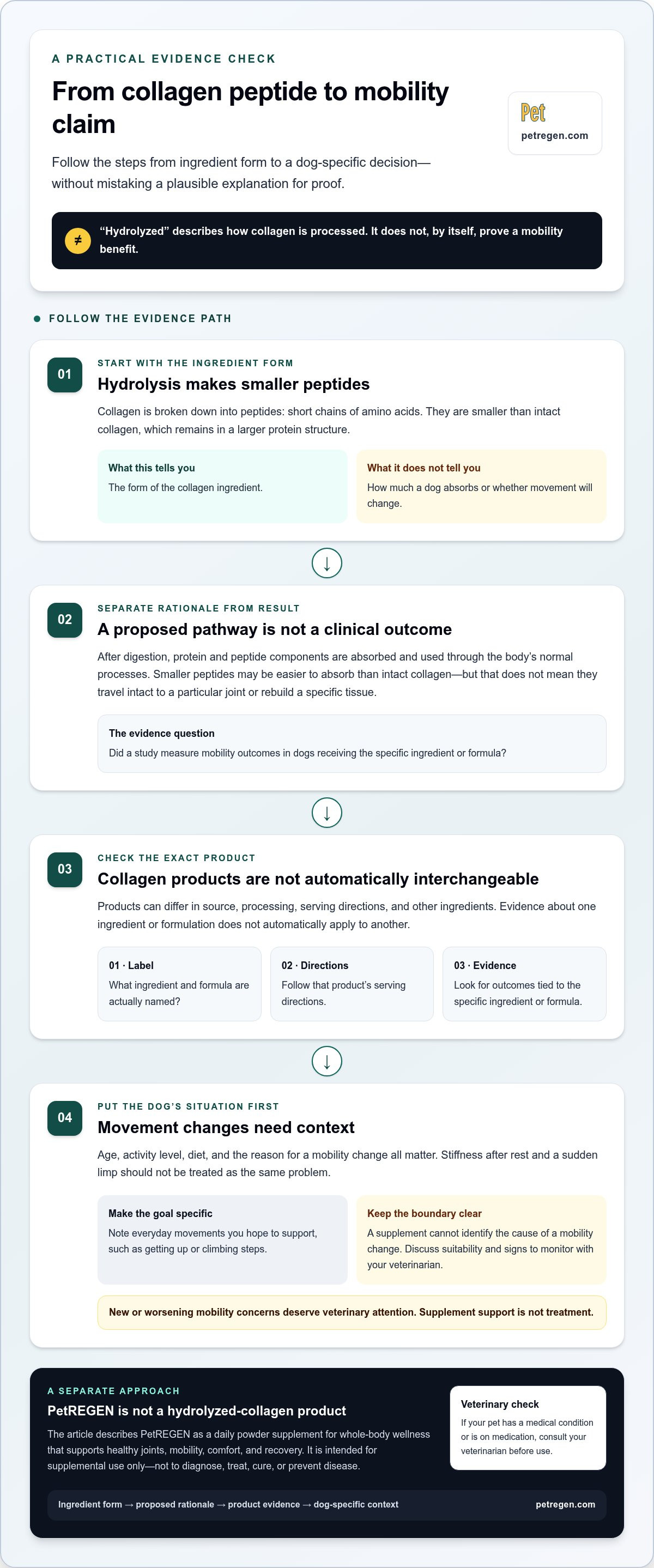
During processing, collagen is broken down into smaller components. These components are called peptides: short chains of amino acids, the building blocks that make up proteins. They’re smaller than intact collagen, which remains in its larger protein structure.
This processing changes the form of the collagen ingredient. It doesn’t, by itself, show how much of a supplement a dog absorbs or uses, or whether the dog’s movement will change. Those questions depend on evidence about the specific ingredient, product, and dogs studied. So, “hydrolyzed” is useful information about what’s in the container, but it isn’t a promise of a particular result.
Where does collagen fit in a dog’s connective tissues?
Collagen is part of the structural framework in connective tissues. These include cartilage, which covers the ends of bones in joints, as well as tendons, which connect muscles to bones, and ligaments, which connect bones to one another. As a structural component, collagen contributes to the organization and support of these tissues.
Collagen is found in several tissue types, including cartilage, tendons, and ligaments. This background can help explain why collagen attracts attention in discussions of joint support. But a tissue’s natural collagen content and a supplement’s effects are separate questions. Eating a collagen ingredient doesn’t mean it travels directly to a particular joint, rebuilds damaged cartilage, or treats a condition.
That distinction matters if your dog is stiff after resting, reluctant to jump, or showing another change in movement. A supplement’s name or processing method can’t identify the cause. Hydrolysis describes the ingredient’s form; evaluating a mobility claim requires looking at research on outcomes in dogs, not just the biological role of collagen. The next step is to consider the proposed pathway and the limits of the evidence, without mistaking a plausible explanation for proof.
How Could Hydrolyzed Collagen Support a Dog's Mobility?
The nutritional idea is straightforward: collagen peptides provide protein components that the body may use as part of its normal processes. Because collagen is present in connective tissues, researchers and supplement makers have explored whether dietary collagen could support those tissues. That rationale can make a supplement worth investigating, but it doesn’t establish that a dog will move better after taking it.
A proposed mechanism can explain why an ingredient might be studied; only relevant evidence can show whether it improves mobility in dogs. That distinction helps keep “supports normal tissue structure” separate from claims about reversing damage, relieving discomfort, or treating a joint disease.
What role might collagen peptides play after digestion?
After a dog eats a supplement, digestion breaks proteins and peptides into smaller components. Those components are absorbed and used through the body’s normal processes. Smaller peptides may be easier to absorb than intact collagen, but that doesn’t mean they travel intact to a particular joint or rebuild a specific tissue.
A plausible nutritional pathway is a reason to ask research questions, not a clinical result. To know whether mobility changes, studies need to measure outcomes in dogs receiving the specific ingredient or formula.
Why does a supplement's formula matter?
Collagen products can differ in source, processing, serving directions, and the other ingredients in the overall formula. Evidence about one ingredient or formulation can’t automatically be applied to every product labeled “collagen.” Check what the label actually names, and follow that product’s directions rather than assuming products are interchangeable.
Compare like with like. A result reported for a particular formulation doesn’t prove that a different source, serving, or combination will have the same effect. Your veterinarian can help weigh a product’s label and evidence alongside your dog’s health and diet.
Expectations also depend on the dog, not just the ingredient. Age may affect overall health, while activity level changes the demands placed on a dog’s body. Diet is part of the broader nutrition picture, and the reason for a mobility change matters: stiffness after rest and a sudden limp shouldn’t be treated as the same problem. A supplement can’t identify what’s causing a change, so new or worsening mobility concerns deserve veterinary attention.
If your goal is general nutritional support, make it specific: note which everyday movements you hope to support, such as getting up or climbing steps, and discuss the concern with your veterinarian. That makes it easier to judge whether a supplement is appropriate and what signs to monitor, without assuming a particular timeline or outcome.
For a separate approach to mobility support, PetREGEN is a daily powder supplement for dogs, cats, birds, and horses, pets of all ages and sizes. It supports healthy joints, mobility, comfort, and recovery, and is not a hydrolyzed-collagen product. Learn about the daily mobility-support supplement as one option to discuss with your veterinarian.
This product is intended for supplemental use only. It is not intended to diagnose, treat, cure, or prevent any disease. If your pet has a medical condition or is on medication, consult your veterinarian before use.
What Benefits and Limits Should Owners Expect From Hydrolyzed Collagen?
It’s understandable to hope that a supplement could make everyday movement easier for your dog. But an ingredient’s role in normal connective-tissue structure is not proof that taking it will change how a dog walks, rises, or plays. The benefits of hydrolyzed collagen for dog mobility depend on evidence for the specific ingredient and product, not simply on collagen’s presence in the body.
A supplement may be intended to support normal nutrition, but that is not the same as treating pain, repairing a joint, or preventing arthritis. No supplement guarantees improved movement, and individual responses can differ. A change in activity or comfort may also have causes that a supplement cannot address.
Which mobility claims deserve careful wording?
Look closely at what a claim actually promises. “May support” is still a claim and should be grounded in relevant evidence for dogs and the product or ingredient being discussed. A proposed mechanism, general ingredient information, or a pet owner’s positive experience can prompt questions, but none alone establishes a clinical effect.
Specific canine study findings should be checked against the original research before they’re cited. Pay attention to what ingredient and formulation were studied, which dogs took part, and what outcomes researchers measured. Evidence about one collagen product shouldn’t automatically be presented as proof for another.
When should mobility changes prompt veterinary advice?
Arrange veterinary advice for a new, worsening, or persistent change in your dog’s movement. Stiffness, reluctance to jump, or difficulty rising can be useful observations to share, but they don’t identify the cause on their own. A veterinarian can assess the problem and advise whether a supplement belongs in a broader care plan.
To make that conversation more useful, note what you’ve observed rather than trying to diagnose the cause. For example, record when a change began, which movements seem different, and whether it varies with activity or rest—setting up an affordable wireless mini security camera can even help capture clear footage of how your dog gets up and moves when resting alone. Bring the supplement’s label and ingredient information, too. These details can help your veterinarian consider suitability and potential interactions, particularly if your dog has a medical condition or takes medication.
Keep expectations grounded while you monitor your companion. Don’t interpret a good day as proof that a supplement caused improvement, or wait on a supplement if your dog’s mobility is getting worse. Your veterinarian can help you decide what changes matter and what next steps are appropriate.
This product is intended for supplemental use only. If your pet has a medical condition or is on medication, consult your veterinarian before use.
How Can You Evaluate Hydrolyzed Collagen for Your Dog?
Start with your dog’s needs, not a bold promise on a package. A careful review can help you distinguish useful label information from marketing language, then bring the right questions to your veterinarian. The goal isn’t to choose a supplement based on a general claim about the benefits of hydrolyzed collagen for dog mobility. It’s to assess the specific product in light of your dog’s health, diet, and mobility concerns.
- Identify your goal. Note the everyday movement you’re concerned about and whether the change is new, worsening, or ongoing. A supplement label can’t explain what’s causing a mobility change.
- Read the full label. Check the collagen source and form, the complete ingredient list, and the product’s own serving directions. Don’t assume products with similar names have identical formulas or instructions.
- Discuss suitability. Share the label and your observations with your veterinarian, especially if your dog has a medical condition or takes medication.
What should owners look for on a collagen label?
Look for clear details about the collagen source, whether it’s hydrolyzed, the other ingredients, and how the manufacturer directs owners to serve it. Then examine mobility claims: are they specific and carefully worded, and do they cite evidence that relates to dogs and the formula being sold? A powder, chew, or appealing phrase isn’t proof of effectiveness.
Follow the selected product’s label rather than borrowing serving directions from another supplement or a general online guide. Don’t infer a dose or expected timeline from the word “hydrolyzed.” If label details or claims are unclear, make a note to discuss them with your veterinarian before use.
What should you discuss with your veterinarian?
Bring the product label and explain your goal, your dog’s current diet, any medical conditions or medications, and the movement changes you’ve noticed. Specific observations, such as difficulty with a familiar activity or a change in willingness to move, can help frame the conversation without suggesting a diagnosis. Your veterinarian can advise whether the supplement is appropriate as part of your dog’s overall care.
This product is intended for supplemental use only. If your pet has a medical condition or is on medication, consult your veterinarian before use.
PetREGEN is a separate daily powder supplement, not a hydrolyzed-collagen product. It supports healthy joints, mobility, comfort, and recovery for dogs, cats, birds, and horses, pets of all ages and sizes. If you’re considering a different approach to mobility support, explore PetREGEN’s daily supplement and discuss its suitability with your veterinarian.
How Does PetREGEN Fit Into a Broader Mobility-Support Conversation?
Hydrolyzed collagen is one specific supplement ingredient, but it isn’t the only way pet owners think about mobility support. PetREGEN is a separate daily powder, not a hydrolyzed-collagen product. Its stated approach centers on whole-body wellness and natural stem cell support, with support for healthy joints, mobility, comfort, and recovery.
That distinction matters. PetREGEN’s stated support doesn’t demonstrate the benefits of hydrolyzed collagen for dog mobility, and it shouldn’t be interpreted as collagen-specific evidence. Instead, it gives owners another kind of supplement approach to consider as part of a conversation about their pet’s overall wellness. A veterinarian can help you decide whether any supplement is appropriate for your companion.
How is PetREGEN's approach different from collagen supplementation?
Collagen supplements focus on collagen as an ingredient. PetREGEN is described as a whole-body wellness supplement with a natural stem cell support approach. Its listed superfood ingredients include AFA algae, reishi mushrooms, and other botanicals. These are distinct approaches, and the product should not be mistaken for a source of hydrolyzed collagen or proof of collagen’s effects.
For pet owners comparing options, keep the question specific: what does the product state it supports, and what does the evidence show about that particular formulation? A product’s stated purpose and its ingredients can help explain its approach, but they don’t establish that it will change an individual pet’s mobility. Avoid comparing products as if they were interchangeable just because both appear in a discussion about joint or mobility support.
What should owners know before exploring PetREGEN?
PetREGEN is a daily powder that’s sprinkled onto food once or twice daily. It’s intended for dogs, cats, birds, and horses, pets of all ages and sizes. Use the product directions and speak with your veterinarian before use if your pet has a medical condition or takes medication. And if your pet’s movement has changed, don’t rely on a supplement in place of veterinary advice.
This product is intended for supplemental use only. If your pet has a medical condition or is on medication, consult your veterinarian before use.
PetREGEN comes with a 30-day money-back guarantee. If its separate approach to mobility support sounds relevant to your pet, you can Explore PetREGEN and consider it alongside your veterinarian’s guidance.
Take the Next Step Toward Informed Mobility Support
Your dog’s comfort is personal, and choosing a supplement deserves the same care. Keep your mobility goal clear, bring product details to your veterinarian, and treat any new or ongoing movement change as worth discussing. The benefits of hydrolyzed collagen for dog mobility should be judged by relevant evidence, not assumed from the ingredient name alone.
If you’re considering a different approach, PetREGEN is a separate daily powder that supports healthy joints, mobility, comfort, and recovery. It comes with a 30-day money-back guarantee, but it isn’t a substitute for veterinary guidance. Explore PetREGEN's whole-body wellness approach and consider whether it fits into a conversation with your veterinarian.
This product is intended for supplemental use only. If your pet has a medical condition or is on medication, consult your veterinarian before use.
With thoughtful questions and the right support, you can take a confident next step for your companion.
Frequently Asked Questions
Is hydrolyzed collagen safe for dogs?
It may be suitable for some dogs, but safety depends on the individual animal and the specific product. Check the full ingredient list, since a collagen supplement may contain other ingredients that affect whether it’s appropriate for your dog. Follow the product label and consult your veterinarian before use, especially if your dog has a medical condition or takes medication. This guidance doesn’t replace a veterinary assessment.
Can hydrolyzed collagen improve a dog's mobility?
It might support a mobility-related goal, but a noticeable change isn’t guaranteed. Collagen is associated with connective tissues, yet that association alone doesn’t establish the benefits of hydrolyzed collagen for dog mobility. Evidence should relate to the specific ingredient or product and measured outcomes in dogs. If your dog starts avoiding walks or seems less willing to play, seek veterinary advice rather than relying on a supplement alone.
How much hydrolyzed collagen should I give my dog?
Use the serving directions on the exact product you choose; there isn’t one general amount to apply to every collagen supplement. Products can differ in concentration and formulation, so don’t transfer a serving amount from another label or an online post. Your veterinarian can help assess suitability in light of your dog’s size, diet, health conditions, and medications. Keep the container available so you can discuss its specific directions.
What happens if I stop giving my dog collagen?
There’s no single outcome to expect after stopping. Your dog’s mobility could change or stay the same, and you shouldn’t assume a supplement was the reason for any change. If you’re considering stopping or switching products, discuss it with your veterinarian, especially if your dog has a medical condition or takes medication. Keep track of the movement changes that prompted you to try a supplement so you can share them during that conversation.
Is hydrolyzed collagen better than regular collagen for dogs?
Not automatically. “Hydrolyzed” describes a processing difference, but it doesn’t by itself prove greater effectiveness for a dog’s mobility. Compare the source, formulation, serving directions, and evidence for the intended benefit rather than relying on the product name or format. For example, two labels may both mention collagen but refer to different ingredients or formulas. Your veterinarian can help you assess whether a particular product suits your dog.
How long does hydrolyzed collagen take to support dog mobility?
There’s no universal timeframe established here, and a response, if any, may vary between dogs and products. Be cautious of promises that movement will improve by a certain date. Follow the chosen product’s label and note any changes without assuming the supplement caused them. If your dog’s mobility concern is new, persistent, or worsening, contact your veterinarian instead of waiting for a supplement to work.
Can collagen replace veterinary care for a dog with mobility problems?
No. A supplement can’t replace veterinary assessment, diagnosis, or care. Mobility changes can have different causes, and signs such as limping or difficulty rising don’t identify the cause on their own. If your dog’s movement has changed, arrange veterinary advice to determine appropriate next steps. If you’re considering any supplement, share its label with your veterinarian, particularly if your dog has a medical condition or takes medication.


