

If your cat is having trouble jumping onto bed, the change can feel worrying. A ramp may help your cat reach a favorite resting place, but it won’t explain why jumping has become difficult. A veterinary check can help investigate the change and guide next steps.
To make access safer at home, measure your bed and available floor space, then build a stable ramp with a securely attached, grippy surface. This guide explains which movement changes to watch for, when to contact your veterinarian, how to check a ramp for safety, and how to introduce it without pressure.
A ramp can be a useful part of your cat’s environment while you take changes in mobility seriously.
Key Takeaways
- If your cat is having trouble jumping onto bed, note when the change began and what movements or daily activities seem different to share with your veterinarian.
- Measure the bed height and available floor space first, then choose a ramp length that creates a manageable incline for your room and cat.
- Use a sturdy board, secure fasteners, a grippy surface, and a non-slip base to help keep the ramp steady during use.
- Let your cat explore the ramp at their own pace, making it more familiar with bedding or small rewards rather than forcing a climb.
- Keep track of changes in movement and ramp use, and share those observations with your cat’s veterinarian.
Cat Having Trouble Jumping onto the Bed? Start by Noticing What Changed
It can be upsetting to see your cat hesitate at a familiar jump or choose a lower place to rest. Difficulty getting onto the bed may reflect discomfort, weakness, an injury, or another change in health. A ramp can make the bed easier to reach, but it can’t identify or treat the reason your cat’s jumping has changed.
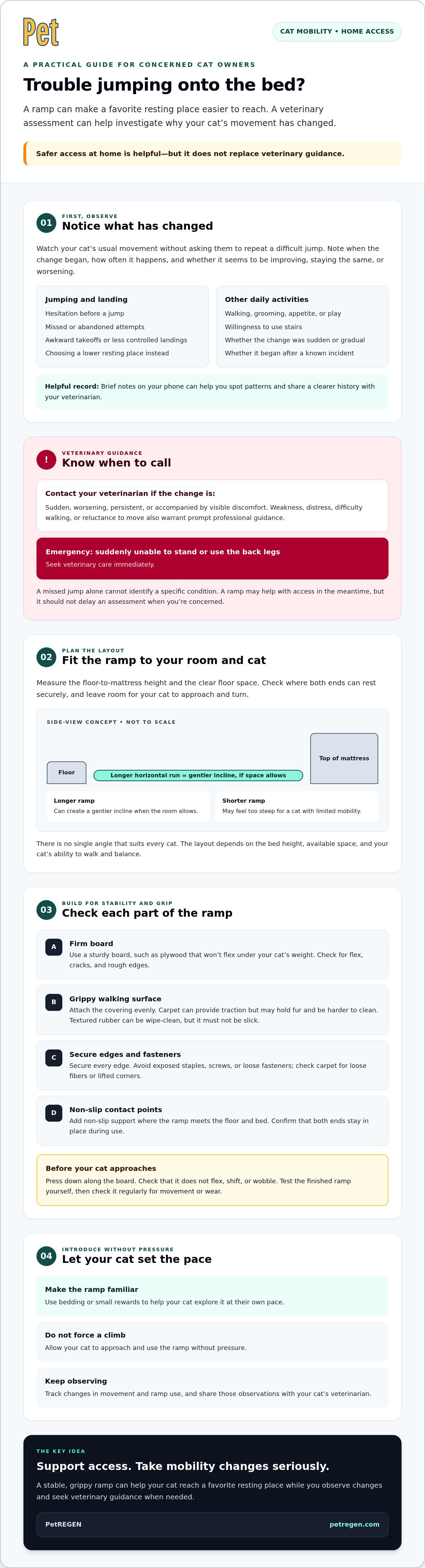
Start by observing rather than asking your cat to repeat the jump. Note when you first noticed the change, how often it happens, and whether it seems to be improving, staying the same, or worsening. These details can help your veterinarian understand what’s different.
A ramp can improve access at home; a veterinary assessment can help investigate the change in mobility.
What changes in your cat’s movement should you observe?
Watch for hesitation before jumping, missed or abandoned attempts, awkward takeoffs, or less controlled landings. Your cat may also choose a chair or floor cushion instead of a usual high resting spot. Don’t assume any one sign identifies a specific condition. For example, osteoarthritis is one possible health concern associated with joint discomfort, but jumping behavior alone can’t confirm it.
Look for changes in other activities, too. Has your cat’s walking, grooming, appetite, play, or willingness to use stairs changed? Record whether the difficulty appeared suddenly, developed gradually, or began after a known incident. A brief note on your phone can help you spot patterns and share a clearer history during a veterinary visit.
When should trouble jumping prompt a veterinary call?
Contact your veterinarian if the mobility change is sudden, worsening, persistent, or accompanied by visible discomfort. Weakness, distress, difficulty walking, or reluctance to move also warrant prompt professional guidance. Don’t try to diagnose arthritis or an injury from a single missed jump. Several different issues can affect movement, and an examination is needed to assess what may be happening.
If your cat suddenly can’t stand or use their back legs, treat it as an emergency and seek veterinary care immediately. Otherwise, note what you’ve observed and call your veterinary clinic for guidance on how soon your cat should be seen. A ramp may help your cat reach a favorite resting place in the meantime, but it shouldn’t delay an assessment when you’re concerned.
Plan a DIY Cat Ramp for the Bed Around Stability and Grip
Plan around your room rather than relying on a one-size-fits-all measurement. Measure from the floor to the top of the mattress, then check how much clear floor space is available for the ramp. Consider where both ends can rest securely, and leave enough room for your cat to approach and turn without squeezing past furniture.
A longer ramp can create a gentler incline if your room allows; a shorter ramp may feel too steep for a cat with limited mobility. The right layout depends on the bed height, available space, and your cat’s ability to walk and balance. Cornell’s guidance on subtle signs of a joint problem explains why a change in jumping deserves attention, not just a furniture adjustment.
How long and steep should a cat bed ramp be?
Compare layouts using the bed height and available floor space: a longer horizontal run creates a gentler incline. There’s no single angle that suits every cat. Before your cat tries the ramp, press down along the board and check that it doesn’t flex, shift, or wobble. Confirm that both ends stay in place during use.
Which materials make a homemade cat ramp safer?
Choose a sturdy board, such as plywood that won’t flex under your cat’s weight. Attach a grippy covering evenly across the walking surface. Carpet can provide traction but may hold fur and be harder to clean. Textured rubber may be easier to wipe, but it must not be slick. Secure every edge and avoid exposed staples, screws, or loose fasteners. Add non-slip support where the ramp meets the floor and bed, then check it regularly for shifting or wear.
| Design choice | Potential benefit | Safety check |
|---|---|---|
| Plywood board | Provides a firm ramp surface | Check for flex, cracks, and rough edges |
| Carpet covering | Can provide paw-friendly grip | Secure all edges; check for loose fibers or lifted corners |
| Textured rubber covering | Can be wipe-clean and grippy | Confirm the surface isn’t slick and won’t slide on the board |
| Non-slip supports | Help limit movement at contact points | Check that the ramp stays put at both ends |
Test the finished ramp yourself before your cat approaches. If you’re also considering broader wellness support, you can learn about the cat-formulated PetREGEN supplement. It isn’t a substitute for a stable ramp or veterinary guidance.
How to Build a DIY Cat Ramp for a Bed Step by Step
Once you’ve chosen a layout, treat the ramp as a home project that needs to fit your bed and room. A cat having trouble jumping onto bed needs a route that feels steady underfoot, not just a board leaning against the mattress. Gather a sturdy board, grippy covering, suitable fasteners, and non-slip support for the floor and upper contact point.
A ramp can make access easier, but it won’t explain why your cat’s mobility has changed. For background on one possible reason for reluctance to jump, see International Cat Care’s guide to Arthritis in cats. Ask your veterinarian about new or worsening changes rather than relying on a home modification alone.
Prepare and assemble the ramp
Measure the route from the floor to the bed and plan for stable contact at both ends. Select or cut a board to fit the space and intended incline, then smooth rough edges so they can’t snag paws or bedding. Attach the grippy material evenly, without wrinkles or gaps that could catch claws.
Use fasteners suited to the board and covering. Keep screw points, staples, and other hard edges away from the walking surface and anywhere your cat could brush against them. Run your hand along the covering to check that it feels flat and firmly attached, with no loose corners or raised seams.
Test the ramp before your cat uses it
Set the ramp on a level floor with non-slip support beneath it, and position the upper end so it can’t slide away from the bed. If you attach it to the bed or frame, make sure the connection stays secure as the bed shifts during ordinary use. Apply gradual hand pressure along the board. Stop if it flexes, wobbles, or moves.
Before inviting your cat to investigate, check the following:
- Stability: The board stays firm under pressure.
- Grip: The covering and base don’t slide or lift.
- Edges: Surfaces are smooth, with no loose material or exposed fasteners.
- Placement: Both ends remain securely positioned.
If any part shifts, catches, or feels unstable, don’t let your cat use the ramp until you’ve corrected it and tested it again.
Help Your Cat Learn to Use the Bed Ramp Without Pressure
A new ramp can feel strange, even when it’s sturdy and well placed. Give your cat time to investigate it in a quiet, familiar part of the room, with the ramp secured in its intended position. If your cat is having trouble jumping onto bed, the goal is to offer an easier route, not to make them use it before they feel ready.
Introduce the ramp in gradual, rewarding steps
Start by letting your cat sniff the ramp or walk beside it. Place familiar bedding near the base, or offer a small reward for voluntary interest. If your cat stays relaxed, reward a paw on the ramp, then let them decide whether to take another step. Keep practice brief and calm, and finish before your cat becomes uneasy.
Don’t push, pull, or place a frightened cat on the ramp. That can make the route feel less safe. Keep the ramp steady, the path clear, and rewards close enough that your cat doesn’t have to stretch or scramble to reach them. Progress may be slow, and that’s okay.
What if your cat still will not use the ramp?
Refusal may mean the ramp feels unfamiliar, but it can also point to a design problem or discomfort. Check that the surface offers reliable grip, the ramp doesn’t wobble, and the route isn’t too steep or narrow. Try adjusting its position so the approach feels natural. If your room allows, a stable intermediate resting place may make the route less daunting.
Consider the bigger picture. A cat who avoids only the new ramp but otherwise moves as usual may need more time or a different setup. Pause training and contact your veterinarian if reluctance comes with visible pain, weakness, distress, or worsening difficulty walking, jumping, or using stairs. Don’t assume persistent refusal is simply stubbornness.
Once your cat is comfortable near the ramp, let them choose when to explore it. Calm repetition and a secure setup can build confidence without pressure. If you’re considering broader wellness support, discuss new or worsening mobility changes with your veterinarian before adding a supplement. You can learn about the cat-formulated PetREGEN supplement as one possible part of general wellness support, not as a replacement for the ramp or veterinary care.
Pair Safer Bed Access With Veterinary Guidance and Ongoing Mobility Support
A DIY ramp can help your cat reach a favorite resting spot, but it doesn’t identify why jumping became difficult or replace a veterinary examination and care plan. If your cat is having trouble jumping onto bed, keep noting changes in movement and share them with your veterinarian. Include when the difficulty started, whether it’s worsening, and how your cat responds to the ramp. These observations can help your veterinarian assess the broader pattern.
Keep the ramp route clear and the landing area free of clutter so your cat can approach and step off without obstacles. Offer a comfortable resting place at an accessible height, too, and notice which spots your cat chooses. Check the ramp routinely for shifting, worn grip, or loose covering, especially after moving it for cleaning or changing bedding.
How can you make the bedroom easier for a cat to navigate?
Think about the whole route, not just the ramp. Move bags, shoes, and other items that could block the approach, and keep the landing area clear. A familiar blanket on a low resting place can offer another comfortable option while you observe your cat’s preferences. Recheck the ramp’s position and surface regularly; a setup that was once secure may loosen or wear with use.
Where might a cat supplement fit into broader wellness support?
Supplements aren’t substitutes for investigating new mobility changes. If you’re considering one, ask your veterinarian first, particularly if your cat has new or worsening difficulty jumping or takes other supplements or medication. PetREGEN’s supplement is formulated for cats to support immune function and the body’s natural regenerative processes. It is not a treatment for the cause of difficulty jumping. Check current product information and discuss whether it’s appropriate for your cat with your veterinarian.
A stable route, an uncluttered bedroom, and veterinary guidance can support safer access while you stay attentive to your cat’s changing needs. Explore PetREGEN for cats as one possible part of a broader wellness conversation with your veterinarian.
Make the Next Step Toward Easier, Safer Bed Access
If your cat is having trouble jumping onto bed, note what has changed and share those observations with your veterinarian. A well-built ramp can offer a safer route to a favorite resting place, but it can’t identify or treat the reason jumping became difficult. Measure for your space, check that the ramp stays stable and grippy, and let your cat explore it at their own pace.
Ongoing wellness support is a separate consideration, not a replacement for veterinary guidance. PetREGEN offers a supplement formulated for cats to support immune function and natural regenerative processes. Ask your veterinarian before adding a supplement, especially if your cat’s mobility has changed or worsened. Explore PetREGEN for cats to learn more.
With thoughtful home adjustments and professional guidance, you can help your companion feel more secure while staying attentive to changing needs. Small, patient steps can make the bedroom more accessible.
Frequently Asked Questions
Why is my cat suddenly having trouble jumping onto the bed?
A sudden change can have several possible explanations, including discomfort, weakness, injury, or another health change. Jumping behavior alone can’t identify the cause. Note when you first noticed the difficulty and whether walking, grooming, appetite, or play have also changed. Contact your veterinarian, especially if the change is worsening or your cat seems distressed. Sudden difficulty walking or standing needs urgent veterinary attention.
Can a ramp help a cat that cannot jump onto the bed?
Yes, a stable ramp can offer another route and make the bed easier to reach. It won’t explain why jumping became difficult, so seek veterinary advice if the change is new or persistent. Choose a ramp with a grippy surface, secure both ends, and introduce it gradually. Stop using it if it shifts, wobbles, or your cat appears uncomfortable while approaching or walking on it.
How do I make a DIY ramp for my cat’s bed?
Measure the bed height and available floor space, then choose a sturdy board that fits the room and creates a manageable incline. Attach grippy material evenly, with no loose edges, exposed fasteners, or raised sections that could catch paws. Stabilize the ramp at both ends and test it for flexing or movement before your cat uses it. Adapt the design to your cat and space rather than relying on one standard size.
What is the best angle for a cat ramp to a bed?
There’s no single incline that works for every cat, bed, and room. A gentler slope may be easier to navigate, but the ramp also needs enough floor space, a secure landing, and reliable grip. Check that it stays in place when you apply pressure, then observe your cat closely during introduction. If movement remains difficult or your cat seems uncomfortable, ask your veterinarian whether the design or your cat’s health needs attention.
How can I get my cat to use a new ramp?
Place the stable ramp in a familiar, quiet spot and let your cat inspect it without pressure. Reward voluntary exploration with a small treat or familiar bedding, then encourage a few steps only if your cat seems comfortable. Keep practice brief and calm. Don’t force your cat onto the ramp. Pause if your cat seems frightened or uncomfortable, or if you notice worsening mobility.
Should I take my cat to the vet for trouble jumping?
Contact your veterinarian if the difficulty is sudden, persistent, worsening, or accompanied by visible discomfort, weakness, distress, or trouble walking. A ramp can make access easier, but it can’t diagnose the reason for the change. Before you call, note when the problem started and any related changes in daily behavior, such as reduced play, altered grooming, or reluctance to use stairs.
Can a supplement help my cat jump onto the bed again?
A supplement shouldn’t be treated as a diagnosis or guaranteed solution for difficulty jumping. Discuss new or persistent mobility changes with your veterinarian first, so they can advise on appropriate care. PetREGEN offers a supplement formulated for cats to support immune function and natural regenerative processes. Check current product information and ask your veterinarian whether it’s appropriate for your cat.


