

Natural supplements for arthritic cats can sound like a gentle option, but “natural” doesn’t tell you whether an ingredient is effective, suitable for your cat, or likely to interact with other care. Arthritis can also be hard to spot: a cat may hesitate before jumping, groom less, sleep more, or become unusually irritable.
If you’re considering a supplement, it’s understandable to want a way to support your companion’s comfort and mobility. Supplements may have a role, but they don’t replace a veterinary diagnosis or treatment, and the evidence varies considerably by ingredient.
This guide explains how to assess the research, compare common joint-support ingredients, and check labels for clear ingredient information and directions. You’ll also learn what to ask your veterinarian about safety, dosing, possible interactions, and how a supplement might fit alongside other parts of a care plan. The goal is to support an informed conversation, so you can make choices based on evidence and your cat’s individual needs, not a label’s promises.
Key Takeaways
- Changes in jumping, grooming, or behavior can signal discomfort, but only a veterinarian can determine whether arthritis is the cause.
- Evidence for natural supplements for arthritic cats varies by ingredient and study; research on an ingredient doesn’t automatically prove a finished product works.
- Compare products by checking full ingredient lists, cat-specific directions, cautions, and how clearly the label explains its claims.
- Before introducing a supplement, share your cat’s medicines, other supplements, and health history with the veterinarian, then monitor changes together.
- PetREGEN may be one option to discuss, but its whole-body wellness positioning isn’t proof that it treats feline arthritis.
How to recognize arthritis in cats, and why supplements are only one consideration
It can be hard to watch a cat move less freely, especially when the change happens gradually. Cats may not limp or cry out; they may simply stop jumping onto a favorite chair or spend more time resting. Changes from your cat’s usual routine are worth noting and sharing with a veterinarian.
Feline osteoarthritis is a long-term joint condition in which changes to the joint, including wear of the cushioning cartilage, can cause discomfort and make movement harder. It’s part of the broader disease process described in Osteoarthritis. A cat’s behavior can raise concern, but signs alone can’t confirm that arthritis is the cause.
What changes in movement may prompt a veterinary visit?
Look for a change from your cat’s normal behavior, such as:
- Hesitating before jumping, avoiding high places, or choosing lower routes.
- Moving stiffly after resting or seeming reluctant to climb stairs.
- Grooming less, especially in areas that are harder to reach, or reacting differently to touch.
- Spending more time resting or becoming less tolerant of handling.
These changes can have other causes, so they aren’t a diagnosis. Keep a brief record of what you notice, when it happens, and whether it’s changing. A short video of your cat moving at home may also help your veterinarian understand what you’re seeing.
Why does an arthritis plan start with a veterinarian?
A veterinary assessment can help identify why your cat’s mobility or behavior has changed and what care may be appropriate. Your veterinarian can consider your cat’s overall health, current medicines, and individual needs before discussing options. A supplement that seems suitable in general may not be right for every cat.
Natural supplements for arthritic cats are best considered as possible supportive care, not a cure or a replacement for diagnosis and veterinary treatment. Don’t let trying a supplement delay an assessment, particularly if movement changes are new, worsening, or affecting daily routines. Ask your veterinarian whether a supplement belongs in your cat’s plan and what signs to track if you decide to try one. That conversation keeps the focus on your cat’s comfort, safety, and quality of life.
What natural supplements may support arthritic cats, and what evidence can show
Supplement claims can sound similar, but the evidence behind ingredients isn’t interchangeable. It may depend on whether a study involved cats or another species, how many animals were studied, what dose and formulation were used, and what researchers measured, such as activity, mobility, or pain-related behavior. A result for one outcome doesn’t automatically establish benefit for another.
An ingredient may have research suggesting potential support, but that does not prove it treats arthritis or that every product containing it will help a cat. Research on an isolated ingredient is different from a clinical study of a finished product, which tests its specific formulation and directions. The VCA Animal Hospitals' guide to joint nutraceuticals reviews options discussed for cats and can help owners understand why ingredients need to be considered individually.
How should owners interpret ingredient research for cats?
Start by checking the species and product studied. Evidence from dogs or people may inform questions, but it can’t automatically be applied to cats. Look at a study’s limitations too: a small group, short follow-up, or reliance on owner observations may make results less conclusive than objective measures or replicated findings.
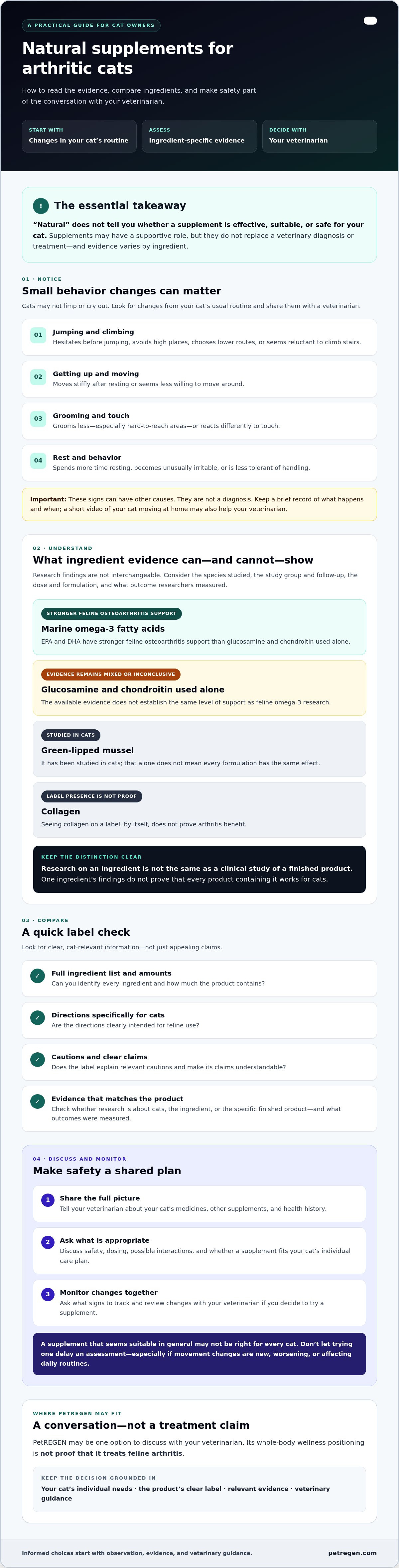
For example, marine omega-3 fatty acids, including EPA and DHA, have stronger feline osteoarthritis support than glucosamine and chondroitin used alone, for which evidence remains mixed or inconclusive. Green-lipped mussel has also been studied in cats. These findings don’t mean every formulation has the same effect. Collagen is another ingredient owners may encounter, but its presence on a label alone isn’t proof of arthritis benefit.
What does “natural” tell you, and what does it not tell you?
“Natural” describes a source or marketing position; it doesn’t establish effectiveness, quality, or safety for your particular cat. Check whether a label names each ingredient and its amount, gives directions specifically for cats, and includes relevant cautions. If amounts or feline directions are missing, ask the manufacturer or your veterinarian for clarification rather than guessing.
Look for evidence that matches the product, not just a familiar ingredient. A study of one dose, combination, or formulation can’t validate another. When comparing natural supplements for arthritic cats, assess the research, label transparency, and veterinary fit together instead of relying on “natural” or a broad joint-support claim.
PetREGEN describes its approach as supporting whole-body wellness, but that positioning isn’t evidence that its supplement treats feline arthritis. If you’d like to review the company’s stated stem cell activator supplement approach, compare the current cat-product label with your veterinarian before deciding whether it fits your cat’s care plan.
How to compare natural supplements for arthritic cats
A clear label helps you and your veterinarian judge whether a product is worth discussing. Compare information you can verify, not just the size of the claims. Use the table below to assess options without assuming that a familiar ingredient or “joint support” wording guarantees a result.
| Evidence | Ingredient transparency | Feline directions | Cautions | Veterinary fit |
|---|---|---|---|---|
| Does the research involve cats, and does it study the ingredient or this finished product? | Are all ingredients and their amounts disclosed, or are they grouped in a blend? | Does the label clearly give directions for cats and explain how to use the product? | Are relevant warnings and limits clear? Are claims overly broad or difficult to verify? | Can your veterinarian assess it alongside your cat’s diet, health conditions, and medicines? |
Which label details should cat owners check?
Read the entire label, including the fine print. Confirm the full ingredient list, amounts where disclosed, serving directions, intended species, cautions, and manufacturer contact information. If a product is marketed for multiple animals, don’t assume directions for dogs or horses apply to cats. Ask the manufacturer or your veterinarian to clarify anything missing or ambiguous.
A “proprietary blend” may group ingredients without showing how much of each it contains. That makes it harder to compare the formula with research or assess what your cat would receive. Treat undisclosed amounts as a reason to ask questions, not as proof that a product is poor quality. Your veterinarian can consider the label in light of your cat’s current food, health history, and medicines.
How can you assess a supplement’s claims?
Match each advertised benefit to the evidence behind it. Check whether research concerns the same ingredient, species, formulation, and outcome described in the claim. Studies of one ingredient don’t automatically establish that a complete product has the same effect. Clear explanations of ingredients and directions are more useful than broad promises that can’t be checked.
Be especially cautious with claims of guaranteed arthritis relief or a cure. Such wording deserves careful scrutiny and a conversation with your veterinarian; it isn’t a substitute for professional assessment. A useful comparison weighs evidence, transparent labeling, cat-specific directions, cautions, and fit with your cat’s care plan. If you can’t find that information, pause before starting the product and get answers first.
How to introduce and monitor a supplement safely with your veterinarian
A careful plan makes it easier to spot changes and gives your cat’s veterinarian useful information to guide next steps. Before starting a supplement, document your cat’s current mobility, discuss the product with the veterinarian, review its complete label together, follow only directions confirmed as appropriate for your cat, and monitor what happens.
Veterinarian-first checklist: record your cat’s baseline, disclose medicines and health history, confirm the product and directions, then agree on what to monitor and when to follow up.
What should you ask the veterinarian before starting?
Bring the product label or a clear photo of it. Tell the veterinarian about every medicine and supplement your cat takes, as well as relevant health conditions and diet. Ask whether the product fits your cat’s diagnosis and individual needs, whether its directions specifically apply to cats, and whether anything in the formula raises concerns alongside current care.
Agree on next steps before you begin. Ask which changes to watch for, when the veterinary team would like an update, and what concerns should prompt you to stop the supplement or seek advice. Don’t adjust a prescribed treatment or exceed label directions in an effort to see a faster result.
How can you monitor whether the plan is helping?
Start with a simple baseline. Note how your cat manages familiar activities, such as jumping to a usual spot, climbing stairs, grooming, and moving around the home. A brief daily or weekly record with dates and specific observations is more useful than relying on memory. If practical, short videos taken in similar situations can help you describe movement changes to the veterinary team.
Keep tracking after the supplement is introduced, and share meaningful changes, including no change or a worsening pattern. A shift in one behavior doesn’t prove the supplement caused it; other changes in routine or health may matter too. Your veterinarian can help interpret the observations and decide whether the plan needs review. Don’t stop, replace, or change prescribed care without veterinary guidance.
If you and your veterinarian decide a supplement is appropriate, review the current product information before use. You can review PetREGEN supplement information and discuss its label and suitability for your cat with the veterinary team. PetREGEN’s whole-body wellness positioning should not be taken as proof that it treats feline arthritis. The aim is a considered, monitored choice that supports, rather than takes the place of, your cat’s veterinary care.
Where PetREGEN may fit in a cat’s joint-support conversation
After comparing evidence and planning how to monitor a supplement, assess a specific product with the same care. PetREGEN sells a stem cell activator supplement formulated for cats, dogs, and horses. The company describes its approach as supporting immune function and the body’s natural regenerative processes. That is the company’s wellness positioning, not evidence that the supplement treats, reverses, or cures feline arthritis.
For owners considering natural supplements for arthritic cats, the relevant question is whether a particular product’s label, evidence, and directions fit their individual cat. Don’t infer an arthritis benefit from a product name or broad description. Use the current cat-product label as the starting point for a conversation with your veterinarian.
What should owners verify about the PetREGEN supplement?
Before considering use, review the complete, current cat-product label. Confirm the listed ingredients and amounts, serving directions, intended species, and any product-specific cautions. General ingredient details may not be enough to assess the current cat formula, so rely on its actual label and ask for clarification if information is missing.
- Are all ingredients and their amounts clearly listed?
- Do the serving directions explicitly apply to cats?
- Are cautions or relevant use limits provided?
- Is there research on the finished product in cats, or only general information about its ingredients or approach?
These checks help separate a company’s description of its approach from evidence for a specific outcome. In particular, the term “stem cell activator” should not be taken to mean that the product has been shown to improve arthritic joints.
How can PetREGEN fit a veterinarian-guided plan?
Share the label with your cat’s veterinarian before starting the supplement. They can consider it alongside your cat’s diagnosis, health history, diet, medicines, and other care needs. Ask whether the product is appropriate, how to follow its cat-specific directions, and what changes or concerns to monitor. Continue any prescribed care unless your veterinarian advises otherwise.
A supplement decision is just one part of a broader plan for your companion. Keep expectations grounded, track observable changes, and check in with the veterinary team if you have questions or notice a concerning change. To review the company’s product information before that discussion, explore PetREGEN and review its supplement information.
Make your cat’s joint-support plan an informed one
Choosing natural supplements for arthritic cats starts with more than a “natural” label. Look for evidence that matches the ingredient, cat, and product, then check the complete label for amounts, feline directions, and cautions. A veterinarian can help determine whether a supplement fits your cat’s health, medicines, and broader care plan.
PetREGEN describes its supplement as formulated for dogs, cats, and horses, and its ingredients as USA-made and human-grade. Verify those details against the current cat-product label and product-specific information, and discuss the label with your veterinarian before use. The company’s whole-body wellness approach is not proof that the supplement treats feline arthritis.
Explore PetREGEN and discuss the label with your veterinarian as one step in an evidence-conscious conversation. With careful observation and veterinary guidance, you can make thoughtful choices that keep your companion’s comfort and wellbeing at the center.
Frequently Asked Questions
Can natural supplements help arthritic cats?
Some supplements may be considered as supportive care within a broader veterinary plan, but evidence differs by ingredient, species, and product. A supplement isn’t a cure or a replacement for veterinary treatment. Ask your veterinarian whether a specific product fits your cat’s diagnosis, health history, diet, and current medicines. If you try one with their guidance, track everyday movement, such as jumping or climbing, and share changes at follow-up.
What is the best natural supplement for an arthritic cat?
There’s no single best supplement for every cat. The right choice depends on your veterinarian’s assessment, your cat’s health and medicines, the product label, and evidence relevant to cats. Compare ingredient amounts, transparency, and cat-specific directions instead of relying on the word “natural” or broad promises. Before adding a product to your cat’s routine, show its complete label to your veterinarian and ask whether it suits your companion.
Are glucosamine supplements safe for cats with arthritis?
Safety and suitability depend on the individual cat and the specific product, so don’t assume glucosamine is appropriate based on the ingredient name alone. Evidence for glucosamine and chondroitin used alone in feline arthritis is mixed or inconclusive. Check that the product is intended for cats, review its full label, and consult your veterinarian, especially if your cat has health conditions or takes medication. Don’t give a dog product unless your veterinarian confirms it’s suitable.
Can I give my cat human joint supplements?
Don’t give your cat a human joint supplement unless your veterinarian advises that the specific product is appropriate. Its ingredients, amounts, or other components may not suit cats, and a human serving can’t be safely converted by simply scaling it down. Bring the exact package or a clear label photo to your veterinarian. They can review it alongside your cat’s health history, diet, and current medicines before you make a decision.
How long does it take for a cat joint supplement to work?
There’s no reliable timeline that applies to every cat or supplement. Any observed change may depend on your cat, the product, the condition, and the overall care plan, and evidence varies by ingredient. Ask your veterinarian what to monitor and when to check in. Keep a simple record of mobility and daily activities so you can compare changes over time. If your cat worsens, contact the veterinary team rather than waiting for a supplement to work.
What should I look for on a cat joint supplement label?
Check that the product is intended for cats, then read the full ingredient list, serving directions, ingredient amounts where provided, and cautions. Look for clear manufacturer information and specific claims you can evaluate, rather than promises to cure arthritis. If a blend doesn’t disclose ingredient amounts or directions aren’t clearly feline-specific, ask for clarification. Share the label with your veterinarian so they can consider it alongside your cat’s diagnosis, medicines, diet, and overall health.
Should I ask a veterinarian before giving my arthritic cat a supplement?
Yes. A veterinarian can assess your cat’s mobility changes, consider other possible causes, and advise whether a specific product fits their health and care plan. Share the complete product label and disclose all medicines and other supplements your cat takes. Ask what changes to monitor and when to follow up. Supplements shouldn’t replace diagnosis, prescribed treatment, or veterinary advice, and you shouldn’t change existing care without guidance from your veterinary team.


